
EN 15085-6: Europe’s Standard For Safe Rail Vehicle Repairs
Master EN 15085-6 for critical railway maintenance welding. Ensure vehicle safety, structural integrity, and extended operational life through expert planning and rigorous inspection.
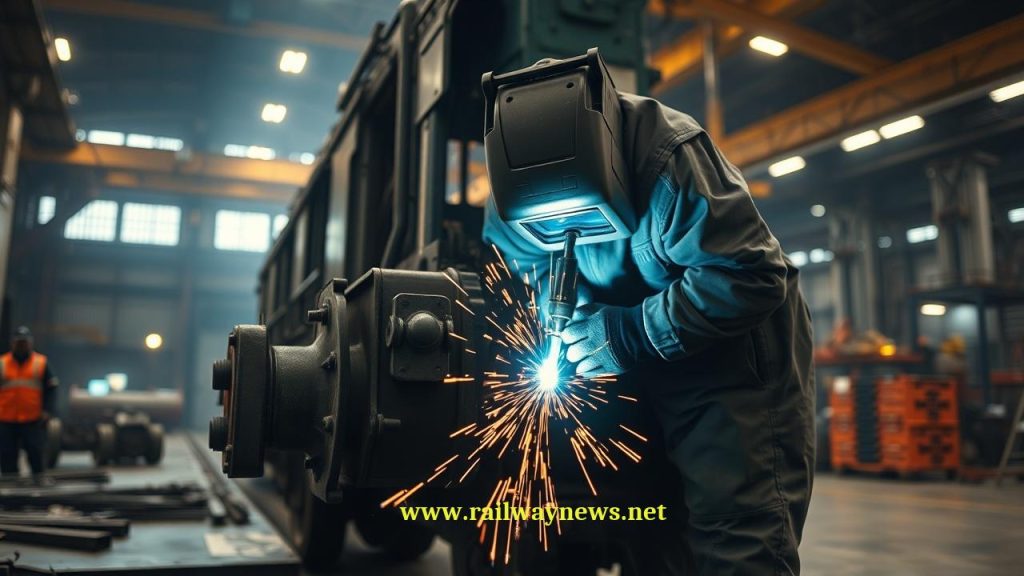
Understanding EN 15085-6: A Detailed Guide to Maintenance Welding in the Railway Sector
The EN 15085 series of standards is the cornerstone for quality assurance in the welding of railway vehicles and their components. While other parts of the standard focus on design, production, and inspection of new builds, EN 15085-6 specifically addresses the critical requirements for maintenance welding. This includes repairs, overhauls, and modifications performed on in-service railway vehicles, ensuring they are returned to operation safely and reliably.
This standard provides a structured framework for maintenance workshops and operators to manage welding activities, guaranteeing that the integrity and safety of the original design are preserved or improved throughout the vehicle’s lifecycle.
What is Maintenance Welding according to EN 15085-6?
Maintenance welding, as defined by EN 15085-6, is any welding activity performed on a railway vehicle or component after it has entered service. This is distinct from production welding and encompasses three main categories: repairs of wear or damage, component replacement, and modifications to the existing structure. The standard ensures these activities are performed with the same level of control and quality as the original manufacturing.
Core Principles and Technical Requirements of EN 15085-6
EN 15085-6 establishes a systematic approach to maintenance welding, focusing on planning, execution, and documentation. Its requirements are designed to manage the unique challenges of working on used, and potentially damaged, materials and structures.
1. The Maintenance Welding Plan (MWP)
The central document required by EN 15085-6 is the Maintenance Welding Plan (MWP). Before any welding begins, this plan must be developed and approved. It serves as a detailed roadmap for the entire repair or modification process.
- Damage Assessment: A thorough analysis of the existing condition, including the type and extent of damage, wear, or the nature of the required modification.
- Material Identification: Determining the base material(s) of the component to be welded, which can be challenging on older vehicles.
- Welding Procedure Specification (WPS): Selecting or developing a qualified WPS appropriate for the repair. This must be based on a corresponding Welding Procedure Qualification Record (WPQR) according to standards like the EN ISO 15614 series.
- Inspection and Testing: Defining the scope and methods for non-destructive testing (NDT) and visual inspection before, during, and after welding.
- Personnel: Identifying the qualified welders and welding coordination personnel responsible for the task.
2. Personnel Qualification
The competence of the personnel involved is paramount for ensuring the safety of a maintenance weld. EN 15085-6 mandates specific qualifications:
- Welders: Must be qualified in accordance with the relevant parts of the EN ISO 9606 series for the materials and welding processes involved. Their qualifications must be valid and specific to the work being performed.
- Welding Coordination: The process must be overseen by a responsible Welding Coordinator as defined in EN ISO 14731. The level of knowledge required (e.g., IWE, IWT, IWS) depends on the complexity and safety criticality of the maintenance task.
3. Quality and Inspection Requirements
Quality assurance is woven into every step of the process. The standard requires a quality management system, often aligned with EN ISO 3834, to be in place.
- Pre-Weld Inspection: Verifying the condition of the base material, joint preparation, and fit-up.
- In-Process Inspection: Monitoring welding parameters and technique during execution.
- Post-Weld Inspection: This includes 100% visual inspection (VT) and non-destructive testing (NDT) such as magnetic particle testing (MT), penetrant testing (PT), ultrasonic testing (UT), or radiographic testing (RT), as specified in the MWP. The acceptance criteria for imperfections are defined in EN ISO 5817.
Comparison: Production Welding (EN 15085-2) vs. Maintenance Welding (EN 15085-6)
While both standards aim for the highest level of safety and quality, their focus and application differ significantly. The following table highlights the key distinctions:
| Feature | EN 15085-2 (Production Focus) | EN 15085-6 (Maintenance Focus) |
|---|---|---|
| Primary Scope | New design and manufacturing of railway vehicles and components. | Repair, overhaul, and modification of in-service vehicles and components. |
| Key Document | Welding coordination plan, design documentation, and production test plans. | Maintenance Welding Plan (MWP) is the central, task-specific document. |
| Main Challenge | Ensuring design specifications are met through controlled, repeatable processes. | Addressing unknown variables like material degradation, hidden damage, and pre-existing stresses. |
| Welding Procedures | Procedures are typically established and qualified during the design and pre-production phase. | Procedures must be carefully selected or re-qualified to suit the specific repair condition and base material. |
| Documentation Focus | Creating a complete manufacturing record for a new component or vehicle. | Creating a detailed record of the specific intervention to ensure traceability and prove restoration of integrity. |
The Maintenance Welding Workflow in Practice
A typical workflow for a repair conducted under EN 15085-6 follows these steps:
- Identification & Assessment: A defect (e.g., a crack in a bogie frame) is identified. An expert assesses the damage to determine if a welding repair is feasible.
- Planning (MWP Creation): The welding coordinator creates the Maintenance Welding Plan. This includes specifying the method for removing the defect, the joint preparation, the WPS to be used, and the NDT requirements.
- Preparation: The defect is removed (e.g., by gouging or grinding), and the area is prepared for welding as per the MWP. Pre-weld NDT may be performed to ensure complete removal of the defect.
- Execution: A qualified welder performs the weld according to the specified WPS, under the supervision of the welding coordinator.
- Inspection & Testing: After welding (and any required post-weld heat treatment), the repaired area undergoes 100% visual inspection and the NDT methods specified in the MWP.
- Documentation & Release: All records, including the MWP, welder qualifications, and NDT reports, are compiled. Once all requirements are met, the component is approved for return to service.
Conclusion: Ensuring Lifecycle Safety
EN 15085-6 is an indispensable standard for the railway industry. It provides the necessary rules and framework to ensure that maintenance welding does not compromise the structural integrity or safety of railway vehicles. By mandating a rigorous process of planning, qualification, execution, and inspection, it ensures that repaired or modified components are fit for purpose and can continue to operate safely, extending the operational life of valuable railway assets while upholding the highest safety standards.
Frequently Asked Questions (FAQ) about EN 15085-6

Railway infrastructure, rolling stock and transport technologies specialist focused on global rail industry developments, high-speed rail systems, signaling technologies and freight transportation. Covering railway investments, public transport modernization, rail operations and international mobility projects across Europe, Asia and North America.