
EN 13749: How It Secures Europe’s Railway Bogie Frames
EN 13749 sets the standard for railway bogie frame structural integrity. It ensures safety and reliability through rigorous design validation, stress analysis, and physical testing.
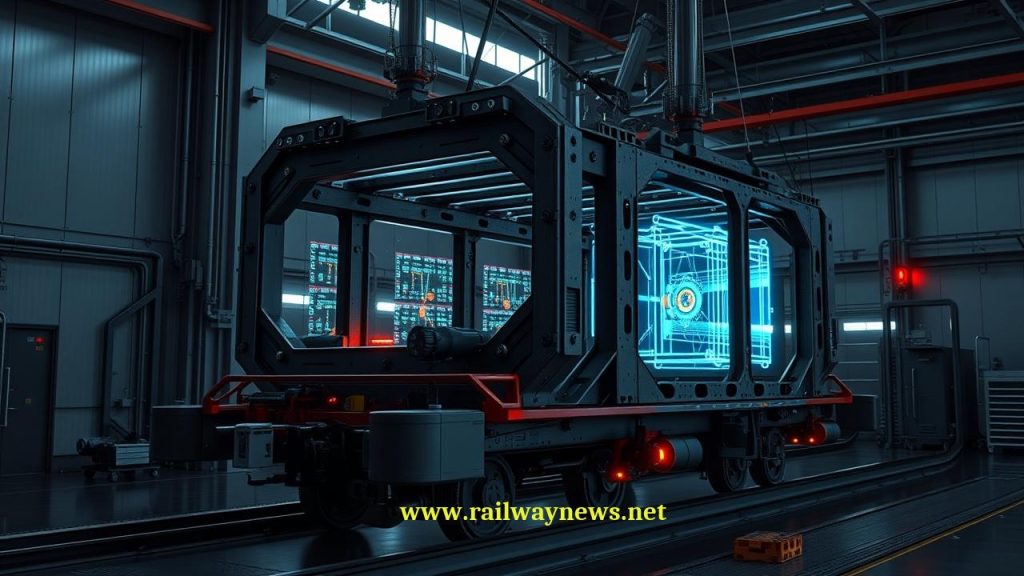
Understanding EN 13749: Structural Requirements for Railway Bogie Frames
EN 13749 is a European Standard that establishes a unified method for specifying the structural requirements of bogie frames. Its primary purpose is to ensure the structural integrity, safety, and reliability of these critical railway components by defining a rigorous process for design validation through analysis and testing.
The bogie frame is the foundational structure that houses the wheelsets, suspension, and braking systems of a railway vehicle. A failure in the bogie frame can have catastrophic consequences. Therefore, EN 13749 provides a systematic framework for manufacturers and operators to define operational loads, perform stress analysis, and set clear acceptance criteria to guarantee the frame can withstand the demanding conditions of railway service throughout its intended lifecycle.
The Core Methodology of EN 13749
The standard outlines a detailed, three-step approach to ensure the structural adequacy of a bogie frame. This process is not a design guide but rather a validation methodology, allowing for innovation in design and materials while maintaining stringent safety standards.
- 1. Definition of Load Cases: The first and most critical step is to identify and quantify all forces that the bogie frame will experience during its operational life. The standard provides a detailed list of load cases that must be considered, derived from the vehicle’s mass, speed, track conditions, and operational scenarios.
- 2. Stress Analysis and Verification: Once the loads are defined, the design must be analyzed to determine the resulting stresses and deformations within the frame. This is typically accomplished using the Finite Element Method (FEM), which allows for a detailed assessment of stress concentrations in complex geometries.
- 3. Acceptance Criteria: The final step is to compare the calculated stresses against the material properties of the bogie frame. The standard sets specific limits based on the material’s yield strength (for exceptional loads) and its endurance limit (for fatigue loads) to ensure an adequate safety margin against both immediate failure and long-term fatigue cracking.
Detailed Breakdown of Load Cases
EN 13749 categorizes loads to ensure all aspects of railway operation are covered. The correct definition of these loads is fundamental to the entire validation process. The loads are generally classified into normal service loads, which occur frequently, and exceptional loads, which are rare but severe.
Key Load Categories and Their Sources
- Vertical Loads: These are primarily due to the weight of the vehicle body (tare and laden), passengers, and cargo. They also include dynamic effects from track irregularities, such as rail joints and switches, which can significantly amplify the static load.
- Transverse (Lateral) Loads: These forces arise from the vehicle negotiating curves (centrifugal force), crosswinds, and the natural “hunting” motion of the wheelsets on the track. They are critical for assessing the frame’s resistance to lateral bending and distortion.
- Longitudinal Loads: These are generated during traction (acceleration) and braking events. In coupled vehicles, they also include the forces transmitted through the drawgear. These loads test the frame’s ability to handle pushing and pulling forces without buckling or failing.
- Warp and Twist Loads: Occur when the bogie traverses twisted or uneven track (track twist) or when one wheel climbs over a rail defect. This scenario imposes a significant torsional load on the frame, testing the integrity of its welded or cast joints.
The combination of these loads creates a complex stress state within the bogie frame. The standard requires the analysis of these combined load cases to represent real-world conditions accurately.
Comparison of Primary Load Scenarios
To provide a clearer technical perspective, the following table compares the different load types specified in EN 13749.
| Load Case Category | Description and Purpose | Typical Scenarios / Events |
|---|---|---|
| Normal Service Loads (Fatigue) | Repetitive, cyclic loads experienced during day-to-day operations. The analysis aims to demonstrate that the bogie frame will not fail due to material fatigue over its design life (e.g., millions of cycles). |
|
| Exceptional Loads (Static Strength) | High-magnitude, low-frequency loads representing worst-case operational or accidental events. The analysis ensures the frame does not permanently deform (yield) or fracture under these extreme conditions. |
|
| Combined Loads | Realistic scenarios where multiple load types occur simultaneously. This is crucial for identifying the highest stress points in the frame. |
|
Technical Validation: From Analysis to Physical Testing
While Finite Element Analysis (FEA) is the primary tool for design verification, EN 13749 also recognizes the importance of physical testing to validate the analytical model and confirm the manufacturing quality.
Static and Fatigue Testing
- Static Tests: These tests involve applying the defined exceptional loads to a physical bogie frame using hydraulic actuators in a controlled laboratory environment. Strain gauges are placed at high-stress locations (identified by FEA) to measure the actual stresses and deformations. The goal is to confirm that the frame’s behavior under extreme loads matches the simulation and that no yielding occurs.
- Fatigue Tests: To validate the frame against fatigue failure, a full-scale test rig applies millions of cycles of combined normal service loads. This test simulates years of operational life in a compressed timeframe. The frame is then inspected for any signs of crack initiation using non-destructive testing (NDT) methods like magnetic particle or dye penetrant inspection.
The Role of EN 13749 in the Railway Sector
EN 13749 is more than just a technical document; it is a cornerstone of safety and interoperability in the European railway industry. By providing a common, transparent, and verifiable methodology, it ensures that bogie frames from any manufacturer meet a consistent and high level of structural safety. This harmonization is essential for cross-border rail traffic and fosters confidence among operators, manufacturers, and regulatory authorities. It creates a level playing field where safety and reliability, backed by rigorous engineering principles, are paramount.

Railway infrastructure, rolling stock and transport technologies specialist focused on global rail industry developments, high-speed rail systems, signaling technologies and freight transportation. Covering railway investments, public transport modernization, rail operations and international mobility projects across Europe, Asia and North America.