
EN 13261: Europe’s Critical Axle Quality & Safety Requirements
Discover EN 13261, the vital standard ensuring railway axle safety and interoperability. It details material, manufacturing, and testing requirements for reliable, high-performance rolling stock.
An In-Depth Technical Guide to EN 13261: Product Requirements for Railway Axles
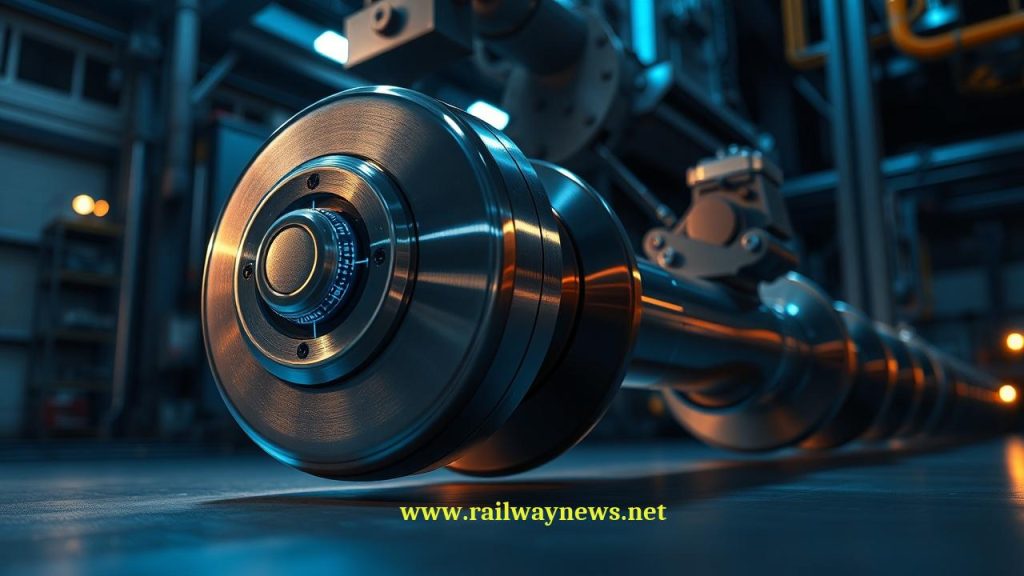
EN 13261 is a critical European Standard that specifies the technical requirements for the design, manufacturing, and product quality of forged and rolled steel axles for railway applications. This standard forms a cornerstone of safety and interoperability within the European railway network, ensuring that axles, one of the most safety-critical components of a wheelset, meet stringent performance criteria.
The standard applies to solid and hollow axles made from vacuum-degassed steel, intended for all types of rolling stock, including high-speed trains, conventional passenger coaches, freight wagons, locomotives, and mass transit vehicles like metros and trams. Its primary goal is to establish a unified set of rules for material quality, manufacturing processes, mechanical properties, and testing protocols to guarantee reliability and prevent in-service failures.
Core Objectives and Scope of the Standard
The EN 13261 standard is designed to achieve several fundamental objectives that are vital for the modern railway industry. These objectives ensure that every axle entering service is fit for purpose and contributes to the overall safety and efficiency of the rail system.
Key Objectives
- Safety Assurance: To define rigorous material, manufacturing, and testing requirements that minimize the risk of axle failure due to fatigue, fracture, or material defects.
- Interoperability: To provide a common technical specification that allows for the seamless use of axles and wheelsets across different European railway networks, a key principle of the Technical Specifications for Interoperability (TSI).
- Quality and Reliability: To establish a robust quality assurance framework, ensuring consistency and high performance from every manufactured axle.
- Standardized Assessment: To provide clear criteria for conformity assessment, allowing manufacturers and operators to verify that an axle meets all necessary product requirements.
Scope of Application
EN 13261 covers the entire product lifecycle from a requirements perspective, although it does not dictate specific design calculations, which are covered in EN 13103 (for solid axles) and EN 13104 (for hollow axles). The scope includes:
- Material Selection: Specifies the chemical composition and steelmaking process for various grades of axle steel.
- Manufacturing Process: Outlines the requirements for forging, rolling, and subsequent heat treatment and machining.
- Mechanical Properties: Defines mandatory values for tensile strength, yield strength, impact toughness, and fatigue resistance.
- Testing and Inspection: Mandates a detailed regime of destructive and non-destructive testing (NDT) to verify the integrity of each axle.
- Marking and Traceability: Establishes rules for permanent marking on each axle to ensure full traceability throughout its service life.
Technical Requirements of EN 13261
The core of EN 13261 is its detailed technical specifications. These requirements are broken down into several key areas, each contributing to the final product’s integrity.
Material and Steelmaking Process
The standard mandates the use of high-quality, vacuum-degassed steel to minimize impurities and dissolved gases (like hydrogen) that can cause internal defects and lead to cracking. The chemical composition is tightly controlled to achieve the desired mechanical properties after heat treatment. The most common steel grades specified are EA1N, EA1T, and EA4T.
- Steel Cleanliness: The steel must meet strict cleanliness requirements regarding non-metallic inclusions, which are potential stress concentration points where fatigue cracks can initiate.
- Grain Size: A fine and uniform grain structure is required to enhance toughness and fatigue resistance.
Manufacturing and Heat Treatment
The manufacturing process is a critical phase controlled by the standard. Axles are typically formed by forging or rolling to create the desired shape and to refine the grain structure of the steel.
- Forging/Rolling: The process must ensure a proper grain flow that follows the contour of the axle, especially at geometric transitions like the wheel seat and journal fillets, which are high-stress areas.
- Heat Treatment: This is arguably the most critical step in achieving the required mechanical properties. For grades like EA1T and EA4T, a quenching and tempering process is applied. For EA1N, a normalizing treatment is used. This process develops the required combination of strength, ductility, and toughness.
- Machining and Surface Finish: The final dimensions and surface finish are crucial. A smooth surface, particularly in the axle body and fillets, is essential to prevent the initiation of fatigue cracks. The standard specifies minimum surface roughness values for different parts of the axle.
Mechanical Properties and Testing
Verification of mechanical properties is done on test pieces taken from a sacrificial axle or a test prolongation from the same manufacturing batch. Key properties include:
- Tensile Strength and Yield Strength: Determines the axle’s ability to withstand static loads without permanent deformation.
- Impact Toughness (Charpy V-notch Test): Measures the axle’s resistance to brittle fracture, especially at low temperatures.
- Fatigue Resistance: While the design standards (EN 13103/13104) deal with fatigue calculations, EN 13261 ensures the material itself has the intrinsic fatigue strength assumed in the design.
Non-Destructive Testing (NDT)
Every single axle must undergo rigorous NDT to ensure it is free from defects. This is a 100% inspection requirement for all safety-critical components.
- Ultrasonic Testing (UT): This is performed to detect internal defects such as cracks, voids, or large inclusions within the axle body. The entire volume of the axle is scanned.
- Magnetic Particle Inspection (MPI): This is used to detect surface or near-surface cracks that are not visible to the naked eye. The entire surface of the finished axle is inspected, with special attention paid to high-stress areas.
Comparison of Common Axle Steel Grades in EN 13261
The standard defines several steel grades, each suited for different applications and performance requirements. The table below compares the most common grades.
| Attribute | Grade EA1N | Grade EA1T | Grade EA4T |
|---|---|---|---|
| Typical Application | Freight wagons, conventional rolling stock (lower axle loads and speeds) | Passenger coaches, locomotives, high-demand freight (higher axle loads) | High-speed trains, locomotives, demanding applications requiring high strength |
| Heat Treatment | Normalized (N) | Quenched and Tempered (T) | Quenched and Tempered (T) |
| Minimum Tensile Strength (Rm) | 550 – 650 MPa | ≥ 600 MPa (Typical value, depends on diameter) | ≥ 720 MPa (Typical value, depends on diameter) |
| Minimum Yield Strength (ReH) | ≥ 290 MPa | ≥ 360 MPa | ≥ 500 MPa |
| Minimum Impact Energy (KV at 20°C) | ≥ 27 J (Longitudinal) | ≥ 40 J (Longitudinal) | ≥ 35 J (Longitudinal) |
| Key Characteristic | Good toughness and ductility, simpler heat treatment. | A balanced combination of strength and toughness. | High strength, suitable for high-stress and high-speed applications. |
Quality Assurance and Conformity Assessment
EN 13261 places a strong emphasis on quality assurance. Manufacturers must operate a certified quality management system (e.g., ISO 9001). Full traceability is required for each axle, from the steel melt to the final product. This is achieved through a unique serial number and manufacturing codes permanently marked on the axle end face.
A detailed set of documentation, including material certificates, heat treatment records, dimensional reports, and NDT reports, must accompany each batch of axles. This documentation serves as proof of conformity to the standard’s requirements and is essential for both the wheelset assembler and the final railway operator.
Conclusion: The Role of EN 13261 in Modern Railways
EN 13261 is more than just a technical document; it is a fundamental pillar supporting the safety, reliability, and interoperability of the European railway system. By setting a high and consistent benchmark for axle quality, the standard ensures that these critical components can withstand the immense dynamic stresses of daily operation. It provides manufacturers with a clear set of requirements and gives operators confidence in the integrity of their rolling stock, ultimately contributing to a safer and more efficient railway network for everyone.

Railway infrastructure, rolling stock and transport technologies specialist focused on global rail industry developments, high-speed rail systems, signaling technologies and freight transportation. Covering railway investments, public transport modernization, rail operations and international mobility projects across Europe, Asia and North America.