
Delhi Metro’s Phase 4: A Japanese Loan & its Impact
Securing a $1.15 billion loan from Japan’s International Cooperation Agency (JICA) has been crucial for Delhi Metro Rail Corporation’s Phase 4 expansion, addressing financial constraints that threatened to halt construction of underground sections and furthering public transportation infrastructure development in Delhi.
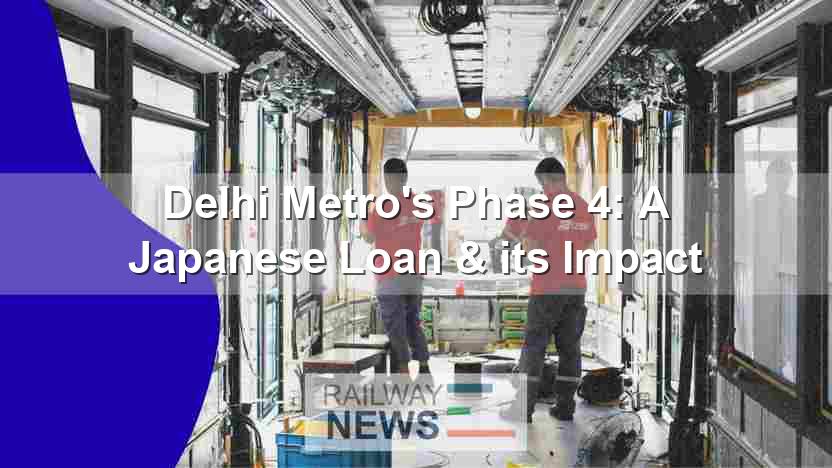
This article examines the crucial role of the Japanese International Cooperation Agency (JICA) loan in facilitating the expansion of Delhi Metro’s Phase 4. The $1.15 billion (Rs 83.9 billion) loan addresses a critical funding gap that threatened to stall the project’s progress, particularly the construction of crucial underground sections. We will analyze the financial implications of this loan, exploring both its benefits and potential challenges. Additionally, we will discuss the broader context of Delhi Metro’s expansion plans, considering its impact on the city’s infrastructure and its economic significance. Finally, we will briefly touch on the recent complete electrification of the West Central Railways zone in India, highlighting the ongoing modernization efforts within the Indian railway system.
Funding the Expansion: The JICA Loan
The securing of a $1.15 billion loan from JICA (Japan International Cooperation Agency) represents a significant milestone for Delhi Metro Rail Corporation (DMRC)’s Phase 4 expansion. The loan agreement, signed in March 2021, directly addresses the financial constraints that had hampered the project’s progress, especially concerning underground construction. This injection of capital allows DMRC to continue work on the planned corridors, furthering the development of Delhi’s public transportation infrastructure. While the loan is designated solely for construction, the alleviation of immediate financial pressures allows DMRC to focus resources and expertise on the timely completion of the project. This funding source exemplifies successful international collaboration in infrastructure development.
Delhi Metro Phase 4: Scope and Significance
Phase 4 of the Delhi Metro expansion is a significant undertaking, adding substantially to the existing network. While the initial plan encompassed six corridors, the Indian government has so far approved three: the Janakpuri West-RK Ashram (28.9 km), Aerocity-Tughlakabad (20.2 km), and Maujpur-Majlis Park (12.5 km) corridors. This expansion adds 65 km to the existing 389 km network, significantly enhancing connectivity and accessibility within Delhi and its surrounding areas. The economic impact of this expansion is substantial, creating jobs, boosting regional development, and fostering economic growth through improved transportation efficiency.
Challenges and Operational Considerations
Despite the JICA loan, Delhi Metro faces ongoing challenges. The COVID-19 pandemic caused significant disruptions, impacting labor availability and project timelines. Additionally, DMRC has reported significant operational losses since the resumption of services, prompting a request for additional financial assistance from the central and state governments. These operational losses underscore the need for sustainable funding models for metro systems, going beyond capital expenditure for construction and encompassing operational costs and potential future expansion phases.
Modernization of the Indian Railway System: Full Electrification of West Central Railways
The complete electrification of the West Central Railways (WCR) zone, a significant achievement in India’s railway modernization efforts, highlights the country’s commitment to improving its rail infrastructure. The electrification eliminates dependence on diesel locomotives, reducing operational costs and minimizing environmental impact. This achievement serves as a positive example of successful infrastructure modernization and aligns with the global trend towards sustainable transportation solutions. This development underscores the complementary nature of such projects; improvements in one sector of rail infrastructure invariably improves other related sectors.
Conclusion
The JICA loan provides a critical lifeline for Delhi Metro’s Phase 4 expansion, addressing immediate funding shortfalls and enabling continued progress. The expansion’s significance extends beyond infrastructure development, contributing to economic growth and improved urban mobility. However, ongoing challenges, including operational losses and the need for sustainable funding, require careful management and strategic planning. The success of the Delhi Metro expansion, coupled with advancements like the full electrification of the West Central Railways zone, illustrates India’s commitment to modernizing its transportation infrastructure. Looking ahead, a multifaceted approach that addresses both capital expenditure and operational sustainability is crucial to ensure the long-term success and viability of the Delhi Metro and the broader Indian railway network. Careful consideration of these financial and operational aspects is vital to avoid future disruptions and ensure the efficient and sustainable growth of India’s vital transportation systems. The integration of advanced technologies, such as Intelligent Transportation Systems (ITS), and ongoing investments in infrastructure modernization will further enhance the efficiency and effectiveness of these systems, paving the way for a more advanced and sustainable transportation future.

Railway infrastructure, rolling stock and transport technologies specialist focused on global rail industry developments, high-speed rail systems, signaling technologies and freight transportation. Covering railway investments, public transport modernization, rail operations and international mobility projects across Europe, Asia and North America.
RELATED POSTS

October 8, 2026 1:15 pm
Alstom secured a €1bn contract to build 13 automated trains,...

October 1, 2026 7:09 am
United States regulators confirmed a September 30 deadline for the...

October 8, 2026 12:18 pm
Siemens Mobility signed an agreement with VinSpeed to supply 350...

October 4, 2026 5:14 pm
Alstom secured a CA$4.7 billion order from VIA Rail Canada...

October 5, 2026 6:12 pm
AECOM and Jacobs secured a contract in September 2026 to...

October 4, 2026 11:08 pm
Sound Transit confirmed the September 30 opening of Seattle Pinehurst...