
CPK Poland Launches Five 2×25 kV HSR Substations Tender
CPK Poland launched a competitive dialogue tender for up to five 2×25 kV HSR traction substations for its Warsaw–Łódź–Wrocław high-speed lines, with bids due June 15.
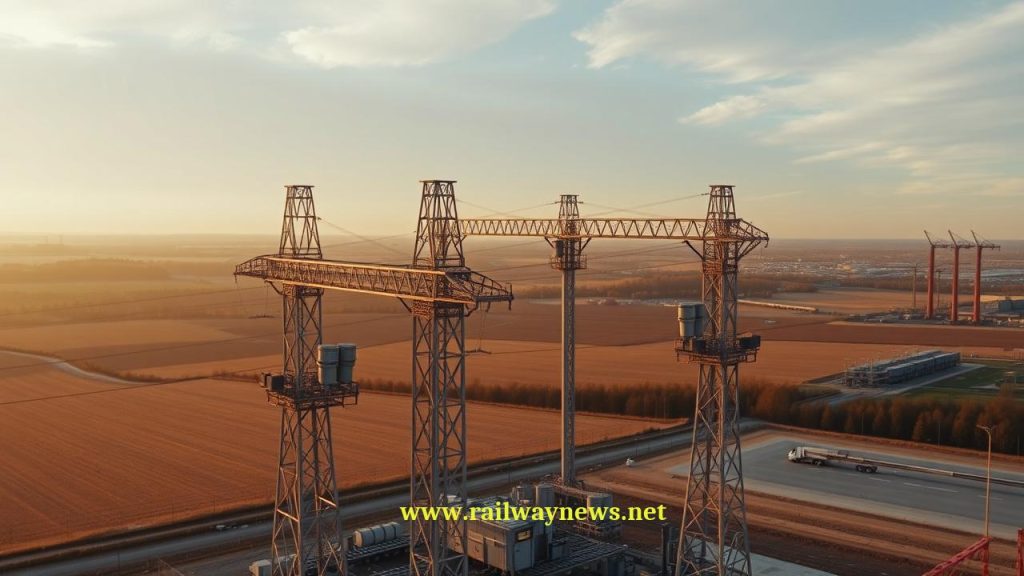
⚡ In Brief: Poland’s Centralny Port Komunikacyjny (CPK) has initiated a tender for the design and construction of up to five 2×25 kV traction substations for its new Warsaw–Łódź–Wrocław high-speed rail lines, with bids due by June 15.
WARSAW, POLAND – Centralny Port Komunikacyjny (CPK) has launched a competitive dialogue tender for a turnkey contract to build traction substations for its high-speed rail network. The procurement, with a bid deadline of June 15, initially covers three substations on the Warsaw–Łódź and Łódź–Wrocław lines. This infrastructure is a critical component of Poland’s larger Port Polska strategic investment program.
What Does This Contract Cover?
The turnkey contract includes the complete design, permitting, construction, and commissioning of an initial three traction substations, with an option for two additional units. Two substations will serve the Warsaw-Łódź line, located near the future CPK airport and in Dmosin, while a third in the Kuźnica–Czajków area will power the Sieradz-Wrocław section. A key technical requirement is the implementation of the 2×25 kV AC power supply standard, a first for Poland’s network, which is necessary to achieve planned operating speeds of up to 350 km/h. The contract also includes a traction power supply control and monitoring system to manage the new high-voltage infrastructure.
Key Contract Data
| Parameter | Value |
|---|---|
| Contract Name | Design & Construction of HSR Traction Substations |
| Total Value | Not disclosed |
| Parties Involved | Centralny Port Komunikacyjny (CPK), Polskie Sieci Elektroenergetyczne (PSE), Bidders (up to 7 selected) |
| Timeline / Completion | Bids due June 15; line sections operational 2032-2035 |
| Country / Corridor | Poland / Warsaw–Łódź–Wrocław High-Speed Lines |
How Does This Compare to Similar Contracts?
While Poland’s CPK is using a competitive dialogue for a bespoke turnkey contract, other network operators are adopting different procurement models to accelerate delivery. In the UK, SSEN Transmission recently awarded a framework agreement to Hitachi Energy and GE Vernova for modular substations, utilizing standardized designs to reduce construction times, with deliveries starting in autumn 2028 (Source: SSEN Transmission, 2024). In terms of project scale within the rail sector, major infrastructure contracts carry significant values; for example, Skanska recently secured a $1 billion contract in the United States for the modernization of a rail bridge in Massachusetts, a project that includes extensive track and signal system upgrades (Source: Construction Dive, 2024).
Editor’s Analysis
This tender is a foundational step in establishing a new technical standard for Poland’s railway, moving beyond its legacy 3 kV DC system to the 2×25 kV AC standard required for genuine high-speed operation. The contract’s success is crucial for the entire Port Polska program, which aims to create an integrated air-rail hub to strengthen Poland’s role in European logistics. This investment aligns with a wider European trend of developing high-speed rail corridors to enhance cross-border connectivity and compete with short-haul aviation.
FAQ
Q: What is the new 2×25 kV power system and why is it important?
A: The 2×25 kV alternating current (AC) system is a high-voltage power supply standard used for high-speed railways. It is essential for reliably powering trains operating at speeds up to 350 km/h, a capability Poland’s current 3 kV direct current (DC) network lacks.
Q: What is the total budget for this substation contract?
A: The total value of the contract has not been publicly disclosed by Centralny Port Komunikacyjny (CPK). The procurement is structured as a competitive dialogue where technical and commercial terms will be finalized with a select group of bidders.
Q: How does this project fit into the larger CPK/Port Polska plan?
A: These substations are a critical enabling component for the new high-speed rail network, which forms the backbone of the Port Polska program. The rail lines will connect major Polish cities and converge at the new Centralny Port Komunikacyjny greenfield airport, creating an integrated transport hub scheduled to open in 2032.

Railway infrastructure, rolling stock and transport technologies specialist focused on global rail industry developments, high-speed rail systems, signaling technologies and freight transportation. Covering railway investments, public transport modernization, rail operations and international mobility projects across Europe, Asia and North America.
RELATED POSTS

October 1, 2026 7:09 am
United States regulators confirmed a September 30 deadline for the...

October 4, 2026 5:14 pm
Alstom secured a CA$4.7 billion order from VIA Rail Canada...
October 1, 2026 10:14 am
HS2 installed a 55-metre steel span in Birmingham, completing phase...

October 1, 2026 11:14 pm
CATS confirmed a six-mile streetcar route in Charlotte to add...
October 1, 2026 11:13 am
Norfolk Southern expanded its 3B Corridor in Alabama in 2025,...
October 1, 2026 1:12 pm
CSX expanded Queensgate Yard in Cincinnati by installing 42 power...