
China’s 600 km/h Maglev: Future of High-Speed Rail & Global Impact
China unveils 600 km/h maglev train, revolutionizing high-speed rail. Faster than existing 350 km/h trains, it targets medium-distance travel.
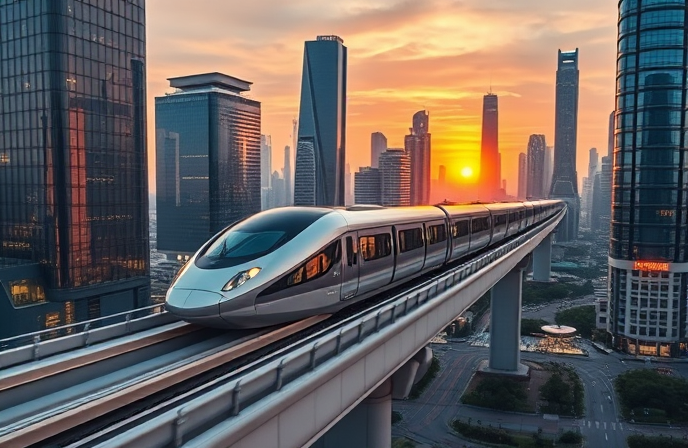
China Unveils 600 km/h Maglev Train, Revolutionizing High-Speed Rail Landscape
China Railway Rolling Stock Corporation (CRRC) has unveiled a groundbreaking 600 km/h high-speed maglev train, poised to dramatically reshape the global landscape of high-speed transportation. Unveiled at the 12th UIC World Congress on High-Speed Rail in Beijing, held from July 8th to 11th, 2025, this innovative technology aims to bridge the speed gap between conventional high-speed rail (350 km/h) and air travel (900-1,000 km/h), offering a compelling alternative for medium-distance travel. This article explores the technological advancements, potential applications, and competitive landscape surrounding CRRC’s high-speed maglev, providing a detailed overview of this transformative development and its implications for the future of rail transport. The key question is: How will China’s maglev technology influence the future of high-speed rail?
Technological Marvel: The Heart of the Maglev System
The 600 km/h maglev train, developed entirely in China by CRRC Qingdao Sifang, a subsidiary of CRRC, leverages cutting-edge magnetic levitation technology. This system uses powerful electromagnets to suspend the train above the guideway, eliminating friction and allowing for exceptionally smooth and quiet operation. Unlike conventional wheel-on-rail systems, maglev trains do not have direct contact with the track, enabling them to achieve significantly higher speeds. The technology involves utilizing rare earth elements and advanced composite materials, fostering innovation in foundational industries and contributing to the growth of the Chinese economy. This innovative design and engineering result in key benefits: high speed, enhanced safety, superior reliability, increased passenger capacity, environmentally sustainable operation, and reduced maintenance costs.
Applications and Operational Advantages
The potential applications of the new maglev train are extensive, with its versatility enabling high-speed commuting within city clusters, integrated transport between major cities, and efficient long-distance corridor transport. The train’s speed and efficiency promise to dramatically reduce travel times. For instance, the journey between Beijing and Shanghai, currently taking around five hours by conventional high-speed train, could be slashed to approximately two and a half hours. This substantial reduction in travel time offers significant advantages in terms of business travel and leisure, making it a highly competitive transport option. The technology has the potential to ease congestion on highways and reduce air travel’s carbon footprint, aligning with global sustainability goals.
Current Status and Future Deployment
China is actively working towards commercializing its 600 km/h maglev train. While the train rolled off the production line in July 2021, it is undergoing extensive testing and trials. CRRC is currently building dedicated maglev test tracks at its Changchun plant to facilitate detailed testing and performance verification. According to statements made by the State Council of China in 2023, the government encourages the acceleration of performance verification and commercialization. CRRC board chairman Sun Yongcai also proposed nighttime operational tests on a high-speed maglev line in Shanghai, and the construction of commercial maglev lines to be promoted domestically. The goal is to introduce commercial services within five to ten years.
Global Competition and Comparison with Japanese Technology
The development of China’s high-speed maglev places it in direct competition with Japan, which has also made significant strides in maglev technology. Japan’s Central Japan Railway (JR Central) is developing the Chuo Shinkansen line, a high-speed maglev project. In 2015, a Japanese maglev train reached 603 km/h on an experimental track. JR Central plans commercial operation at a maximum speed of 505 km/h on the Chuo Shinkansen line, connecting Tokyo and Nagoya, with expansion to Osaka planned for completion in the 2030s. The Chuo Shinkansen aims to drastically cut travel times, from 2.5 to 3 hours on the current Shinkansen to approximately one hour. However, the project faces a significant hurdle: a substantial cost of approximately JPY 9 trillion (USD 60.4 billion) due to extensive tunneling and construction in Japan’s challenging terrain. This contrasts with the existing Shanghai Maglev line, which connects a metro station to Shanghai Pudong International Airport, the world’s first commercial maglev line, launched in 2002, with a top speed of 430 km/h, employing German technology.
Conclusion
CRRC’s unveiling of the 600 km/h high-speed maglev train marks a pivotal moment in the evolution of rail transport. The technology’s speed and efficiency offer the potential to revolutionize travel, and its commercialization is poised to reshape the global high-speed rail market. While challenges remain, including infrastructure development and regulatory approvals, the potential economic and environmental benefits are substantial. The ability to reduce travel times, connect cities more effectively, and reduce carbon emissions presents a compelling vision for the future of transportation. As China continues to refine and deploy this technology, it is likely to play a leading role in shaping the future of global high-speed rail and directly compete with established manufacturers. Future investment, collaboration, and advancements in operational testing are crucial for the technology’s widespread adoption. In the coming years, the performance and impact of China’s maglev technology will be closely observed, which also impacts the speed for the future of high-speed rail.

Railway infrastructure, rolling stock and transport technologies specialist focused on global rail industry developments, high-speed rail systems, signaling technologies and freight transportation. Covering railway investments, public transport modernization, rail operations and international mobility projects across Europe, Asia and North America.
RELATED POSTS

October 1, 2026 7:09 am
United States regulators confirmed a September 30 deadline for the...

October 8, 2026 1:15 pm
Alstom secured a €1bn contract to build 13 automated trains,...

October 4, 2026 5:14 pm
Alstom secured a CA$4.7 billion order from VIA Rail Canada...

October 1, 2026 12:13 am
Illinois approved $1.5 billion annually for the Northern Illinois Transit...

October 6, 2026 2:14 am
Union Pacific launched export rail shipments with Ferromex to deliver...

October 1, 2026 6:10 am
Amtrak approved a System Expansion Committee on July 30 to...