
China Secures CKU Railway Funding: $2.3B Loan Signed
China injects $2.3B to fund the CKU railway, creating a crucial Eurasian trade route. This project boosts global connectivity and economic potential for Central Asia.
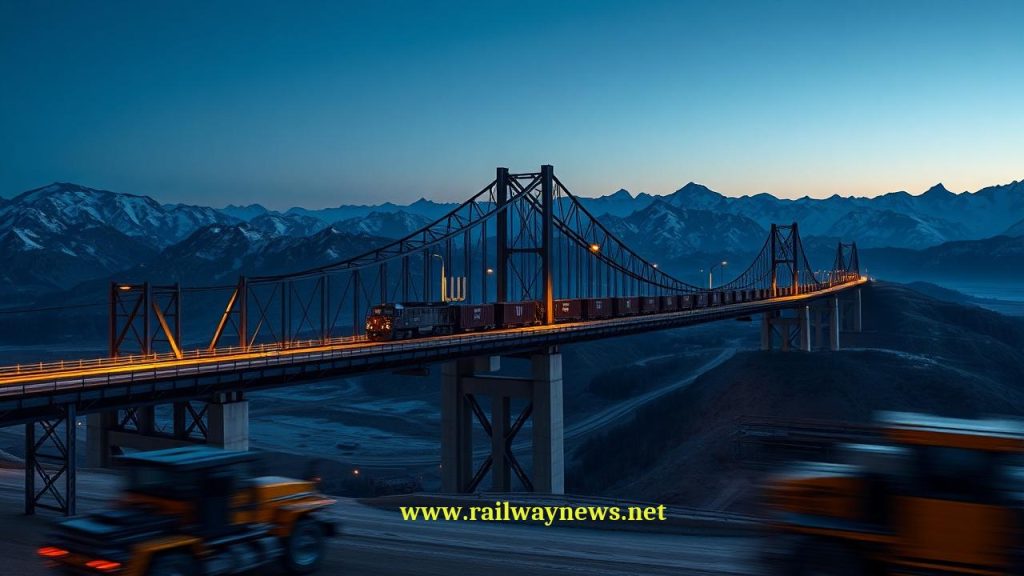
Financing Secured: China Injects $2.3B Loan to Finalize Landmark Central Asian Railway
A Chinese banking syndicate has committed a USD 2.3 billion loan to complete the financing for the strategic China-Kyrgyzstan-Uzbekistan (CKU) railway, a transformative USD 4.7 billion project set to create a new Eurasian trade artery. The agreement, signed on December 16, finalizes the project’s funding well ahead of schedule and marks a pivotal step in realizing a transport corridor that has been decades in the making.
| Category | Details |
|---|---|
| Project Name | China–Kyrgyzstan–Uzbekistan (CKU) Railway |
| Total Estimated Cost | USD 4.7 billion |
| Financing Secured | USD 2.3 billion (35-year loan from China Development Bank & EximBank China) |
| Route Length | Approx. 520 km (China: 213 km, Kyrgyzstan: 304 km, Uzbekistan: 50 km) |
| Key Engineering Challenge | 40% of the route comprises 50 bridges and 29 tunnels across mountainous terrain. |
| Project Lead | China–Kyrgyzstan–Uzbekistan Railway Company (Joint Venture) |
BISHKEK – The final financial cornerstone for the ambitious China-Kyrgyzstan-Uzbekistan (CKU) railway has been laid, following the signing of a major loan agreement. A syndicate formed by the China Development Bank and EximBank China has officially allocated a USD 2.3 billion, 35-year loan to the joint project company. This move secures the remaining half of the project’s USD 4.7 billion total cost. The other half is being jointly covered by the three partner nations, with China contributing 51% and Kyrgyzstan and Uzbekistan contributing 24.5% each. Kyrgyz Deputy Prime Minister Bakyt Töröbaev lauded the achievement, noting that the agreement was signed on December 16, comfortably meeting the December 20, 2025, deadline stipulated in the initial investment agreement.
The CKU railway represents one of the most formidable engineering projects in the region. The planned 520 km route traverses challenging high-altitude terrain, particularly the 304 km segment through Kyrgyzstan. An astonishing 40% of the entire line will consist of complex civil engineering structures, including 50 bridges with a combined length of 120 km and 29 tunnels. This highlights the immense technical difficulty and capital investment required. Construction is already underway, with an official commencement ceremony held on December 27, 2024, and Kyrgyzstan reporting the start of work on its first three tunnels in late April.
After nearly three decades of discussion, the project’s realization cements its status as a flagship component of China’s Belt and Road Initiative (BRI). The CKU railway’s scale and strategic importance are comparable to other massive Chinese-backed infrastructure ventures globally, such as the trans-Guinean railway for the Simandou iron ore project and numerous highway and port developments spearheaded by firms like China Road and Bridge Corporation (CRBC). By creating a shorter, more direct southern corridor for freight between China and markets in Europe and the Middle East, the CKU line diversifies Eurasian trade routes and significantly boosts the economic potential of its landlocked Central Asian partners.
Key Takeaways
- Full Funding Achieved: The USD 2.3 billion loan from Chinese state banks completes the USD 4.7 billion financing package, removing the last major obstacle for the project’s full-scale implementation.
- New Eurasian Corridor: The railway will establish a shorter trade route from China to Europe and the Middle East, bypassing Russia to the north and offering significant time and cost savings for freight.
- Major Engineering Feat: The project requires extensive construction of tunnels and bridges through Kyrgyzstan’s mountains, making it a testament to modern high-altitude railway engineering.
Editor’s Analysis
The finalization of the CKU railway’s financing is more than a project milestone; it is a significant geopolitical development. For the global rail market, it signals China’s unwavering commitment to expanding its BRI framework, creating new supply chains that are centered on its economic and logistical influence. This railway fundamentally alters the strategic calculus for Central Asia, providing Kyrgyzstan and Uzbekistan with unprecedented access to global maritime trade via Chinese ports and reducing their historic dependence on Russian infrastructure. The project will not only generate substantial contracts for engineering and rolling stock but will also catalyze industrial and resource development along its corridor, creating a new economic gravity in the heart of Eurasia.
Frequently Asked Questions
- How is the China-Kyrgyzstan-Uzbekistan railway being funded?
- The project’s total cost is USD 4.7 billion. It is funded through a 50/50 split: a USD 2.3 billion loan from a Chinese banking syndicate, and USD 2.3 billion in joint investment from the three countries (China 51%, Kyrgyzstan 24.5%, Uzbekistan 24.5%).
- What makes this railway project so technically challenging?
- Its route crosses rugged, high-altitude mountain ranges. This necessitates the construction of 50 bridges and 29 tunnels, which together will make up 40% of the railway’s total 520 km length.
- What is the strategic importance of the CKU railway?
- It creates a new, shorter transport corridor between China and Europe/Middle East, enhancing trade efficiency. It also provides landlocked Kyrgyzstan and Uzbekistan with vital access to global markets and strengthens China’s Belt and Road Initiative in Central Asia.

Railway infrastructure, rolling stock and transport technologies specialist focused on global rail industry developments, high-speed rail systems, signaling technologies and freight transportation. Covering railway investments, public transport modernization, rail operations and international mobility projects across Europe, Asia and North America.
RELATED POSTS

October 8, 2026 1:15 pm
Alstom secured a €1bn contract to build 13 automated trains,...

October 1, 2026 7:09 am
United States regulators confirmed a September 30 deadline for the...

October 4, 2026 5:14 pm
Alstom secured a CA$4.7 billion order from VIA Rail Canada...

October 1, 2026 12:13 am
Illinois approved $1.5 billion annually for the Northern Illinois Transit...

October 1, 2026 6:10 am
Amtrak approved a System Expansion Committee on July 30 to...

October 5, 2026 1:13 pm
New York MTA confirmed a late 2026 DEIS release for...