
Canada Launches CA$100M Interprovincial Steel Rail Rebate
Canada launched a CA$100 million federal rebate covering 50% of the cost of moving certified Canadian-made steel between provinces by rail and marine in 2025.
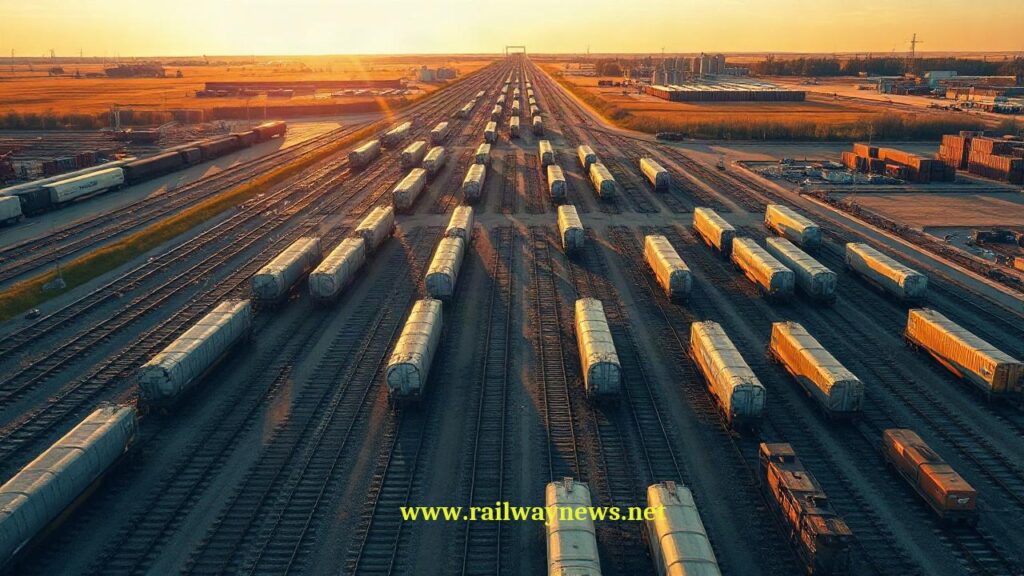
⚡ In Brief: Canada’s federal government launched a CA$100 million rebate covering 50% of interprovincial rail and marine transport costs for certified Canadian-made steel, announced in Ottawa in 2025.
OTTAWA, Canada – The Canadian federal government has created a CA$100 million rebate programme that returns 50% of the transport cost for eligible Canadian-made steel moved between provinces by rail and marine. The measure forms part of Prime Minister Mark Carney’s response to U.S. tariffs on Canadian steel, aluminium and copper, and is intended to lower domestic shipping costs for producers. The programme applies to interprovincial movements only, not exports.
How Is the Funding Structured?
The CA$100 million envelope is disbursed as a post-movement rebate rather than a direct grant, with the government covering half of the freight bill on qualifying interprovincial steel shipments by rail or water.
The design is mode-specific and origin-specific: steel must be certified as Canadian-made, and the trip must cross a provincial boundary. That structure differs from broad infrastructure grantmaking, because payments scale with actual freight spend rather than with capital works. Aluminium and copper, both named alongside steel in the tariff dispute, are not listed as eligible commodities in the announced programme.
No cap per shipment, no total tonnage ceiling and no application window have been published. Those omissions matter for shippers modelling the value of the rebate against existing Class I freight rates.
Key Funding Data
| Parameter | Value |
|---|---|
| Fund / Programme Name | Federal rebate programme for interprovincial transportation of eligible steel products |
| Total Value | CA$100 million |
| Rebate Rate | 50% of interprovincial transport cost |
| Eligible Modes | Rail and marine (water) |
| Parties Involved | Government of Canada; Prime Minister Mark Carney; Canadian steel producers and rail/marine carriers |
| Timeline / Completion | Application window and programme end date not disclosed |
| Country / Corridor | Canada, interprovincial corridors only (no export shipments) |
Not disclosed: the maximum rebate per shipment, the projected tonnage the CA$100 million is expected to cover, which fiscal year the funds are drawn from, and whether the rebate is taxable income for recipients.
How Does This Compare to Similar Funding Programs?
Direct comparables for a Canadian interprovincial freight rebate are scarce, because most federal transport support flows through capital programmes rather than per-shipment operating subsidies. The closest scale anchor available is the freight market itself: the United Kingdom rail market was valued at USD 108.15 billion in 2025 and is projected to grow at a 6.65% CAGR through 2034 (Source: Market Data Forecast, 2025). Against that benchmark, CA$100 million is a targeted intervention covering a narrow commodity flow, not a market-level stimulus.
The policy trigger is measurable. The United States raised Section 232 tariffs on Canadian steel and aluminium to 50% in 2025, which raised the relative cost of exporting southbound and increased the incentive to redirect tonnage into domestic channels (Source: White House proclamations, 2025). Canada’s rebate effectively subsidises that redirection, offsetting half the incremental inland freight cost.
Global rail capital spending is moving in a different direction. High-speed rail investment rose 24% worldwide in 2025, led by China and India, while electric multiple units took a 72% share of the railway multiple-unit market, reflecting passenger-network modernisation rather than freight subsidy (Source: Business Research Insights, 2025; Precedence Research, 2025). Canada’s programme sits outside that passenger-led trend and targets freight economics instead.
Note: Independent verification of the projected tonnage covered by the CA$100 million rebate was not available at time of publication.
Editor’s Analysis
This is a demand-side intervention dressed as a transport subsidy. By rebating half the freight bill rather than cutting producer levies, Ottawa is betting that lower inland logistics costs will let Canadian mills hold domestic market share that tariff-driven export losses would otherwise erode — and the money flows to carriers as much as to steelmakers. The programme’s ceiling is its own constraint: CA$100 million against a national steel logistics bill will exhaust quickly if uptake is high, and the absence of a published per-shipment cap or tonnage forecast suggests the government has not yet modelled that burn rate. Watch whether CN, CPKC and St. Lawrence Seaway operators adjust interprovincial rate structures in response, since a 50% rebate changes the price elasticity of short-haul steel moves that were previously uneconomic by rail.
FAQ
Q: Who qualifies for Canada’s steel shipping rebate?
A: Shippers moving certified Canadian-made steel between provinces by rail or marine are eligible for a rebate of 50% of the transport cost. Steel that is exported or moved within a single province does not qualify under the announced terms.
Q: What is the application deadline or programme end date?
A: No application window, deadline or programme end date has been officially disclosed. The government has also not published a per-shipment rebate cap or the total tonnage the CA$100 million is expected to cover.
Q: How will this affect rail operators and steel shippers?
A: The rebate lowers the effective cost of interprovincial rail and marine moves, which should support volumes for carriers serving domestic steel corridors. Specific volume or revenue impacts on individual operators have not been confirmed, and aluminium and copper are excluded from the eligible commodity list.

Railway infrastructure, rolling stock and transport technologies specialist focused on global rail industry developments, high-speed rail systems, signaling technologies and freight transportation. Covering railway investments, public transport modernization, rail operations and international mobility projects across Europe, Asia and North America.
RELATED POSTS

October 8, 2026 1:15 pm
Alstom secured a €1bn contract to build 13 automated trains,...

October 1, 2026 7:09 am
United States regulators confirmed a September 30 deadline for the...

October 8, 2026 12:18 pm
Siemens Mobility signed an agreement with VinSpeed to supply 350...

October 4, 2026 5:14 pm
Alstom secured a CA$4.7 billion order from VIA Rail Canada...

October 5, 2026 6:12 pm
AECOM and Jacobs secured a contract in September 2026 to...

October 1, 2026 12:13 am
Illinois approved $1.5 billion annually for the Northern Illinois Transit...