
California High-Speed Rail: Navigating Complexities & Future Trends
California’s high-speed rail faces complex technical, financial, and political hurdles. Discover the intricate challenges and potential solutions.
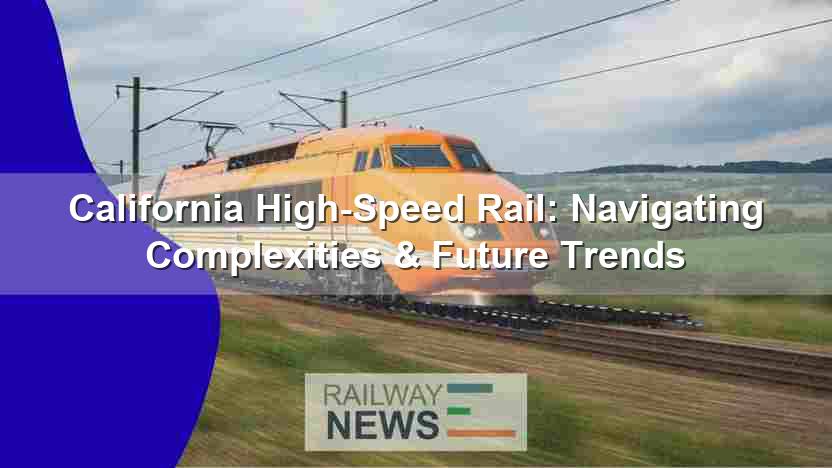
The proposed California High-Speed Rail project has ignited a fervent debate, attracting both ardent supporters and staunch critics. This article explores the intricate challenges and complexities facing this ambitious endeavor, examining the technical hurdles, financial constraints, and political dynamics that have hampered progress. From evaluating the feasibility of the proposed infrastructure to exploring alternative funding models, we aim to provide a detailed analysis of the obstacles to successful high-speed rail implementation in California. The project’s potential economic impact, environmental considerations, and social implications will be carefully scrutinized. This examination will serve to inform readers and stakeholders about the intricate challenges and potential solutions to navigating the path towards operational high-speed rail in the Golden State.
Navigating the Technical Terrain
The sheer scale and complexity of constructing a high-speed rail network present formidable technical challenges. Precise alignment calculations, substantial tunneling requirements, and integrating existing infrastructure with new lines demand sophisticated engineering solutions. The California terrain, characterized by mountainous regions and diverse geographical features, exacerbates these difficulties. Addressing these issues necessitates meticulous planning, extensive feasibility studies, and innovative engineering approaches to ensure cost-effective and reliable operation.
Financial Feasibility and Funding Models
Securing the necessary financial resources to complete such a massive project is a critical hurdle. Significant capital investments are required for land acquisition, construction, and the procurement of advanced rolling stock. Alternative funding models, including public-private partnerships (PPPs), are often explored to mitigate the financial burden on the public sector. This also necessitates careful consideration of long-term operational costs, potential revenue streams, and the viability of potential private sector involvement. Evaluating the long-term financial sustainability of the project is paramount.
Political and Societal Factors: A Challenging Landscape
High-speed rail projects frequently encounter substantial political opposition and community concerns. Public perception, environmental impacts, and land use implications all play pivotal roles. Navigating these issues requires careful stakeholder engagement, robust environmental impact assessments (EIAs), and the development of transparent communication strategies. Community input and a focus on equitable development are fundamental to mitigating these political challenges. Additionally, the project’s alignment with overall transportation strategy and long-term economic goals must be demonstrably clear.
The California High-Speed Rail Contract: A Case Study
The California High-Speed Rail project’s progress has been significantly affected by the procurement processes and contractual agreements. This includes complex vendor selection procedures, detailed contractual agreements, and issues related to project delays. Examining past contracts and the lessons learned from the experience of similar projects across the globe can offer valuable insights for improving the efficiency and efficacy of future procurement processes. This crucial aspect has profound consequences for both project timelines and overall cost control.
The challenges surrounding the California High-Speed Rail project are substantial, encompassing complex technical considerations, funding constraints, and considerable political and societal factors. The project’s long-term success hinges on effective collaboration among stakeholders, rigorous planning, and strategic solutions for navigating these multifaceted challenges. Evaluating the project’s viability and securing long-term funding will be crucial in overcoming the obstacles ahead. A realistic assessment of project feasibility and cost-effectiveness, combined with a robust procurement process, will be vital for future planning and execution.
Ultimately, achieving a successful high-speed rail system in California requires an integrated approach that encompasses sound engineering practices, sustainable financing mechanisms, transparent communication, and robust stakeholder engagement. The lessons learned from similar projects, international best practices, and detailed assessments of the economic and social ramifications are paramount in ensuring that this ambitious endeavor achieves its intended purpose. The California High-Speed Rail contract serves as a prime example of the complexities in large-scale infrastructure development, emphasizing the need for careful planning, stakeholder collaboration, and adaptive project management strategies. This is a complex project, and success will rely on lessons learned from past endeavors.
You might be interested in:
Last March 2019, we looked at Alstom’s €150M Coradia Lint deal, focusing on Bavaria’s rail upgrade. Click here to read – Alstom’s €150M Coradia Lint Deal: Bavaria’s Rail Upgrade

Railway infrastructure, rolling stock and transport technologies specialist focused on global rail industry developments, high-speed rail systems, signaling technologies and freight transportation. Covering railway investments, public transport modernization, rail operations and international mobility projects across Europe, Asia and North America.
RELATED POSTS

October 1, 2026 7:09 am
United States regulators confirmed a September 30 deadline for the...

October 8, 2026 1:15 pm
Alstom secured a €1bn contract to build 13 automated trains,...

October 4, 2026 5:14 pm
Alstom secured a CA$4.7 billion order from VIA Rail Canada...

October 1, 2026 12:13 am
Illinois approved $1.5 billion annually for the Northern Illinois Transit...

October 6, 2026 2:14 am
Union Pacific launched export rail shipments with Ferromex to deliver...

October 1, 2026 6:10 am
Amtrak approved a System Expansion Committee on July 30 to...