
France’s Brittany-Loire Valley High-Speed Rail Boosts Connectivity
France’s new Brittany-Loire Valley high-speed rail line, a €3.4 billion project, boosts regional connectivity and economic growth with ERTMS Level 2 signaling.
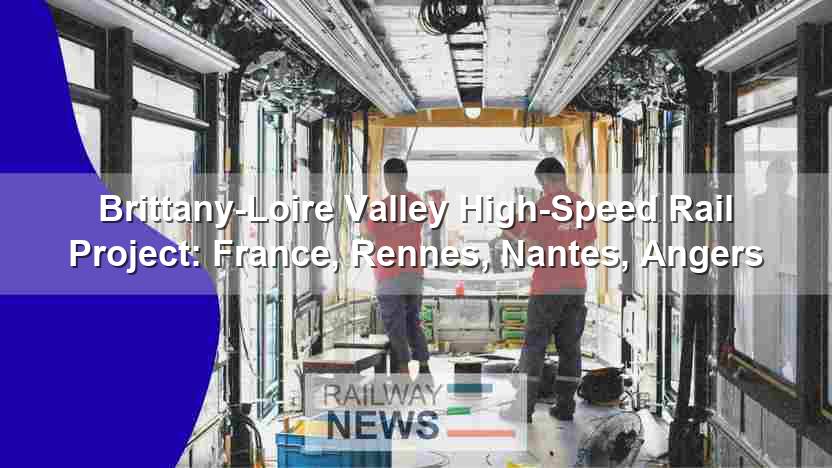
This article explores the engineering and financial aspects of the Brittany-Loire Valley (BPL) high-speed rail line project in France. The project, a significant undertaking in European high-speed rail development, aimed to drastically reduce travel times between major cities in northwestern France and Paris, while simultaneously stimulating economic growth and enhancing regional connectivity. This analysis will delve into the project’s design, construction, financing, and technological implementations, highlighting the complexities and innovative solutions employed in its realization. The key objectives of this study are to understand the logistical challenges overcome during construction, analyze the innovative financing model employed, and assess the technological advancements implemented within the BPL project’s signaling and electrification systems. The ultimate goal is to provide a detailed overview of a large-scale public-private partnership (PPP) project in the high-speed rail sector, offering valuable insights for future similar endeavors. The project’s impact on regional development and its role within the broader context of the European high-speed rail network will also be considered.
Project Overview and Financing
The €3.4 billion ($4.41 billion USD) Brittany-Loire Valley (BPL) high-speed rail line is a testament to large-scale infrastructure development. Developed under a public-private partnership (PPP) model, the project showcases a novel approach to financing such ambitious undertakings. Eiffage, a major French construction company, through its subsidiary Eiffage Rail Express (ERE), took on the responsibility of financing, designing, building, and maintaining the line for 25 years under an availability payment model. This model guarantees payments to Eiffage based on the availability of the line, incentivizing high operational performance and efficient maintenance. The funding was a multifaceted effort, combining public sector contributions from the French state and local authorities with significant private investment secured through bank loans and equity financing from Eiffage. The European Investment Bank (EIB) played a substantial role, providing a significant portion of the €1 billion ($1.3 billion USD) in commercial bank financing. The European Union (EU) also contributed to the preliminary studies.
Construction and Engineering
The BPL project involved the construction of 214km of new railway lines, including 182km of high-speed lines and 32km of connecting lines. This required extensive land acquisition (2,100 hectares across three French departments), complex earthworks including seven covered trenches and ten viaducts, and the deployment of significant quantities of materials (900,000 tonnes of ballast, 820km of rails, and 680,000 sleepers). The line is designed for 320 km/h TGV (Train à Grande Vitesse) operation, utilizing concrete sleepers and a ballasted track. Electrification is provided by the French electricity transmission system (Réseau de Transport d’Electricité – RTE) via substations and catenary cables, with a system capable of supporting speeds up to 350 km/h.
Signaling and Communication Systems
The signaling system for the BPL line represents a significant technological advancement. The high-speed section (182km) employs the European Rail Traffic Management System (ERTMS) Level 2, eliminating the need for traditional trackside signals. Instead, the system relies on Radio Block Centres (RBCs) and Eurobalises for continuous information transmission directly to the train driver’s cab via GSM-R (Global System for Mobile Communications – Railway). The 32km of conventional connecting lines utilize ERTMS Level 1. Ansaldo STS, a leading signaling company, secured a substantial contract for providing and installing this state-of-the-art signaling infrastructure. The entire system is controlled from a switching station in Rennes.
Project Summary and Impact
The BPL project is a showcase of modern high-speed rail development. It exemplifies the use of innovative financing models (PPPs), cutting-edge signaling technology (ERTMS Level 2), and a commitment to improving regional connectivity. The significant reduction in journey times between Paris and cities like Rennes, Nantes, and Angers will undoubtedly benefit both commuters and businesses. Additionally, the estimated 10,000 jobs created during construction underscore the line’s positive impact on the French economy. The project’s success demonstrates the viability of large-scale infrastructure projects using innovative financing mechanisms and advanced technological solutions. This ambitious undertaking serves as a valuable case study for future high-speed rail projects, highlighting the importance of strategic partnerships, technological innovation, and sustainable investment strategies.
| Project Parameter | Value |
|---|---|
| Project Cost | €3.4 billion ($4.41 billion USD) |
| Project Length | 214 km (182 km high-speed, 32 km connecting) |
| Design Speed | 320 km/h |
| Signaling System | ERTMS Level 2 (high-speed), ERTMS Level 1 (connecting lines) |
| Main Contractor | Eiffage Rail Express (ERE) |
| Signaling Contractor | Ansaldo STS |
| Rail Supplier | Tata Steel |
| Estimated Jobs Created | 10,000 (construction phase) |
Company Information:
- Eiffage: A large French construction and concessions company.
- Eiffage Rail Express (ERE): A subsidiary of Eiffage specializing in rail infrastructure.
- Alstom: A multinational company that manufactures railway equipment, including the Euroduplex TGV trains.
- Ansaldo STS: A global provider of signaling and train control systems.
- Tata Steel: A major steel producer.
- European Investment Bank (EIB): The European Union’s long-term lending institution.

Railway infrastructure, rolling stock and transport technologies specialist focused on global rail industry developments, high-speed rail systems, signaling technologies and freight transportation. Covering railway investments, public transport modernization, rail operations and international mobility projects across Europe, Asia and North America.