
Balfour Beatty VINCI Completes 2,742 HS2 Viaduct Segments
Balfour Beatty VINCI completed 2,742 pre-cast concrete segments for HS2 Delta Junction viaducts at its Warwickshire facility over 3.5 years.
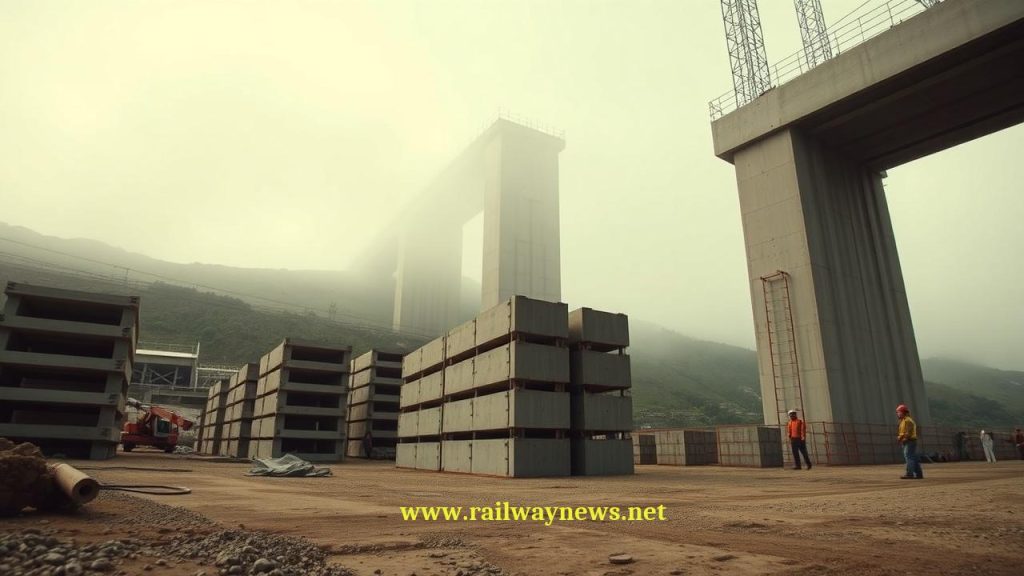
⚡ In Brief: Balfour Beatty VINCI has completed manufacturing all 2,742 pre-cast concrete segments, weighing up to 85 tonnes each, for the High Speed 2 (HS2) Delta Junction viaducts at a temporary facility in Warwickshire, United Kingdom.
WARWICKSHIRE, UK – HS2’s main works contractor for the West Midlands, Balfour Beatty VINCI (BBV), has concluded a three-and-a-half-year manufacturing program, producing 2,742 pre-cast viaduct segments. The components were cast at a temporary outdoor facility near Kingsbury. The site will now be repurposed to produce deck slabs for another section of the high-speed line.
What Is the Full Scope of This Project?
This phase of the project involved the on-site manufacturing of all deck segments for the complex Delta Junction viaducts at Coleshill and Water Orton. The temporary 55,000 square metre facility produced up to eight segments per day, which together will form over 6.5km of viaduct decks. The facility is part of a major new timber building platform launched for the UK, a structural detail not widely reported in project updates (Source: Forestry Journal).
Key Project Data
| Parameter | Value |
|---|---|
| Project / Contract Name | HS2 Delta Junction Viaduct Segment Manufacturing |
| Total Value | Not disclosed |
| Parties Involved | HS2 Ltd, Balfour Beatty VINCI (BBV) |
| Timeline / Completion | Segment casting complete after 3.5 years; site now repurposing |
| Country / Corridor | United Kingdom / HS2 London-Birmingham |
How Does This Compare to Similar Projects?
Comparable cost and production efficiency data for pre-cast segment manufacturing on other recent UK infrastructure projects, such as HS1 or Crossrail, was not publicly available for a direct comparison at the time of publication. The strategy of establishing a large, temporary, single-purpose pre-cast yard close to the installation site is a common approach for large-scale viaduct construction to minimise transportation logistics and costs, but specific performance metrics are seldom released.
Editor’s Analysis
The completion of this major manufacturing task is a tangible milestone for BBV, but it occurs as the entire HS2 project undergoes a “detailed reset” to manage costs. This reflects a global pattern where transit authorities are forced to find savings on megaprojects, as seen with Sound Transit in the US exploring cost-reduction options for its light rail expansions amid financial pressures (Source: KOMO News). The successful repurposing of the Kingsbury yard for a new component type will be a key test of the project’s adaptability and efficiency under this new cost-conscious leadership.
FAQ
Q: What will the Kingsbury manufacturing facility be used for next?
A: The outdoor facility will be repurposed to produce over 1,200 concrete deck slabs. These components are for the Curzon Approach viaducts, which will carry the HS2 railway into central Birmingham.
Q: How heavy are the viaduct segments and how are they installed?
A: The segments weigh between 50 and 85 tonnes each and are 3.5m high. They are installed using a cantilever process where segments are supported by temporary steel cables until a span is self-supporting and permanent post-tensioned cables are fitted.
Q: What is the overall status of the HS2 project?
A: While progress is being made on construction elements like the viaducts, the entire 140-mile project is under review. New HS2 Ltd Chief Executive Mark Wild is leading a reset to deliver the remaining route for the lowest reasonable cost.

Railway infrastructure, rolling stock and transport technologies specialist focused on global rail industry developments, high-speed rail systems, signaling technologies and freight transportation. Covering railway investments, public transport modernization, rail operations and international mobility projects across Europe, Asia and North America.
RELATED POSTS

October 1, 2026 7:09 am
United States regulators confirmed a September 30 deadline for the...

October 8, 2026 1:15 pm
Alstom secured a €1bn contract to build 13 automated trains,...

October 4, 2026 5:14 pm
Alstom secured a CA$4.7 billion order from VIA Rail Canada...

October 1, 2026 12:13 am
Illinois approved $1.5 billion annually for the Northern Illinois Transit...
October 6, 2026 2:14 am
Union Pacific launched export rail shipments with Ferromex to deliver...

October 1, 2026 6:10 am
Amtrak approved a System Expansion Committee on July 30 to...