
Australia’s Inland Rail: A$5 Billion Mega-Project
The Regionerate Rail consortium has secured a $5 billion design and build contract for Australia’s Inland Rail project, focusing on constructing a 128km rail line between Gowrie and Kagaru in Queensland, challenging terrain requiring a substantial tunnel through the Great Dividing Range.
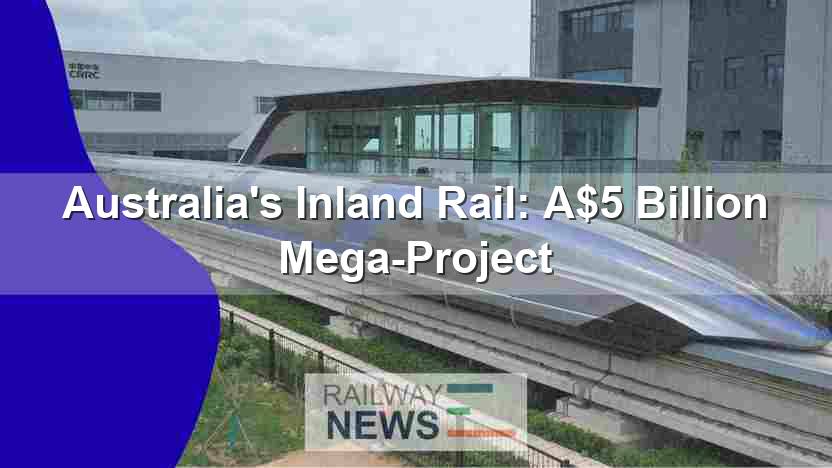
This article examines the significant award of a A$5 billion ($3.7 billion USD) design and build contract to the Regionerate Rail consortium for a crucial section of Australia’s Inland Rail project. The contract focuses on the construction of a 128km rail line between Gowrie and Kagaru in Queensland, a section considered the most geographically challenging due to its terrain and the necessity of a substantial tunnel through the Great Dividing Range. This project represents a substantial investment in Australia’s national rail infrastructure, promising economic growth and job creation. We will explore the consortium’s composition, the engineering challenges involved in constructing this section of the Inland Rail, the economic implications of the project, and the long-term maintenance considerations inherent in such a large-scale undertaking. The analysis will delve into the complexities of public-private partnerships (PPPs) in large infrastructure projects and their role in facilitating timely and efficient delivery.
The Regionerate Rail Consortium and Project Scope
The Regionerate Rail consortium, a joint venture comprising Clough, GS Engineering & Construction, Webuild, Service Stream, and Plenary Group, brings together a diverse range of expertise in construction, engineering, and project management. This collaborative approach is crucial for tackling the complexities of the Gowrie-Kagaru section, which includes the construction of a 6.2km tunnel through the Great Dividing Range – touted as the largest diameter freight tunnel in the Southern Hemisphere. This tunnel’s construction necessitates advanced geotechnical engineering solutions to manage the challenging geological conditions and ensure structural integrity. The project’s scope extends beyond tunnel construction, encompassing track laying, earthworks, and associated infrastructure development for a fully operational and high-capacity freight line.
Engineering Challenges and Innovative Solutions
The Gowrie-Kagaru section presents numerous engineering challenges. The mountainous terrain of the Great Dividing Range requires innovative solutions for excavation, tunnel boring, and overall alignment. Factors like rock stability, groundwater management, and minimizing environmental impact are paramount. The large diameter of the freight tunnel presents unique logistical and engineering challenges in terms of ventilation, access, and the safe and efficient removal of excavated materials. The use of advanced tunneling methodologies and technologies will be essential to ensure timely and cost-effective completion. Environmental considerations, including minimizing disruption to the surrounding ecosystem and managing potential impacts on water resources, also play a critical role in the project’s execution.
Economic Impact and Job Creation
The A$5 billion investment in the Gowrie-Kagaru section signifies a considerable injection of capital into the Queensland economy. The Australian Rail Track Corporation (ARTC) anticipates that the Inland Rail project as a whole will generate more than 11,800 jobs and deliver a A$7.8 billion boost to the state’s economy throughout the construction phase and subsequent operations. This economic stimulus extends beyond direct employment, impacting related industries such as manufacturing, logistics, and support services. The long-term benefits include increased freight capacity, improved efficiency in transporting goods, and reduced reliance on road transport, leading to a positive effect on regional economies along the Inland Rail corridor.
Public-Private Partnerships and Long-Term Maintenance
The project operates under a Public-Private Partnership (PPP) model, where the Regionerate Rail consortium assumes responsibility for design, construction, and a 25-year maintenance phase. This approach leverages private sector expertise and capital to expedite project delivery and spread the financial burden over time. The 25-year maintenance commitment is a crucial aspect of ensuring the long-term operational efficiency and safety of the rail line. A well-defined maintenance plan, utilizing advanced monitoring technologies and predictive maintenance strategies, is critical to minimizing downtime and maximizing the life cycle of the infrastructure. The PPP model also necessitates a clear framework for risk allocation, performance monitoring, and dispute resolution between the public and private partners.
Conclusion
The awarding of the A$5 billion contract to the Regionerate Rail consortium for the Gowrie-Kagaru section of the Inland Rail project marks a pivotal step in the development of Australia’s national freight network. The project represents a substantial investment in infrastructure, generating significant economic benefits and creating numerous jobs. The consortium’s expertise in overcoming the engineering challenges posed by the Great Dividing Range tunnel is crucial for the project’s success. The adoption of a Public-Private Partnership (PPP) model ensures efficient project delivery and long-term maintenance. However, successful completion depends on robust project management, effective risk mitigation strategies, and close collaboration between the consortium and the ARTC. The project’s success will set a benchmark for future large-scale infrastructure projects, demonstrating the potential of PPPs to deliver complex and nationally significant infrastructure assets. Careful monitoring of the project’s progress and ongoing evaluation of its economic and social impacts will be vital in ensuring the long-term sustainability and benefits of the Inland Rail. The meticulous planning, innovative engineering, and detailed risk management strategies involved will undoubtedly influence future large-scale rail projects both in Australia and globally, setting a new standard for efficiency and sustainability.

Railway infrastructure, rolling stock and transport technologies specialist focused on global rail industry developments, high-speed rail systems, signaling technologies and freight transportation. Covering railway investments, public transport modernization, rail operations and international mobility projects across Europe, Asia and North America.
RELATED POSTS

October 8, 2026 1:15 pm
Alstom secured a €1bn contract to build 13 automated trains,...

October 1, 2026 7:09 am
United States regulators confirmed a September 30 deadline for the...

October 8, 2026 12:18 pm
Siemens Mobility signed an agreement with VinSpeed to supply 350...

October 4, 2026 5:14 pm
Alstom secured a CA$4.7 billion order from VIA Rail Canada...

October 5, 2026 6:12 pm
AECOM and Jacobs secured a contract in September 2026 to...

October 4, 2026 11:08 pm
Sound Transit confirmed the September 30 opening of Seattle Pinehurst...