
EKFB Completes 320-Metre Westbury Viaduct for UK HS2
EKFB completed the 320-metre Westbury viaduct for UK HS2 in October 2024, sliding 2,695 tonnes of steel deck spans across piers on the central section.
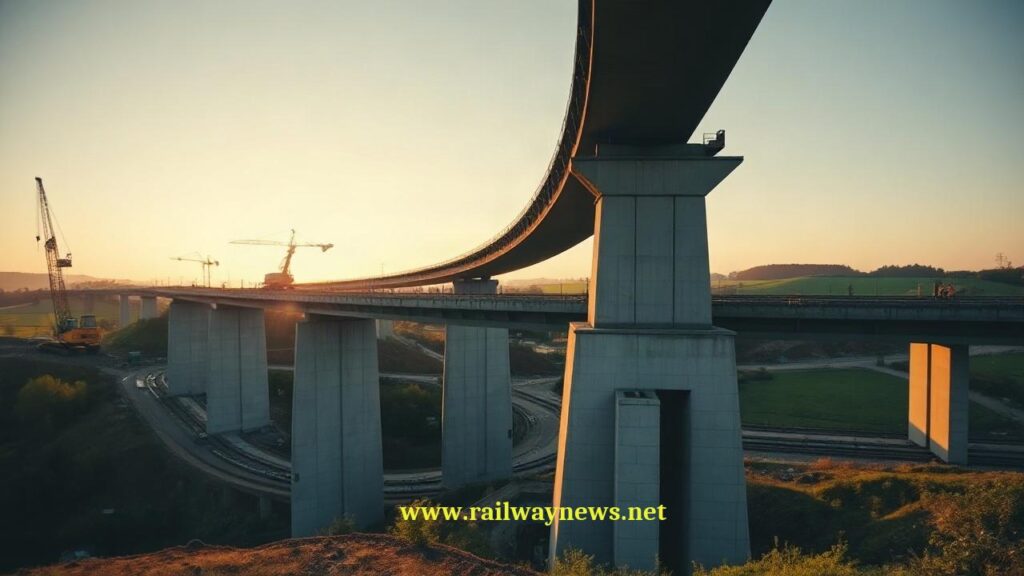
⚡ In Brief: HS2 contractor joint venture EKFB has completed the 320-metre Westbury viaduct in Buckinghamshire using a French TGV-derived double composite engineering technique that lowers structural steel and concrete volumes.
WESTBURY, UNITED KINGDOM – HS2 main works contractor EKFB completed structural engineering on the 320-metre Westbury viaduct in October 2024, sliding 2,695 tonnes of steel deck spans into position across the central section of the high-speed rail corridor. The structure represents the first of five viaducts along the route using a double composite box-beam format that sandwiches structural steel between upper and lower reinforced concrete slabs. Trackbed completion allows earthworks teams to advance adjacent infrastructure connections between London and Birmingham.
What Is the Full Scope of This Project?
The Westbury viaduct forms a central component of the 500 bridging structures being erected along the initial 225-kilometre Phase One alignment of High Speed 2. Construction required sliding pre-assembled steel box girders along concrete piers using low-friction coated sliding plates, followed by casting the concrete upper deck in sequential 42-metre sections using an advancing formwork carriage. Beyond the main 320-metre viaduct, EKFB’s central package incorporates 15 viaducts alongside earthworks, the completed Turweston green bridge, and the realigned A43 trunk road. Total capital expenditure specific to the Westbury viaduct contract was not disclosed by HS2 Ltd.
Key Project Data
| Parameter | Value |
|---|---|
| Project / Contract Name | HS2 Central Section – Westbury Viaduct |
| Total Value | Not disclosed |
| Parties Involved | HS2 Ltd, EKFB (Eiffage, Kier, Ferrovial Construction, BAM Nuttall), Eiffage Metal, Infrasolutions Ltd |
| Timeline / Completion | Structural slide March–October 2024; civils finished 2025 |
| Country / Corridor | United Kingdom / London–West Midlands (HS2 Phase One) |
How Does This Compare to Similar Projects?
HS2’s adoption of double composite viaduct designs directly imports civil engineering practices proven across the French TGV network, where SNCF Réseau deployed similar steel-concrete box sections to lower embodied carbon on the LGV Rhin-Rhône and LGV Bretagne-Pays de la Loire corridors (Source: Railway Supply, 2024). Within the UK program itself, the 320-metre Westbury span is substantially smaller than the flagship 3.4-kilometre Colne Valley Viaduct, but it achieves higher structural weight reductions than traditional concrete segmental spans by reducing deadload mass. These European procurement and engineering transfers unfold against an expanding worldwide market, with the global passenger rail sector forecast to expand at a compound annual growth rate (CAGR) of 5.8% between 2025 and 2033 (Source: Market Data Forecast, 2024). While European operators like Finland’s VR saw operational profits increase by 53% to €129.8 million in 2025 due to network efficiencies (Source: VR Group, 2025), UK project deliverers remain under scrutiny to demonstrate that modified civil designs yield lower lifecycle asset costs.
Editor’s Analysis
The execution of the double composite format at Westbury demonstrates how continental civil engineering techniques can successfully reduce structural carbon footprints across UK rail construction. However, with the global railroads market forecast to grow at a 5.57% CAGR through 2034 driven by massive modernization schemes (Source: Market Data Forecast, 2024), HS2’s primary strategic vulnerability remains capital cost control rather than structural design execution. Delivering five identical double composite bridges allows EKFB to capture supply-chain repeatability gains that will determine final delivery economics on the central section.
FAQ
Q: What makes the Westbury viaduct’s double composite design different from conventional rail bridges?
A: It integrates reinforced concrete slabs both above and below a central steel beam, creating an efficient composite box girder that requires less raw concrete and steel than traditional solid concrete deck spans.
Q: Who manufactured and placed the viaduct’s structural steel components?
A: Eiffage Metal fabricated and installed the 2,695 tonnes of steel beams, which were jacked and slid across concrete piers using non-stick friction pads between March and October 2024.
Q: When will passenger trains begin operating across the completed Westbury viaduct?
A: Track-laying and signaling integration across Phase One must precede revenue service, which HS2 Ltd expects to commission between 2029 and 2033.

Railway infrastructure, rolling stock and transport technologies specialist focused on global rail industry developments, high-speed rail systems, signaling technologies and freight transportation. Covering railway investments, public transport modernization, rail operations and international mobility projects across Europe, Asia and North America.
RELATED POSTS

October 1, 2026 7:09 am
United States regulators confirmed a September 30 deadline for the...

October 8, 2026 1:15 pm
Alstom secured a €1bn contract to build 13 automated trains,...

October 4, 2026 5:14 pm
Alstom secured a CA$4.7 billion order from VIA Rail Canada...

October 1, 2026 12:13 am
Illinois approved $1.5 billion annually for the Northern Illinois Transit...
October 6, 2026 2:14 am
Union Pacific launched export rail shipments with Ferromex to deliver...
October 1, 2026 6:10 am
Amtrak approved a System Expansion Committee on July 30 to...