
HMM Expands Tacoma Capacity by 290,000 TEUs with Four Cranes
HMM subsidiary Washington United Terminals ordered four cranes from HD Hyundai Samho at Port of Tacoma, raising annual throughput from 590,000 to 880,000 TEUs by 2028.
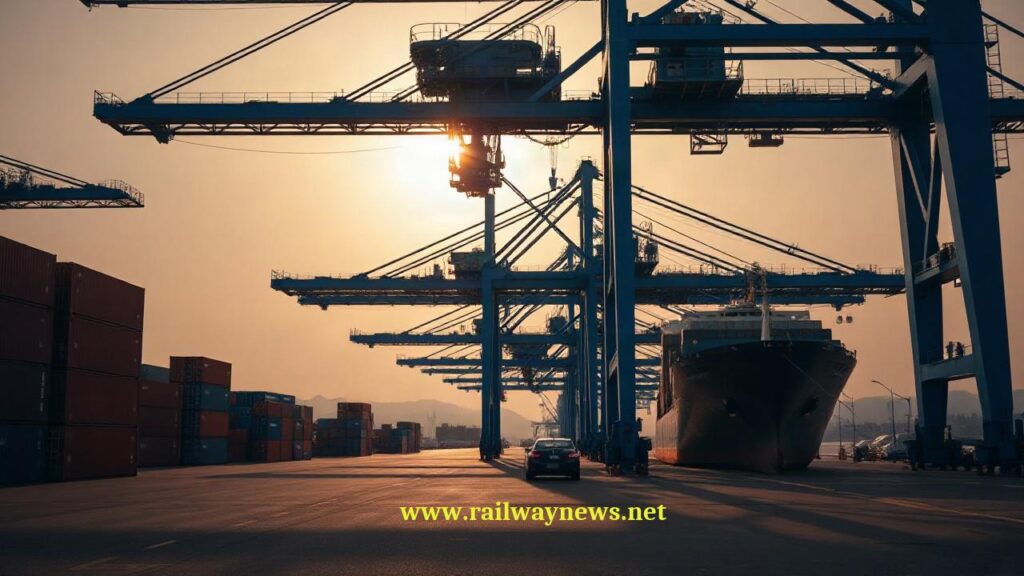
⚡ In Brief: HMM’s Washington United Terminals ordered four cranes from HD Hyundai Samho at the Port of Tacoma, expanding annual capacity from 590,000 to 880,000 TEUs by 2028.
TACOMA, Washington – HMM subsidiary Washington United Terminals Inc. (WUT) has contracted HD Hyundai Samho to supply four new port cranes at the Port of Tacoma, raising annual cargo capacity from 590,000 TEUs to 880,000 TEUs. The turnkey project covers design, manufacturing, transport, installation and commissioning, with completion scheduled by 2028.
What Does This Contract Cover?
The contract covers two replacement quay cranes and two additional yard cranes at WUT’s 126-acre Tacoma terminal, which operates a 793-meter berth, an on-dock rail system, eight existing quay cranes and six yard cranes. After the replacement program, the terminal will run a modernized fleet of eight quay cranes and eight yard cranes. HD Hyundai Samho assumes end-to-end accountability, including commissioning risk, before the cranes enter commercial service.
Key Contract Data
| Parameter | Value |
|---|---|
| Contract Name | WUT–HD Hyundai Samho four-crane supply contract (official contract title not disclosed) |
| Total Value | Not disclosed |
| Parties Involved | Washington United Terminals Inc. (HMM subsidiary); HD Hyundai Samho |
| Timeline / Completion | By 2028, turnkey delivery |
| Country / Corridor | United States – Seattle-Tacoma gateway, Port of Tacoma |
How Does This Compare to Similar Contracts?
The WUT order is part of a broader U.S. gateway competition focused on rail connectivity: the ports of Los Angeles and Long Beach are seeking a new operator for their jointly owned shortline railroad, with proposals due July 28, 2026, after Pacific Harbor Line’s tenure since 1998. (Source: FreightWaves, 2026). Comparable cost data for U.S. West Coast ship-to-shore crane orders of this scale was not publicly available at time of publication.
The capacity uplift at Tacoma aligns with projected rail freight growth, which Future Market Insights estimates will rise from USD 370.0 billion in 2025 to USD 602.7 billion by 2036 at a 4.5% CAGR (Source: Future Market Insights, 2025). WUT’s on-dock rail system and its berth depth are decisive assets as HMM pursues larger vessels on transpacific loops; the two ports of Los Angeles and Long Beach have set a stated target of moving 35% of containers by train under their Clean Air Action Plan (Source: FreightWaves, 2026).
Editor’s Analysis
By allocating capex to Tacoma rather than Southern California, HMM is effectively consolidating its transpacific strategy around a gateway with expansion room, on-dock rail connectivity and a labor environment it knows well. Crane specifications, including outreach, lift height and power supply (electric versus diesel-electric), were not disclosed, which is notable given Washington state’s emissions limits and the Northwest Seaport Alliance’s stated environmental targets. The 290,000-TEU capacity uplift signals that ocean carriers will keep investing in U.S. terminals where they control the operating subsidiary, even as alliance structures shift.
FAQ
Q: How much will annual capacity increase after the new cranes are installed?
A: Washington United Terminals will expand from 590,000 to 880,000 TEUs per year, a gain of approximately 290,000 TEUs once the cranes are commissioned by 2028.
Q: Will the new cranes be all-electric models?
A: This has not been officially confirmed; neither WUT nor HD Hyundai Samho disclosed power specifications, and the existing terminal is a mix of quay cranes and yard cranes with different drive systems.
Q: Why is HMM investing in Tacoma instead of a larger U.S. port?
A: HMM’s WUT subsidiary controls the terminal’s operations, and the 793-meter berth plus on-dock rail supports the larger vessels HMM deploys across the Pacific. The order signals confidence in the Seattle-Tacoma gateway’s ability to compete for discretionary cargo.

Railway infrastructure, rolling stock and transport technologies specialist focused on global rail industry developments, high-speed rail systems, signaling technologies and freight transportation. Covering railway investments, public transport modernization, rail operations and international mobility projects across Europe, Asia and North America.
RELATED POSTS

September 6, 2026 5:19 am
Hitachi delivered Taiwan's first N700ST high-speed train from Japan in...

September 5, 2026 4:19 pm
CPK launched formal tender talks with four consortia to design...
September 6, 2026 6:17 am
Hungary ordered a national ban on most freight trains from...

September 5, 2026 7:14 pm
HS2 Ltd signed renegotiated civils contracts with EKFB and Align...

September 6, 2026 4:12 am
Alstom delivered the first of 100 new G Class trams...
September 6, 2026 1:17 am
Hitachi Toshiba Supreme Consortium confirmed the first of 12 N700ST...