
China Completes 11.3-km Underwater Yangtze Railway Tunnel
China Railway Tunnel Group completed the 11.3-km underwater Yangtze tunnel on the Chongtai line, a single TBM pass for 350 km/h trains, scheduled for 2026.
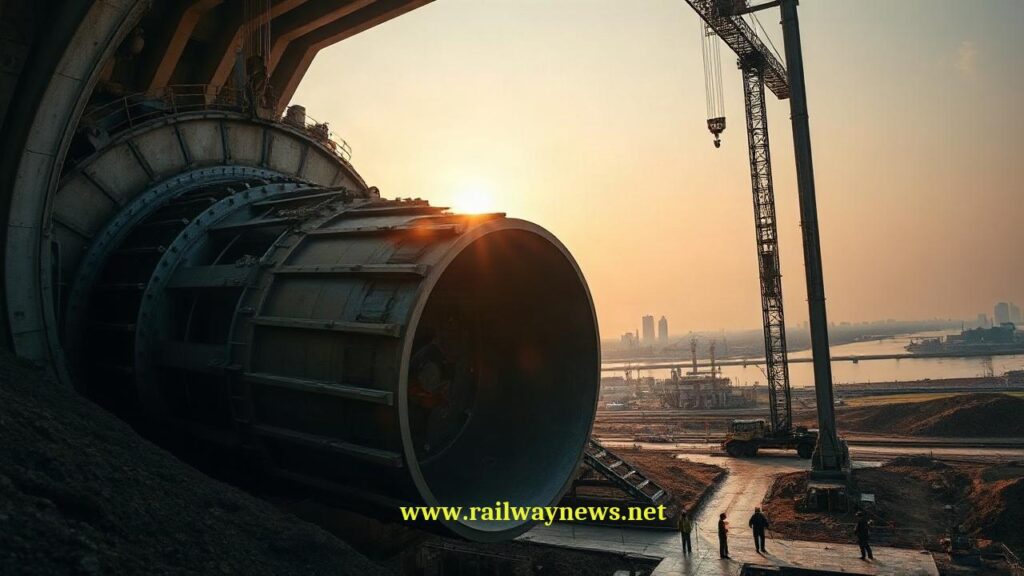
⚡ In Brief: China has completed the 11.3-kilometre underwater section of the Chongtai railway tunnel under the Yangtze River, a single-pass TBM drive that will let high-speed trains cross at 350 km/h in about two minutes.
SHANGHAI – China Railway Tunnel Group has completed the 11.3-kilometre underwater section of the Chongtai railway tunnel beneath the Yangtze River. The drive connects Chongming Island, which belongs to Shanghai, with Taicang in Jiangsu province and is scheduled to open with the wider corridor by the end of 2026. The bore was excavated in one continuous pass by ‘Linghang’, a tunnel-boring machine with a diameter of approximately 15 metres.
What Is the Full Scope of This Project?
The Chongtai Yangtze tunnel is one segment of a 2,000-kilometre Shanghai–Chongqing–Chengdu high-speed rail corridor carrying a total estimated investment of more than CNY 530 billion, equivalent to approximately EUR 67 billion. The underwater element alone is valued at over CNY 7.1 billion (around EUR 900 million) and will provide the first rail connection of any kind to Chongming Island, China’s third-largest island.
At its deepest point the tunnel runs 89 metres below the Yangtze riverbed, in a design that accounts for high water pressure and ground settlement risk. According to the official Xinhua news agency, the single continuous drive of 11.3 kilometres is the longest distance ever tunnelled in one stage by a TBM of roughly 15 metres in diameter. China Railway Tunnel Group states that trains will take approximately two minutes to cross the river at the tunnel’s 350 km/h design speed, which would make it the fastest underwater railway tunnel in the world once open. The date the TBM began its drive and the contract breakdown between machine manufacturing and civil works were not disclosed.
Key Project Data
| Parameter | Value |
|---|---|
| Project / Contract Name | Chongtai Railway Tunnel – Yangtze River crossing |
| Total Value | Over CNY 7.1 billion (~EUR 900 million) for the tunnel; over CNY 530 billion (~EUR 67 billion) for the full corridor |
| Parties Involved | China Railway Tunnel Group (state-owned tunnelling contractor) |
| Timeline / Completion | Underwater tunnelling complete; project scheduled for completion by end-2026 |
| Country / Corridor | China: Chongming Island (Shanghai) to Taicang (Jiangsu), on Shanghai–Chongqing–Chengdu high-speed line |
| TBM Diameter | Approximately 15 metres |
How Does This Compare to Similar Projects?
The Chongtai advance is a diameter-and-speed benchmark rather than a total-length record, and the most useful European comparison is the Brenner Base Tunnel, where construction passed major milestones in late 2025. At the Brenner Pass project led by Porr Bau, the twin 10.4-metre-diameter TBMs ‘Wilma’ and ‘Olga’ completed their drives in late August and early October 2025 respectively, while drill-and-blast works for the main tubes reached nearly three-quarters of the total volume (Source: Tunnels & Tunnelling International, 2025).
By contrast, the Linghang machine bored a single sub-river stage of 11.3 kilometres at depths of up to 89 metres below the seabed, and the finished tunnel is designed for a line speed of 350 km/h. The project also sits inside a national high-speed network that reached 50,000 kilometres in service by 2025, representing more than 70 per cent of the global high-speed total; market analysis for 2025 attributed 46 per cent of Asia-Pacific railway deployment to China (Source: Business Research Insights, 2025). Comparable cost-per-kilometre data for long underwater high-speed tunnels was not available at the time of publication.
Editor’s Analysis
The Chongtai crossing turns a major river barrier into a full-speed section of a 2,000-kilometre east–west corridor, which removes the need for trains to slow for the Yangtze and shortens journey times between Shanghai and the interior. The project’s strategic logic is explicitly industrial: the corridor links regions containing roughly a quarter of China’s advanced manufacturing centres and about 40 per cent of its strategic state-run laboratories (Source: China Railway Tunnel Group via Xinhua, 2025).
The tunnelling contractor’s claim that the method can be “replicated and scaled up” signals that Chinese underwater high-speed tunnelling is now being packaged as a repeatable export model, not a one-off engineering response. Watch for subsequent tenders along the Yangtze delta and coastal island links that adopt the same single-drive, large-diameter approach.
FAQ
Q: What world record does the Chongtai tunnel claim?
A: Xinhua reports that the 11.3-kilometre underwater section was excavated in a single stage by a TBM of roughly 15 metres in diameter, which it says is the longest distance ever achieved in one pass by a machine of that size. Once operational at 350 km/h, it will also be the world’s fastest underwater railway tunnel.
Q: When will high-speed trains begin running through the tunnel?
A: The full Chongtai project is scheduled for completion by the end of 2026. Chinese authorities have not yet confirmed the exact date of commercial service entry.
Q: Why is millimetre-level tunnelling precision required for a 350 km/h railway?
A: At 350 km/h, even minor deviations in the tunnel alignment affect ride comfort and running safety. Wang Yi, deputy project director at China Railway Tunnel Group, has stated that precision requirements for the tunnelling machine were set at millimetre level for this reason.

Railway infrastructure, rolling stock and transport technologies specialist focused on global rail industry developments, high-speed rail systems, signaling technologies and freight transportation. Covering railway investments, public transport modernization, rail operations and international mobility projects across Europe, Asia and North America.
RELATED POSTS

October 8, 2026 1:15 pm
Alstom secured a €1bn contract to build 13 automated trains,...

October 1, 2026 7:09 am
United States regulators confirmed a September 30 deadline for the...

October 8, 2026 12:18 pm
Siemens Mobility signed an agreement with VinSpeed to supply 350...

October 4, 2026 5:14 pm
Alstom secured a CA$4.7 billion order from VIA Rail Canada...

October 1, 2026 12:13 am
Illinois approved $1.5 billion annually for the Northern Illinois Transit...

October 5, 2026 6:12 pm
AECOM and Jacobs secured a contract in September 2026 to...