
KB Signaling Upgrades Fortescue ITCS in Pilbara Through 2027
KB Signaling upgrades Fortescue’s 620-km Pilbara ITCS railway through mid-2027 with new wayside hardware for dynamic routing and real-time monitoring.
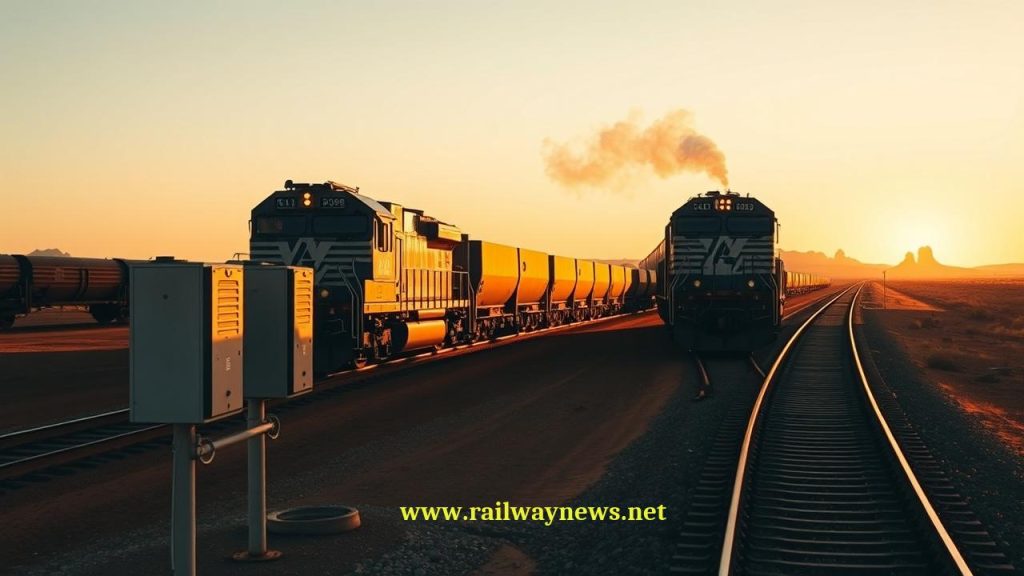
⚡ In Brief: KB Signaling Inc. is modernizing the Incremental Train Control System (ITCS) on Fortescue’s heavy-haul iron ore railroad in Western Australia through mid-2027, enabling dynamic route changes without train stoppages and adding real-time monitoring across hundreds of kilometers of remote desert track.
PERTH, AUSTRALIA – KB Signaling Inc. has begun a multiyear upgrade to the Incremental Train Control System (ITCS) governing train movements across the Fortescue heavy-haul iron ore network in Western Australia’s Pilbara region. The project, running through mid-2027, will modernize wayside service hardware on the company’s ElectroLogIXS platform. The upgrade enables Fortescue to modify routes and destinations without bringing ore trains to a halt — a capability the existing ITCS deployment, operational since the early 2010s, does not provide.
What Are the Technical Specifications?
The ITCS deployment on Fortescue’s network spans approximately 620 kilometers of track connecting multiple mine sites to the export terminal at Port Hedland. The system originally provided virtual block train separation using radio-based communication between locomotives and wayside interface units, managing speed enforcement and headway control for high-frequency iron ore movements. The current ElectroLogIXS upgrade replaces legacy wayside hardware with modernized units capable of dynamic route reconfiguration — eliminating the previous requirement to bring trains to a stop when destination or route changes are needed. Additionally, the new hardware introduces real-time remote monitoring capabilities across hundreds of kilometers of track that previously lacked continuous telemetry coverage. The communications backbone, track geometry, and existing ITCS safety logic architecture remain unchanged; only the wayside hardware layer is being modernized.
Note: KB Signaling did not disclose the total number of wayside units being replaced, the communications protocol used for the new monitoring capability, or the specific hardware specifications of the upgraded ElectroLogIXS platform at time of publication.
Key Technical Data
| Parameter | Value |
|---|---|
| Technology / System Name | ITCS upgrade on ElectroLogIXS platform (KB Signaling Inc.) |
| Total Value | Not disclosed |
| Parties Involved | KB Signaling Inc. (supplier); Fortescue Metals Group (operator) |
| Timeline / Completion | Underway; expected completion mid-2027 |
| Country / Corridor | Australia / Pilbara region, Western Australia (mine-to-port heavy-haul corridor) |
Where Does This Technology Stand in the Market?
Fortescue’s ITCS deployment represents one of only two operational heavy-haul railways in the Pilbara using radio-based virtual block signaling — the other being Rio Tinto’s fully autonomous AutoHaul system, developed with Hitachi Rail (formerly Ansaldo STS), which achieved full driverless operations in 2019 across approximately 1,700 km of track. AutoHaul operates at GoA4 (unattended train operation), whereas Fortescue’s ITCS currently supports driver-supervised movements with automated train protection — positioning it at GoA2 on the Grade of Automation scale. In North America, Wabtec’s Interoperable Electronic Train Management System (I-ETMS) dominates heavy-haul PTC deployments across Class I railroads, covering over 90,000 route-km of mixed-traffic freight corridors as of 2024. I-ETMS uses GPS-based location determination with wayside interface units communicating via 220 MHz radio spectrum, a fundamentally different architecture from ITCS’s virtual block approach. Globally, ETCS Level 3 — which also enables moving-block operations without fixed track circuits — has seen limited adoption in heavy-haul contexts, with most mining railways outside Australia still relying on conventional fixed-block signaling or ETCS Level 2 with lineside signals retained. (Source: Rio Tinto AutoHaul project data, 2019; Wabtec I-ETMS deployment statistics, 2024; UIC ETCS deployment atlas, 2023)
Editor’s Analysis
KB Signaling’s upgrade targets a specific operational bottleneck — the inability to change train destinations dynamically without stopping — that has direct throughput implications for Fortescue’s export supply chain. In a mining corridor where train cycle time directly determines annual export tonnage, eliminating stationery dwell for route reconfiguration yields measurable productivity gains. This project also signals Fortescue’s preference for incremental modernization of its existing ITCS architecture rather than a wholesale migration to a fully autonomous system like Rio Tinto’s AutoHaul. The broader Australian rail investment environment — including the Minns Government’s $12 billion train manufacturing commitment in New South Wales and the $15.4 billion River Torrens to Darlington project in South Australia — reflects sustained capital flows into both passenger and freight rail across the country, creating a competitive supplier ecosystem that benefits technology vendors like KB Signaling. The undisclosed evaluation of new KB Signaling technologies on Fortescue’s network warrants monitoring; any subsequent adoption of those technologies could reshape the competitive landscape for mining railway automation in the Pilbara.
FAQ
Q: What is the Incremental Train Control System (ITCS) and how does it differ from conventional signaling?
A: ITCS is a radio-based positive train control system that uses virtual blocks rather than physical track circuits or axle counters to manage train separation. Originally developed by GE Transportation for Amtrak’s Chicago–Detroit corridor in the 1990s, it was adapted for Fortescue’s heavy-haul operations in the early 2010s, enabling moving-block-like operation without fixed wayside signals across approximately 620 km of Pilbara track.
Q: What specific capability does the ElectroLogIXS upgrade add that the existing ITCS lacked?
A: The upgrade enables dynamic route and destination reconfiguration without requiring trains to stop — a limitation of the original wayside hardware. It also introduces real-time remote monitoring across hundreds of kilometers of desert track that previously lacked continuous telemetry, improving fault detection and maintenance response times.
Q: Which new technologies is KB Signaling deploying for evaluation on Fortescue’s network?
A: KB Signaling has not publicly named the specific technologies being evaluated. The company stated only that “several of its new technologies” will be deployed for assessment, with no further details on function, readiness level, or evaluation timeline disclosed at time of publication.

Railway infrastructure, rolling stock and transport technologies specialist focused on global rail industry developments, high-speed rail systems, signaling technologies and freight transportation. Covering railway investments, public transport modernization, rail operations and international mobility projects across Europe, Asia and North America.
RELATED POSTS

September 6, 2026 5:19 am
Hitachi delivered Taiwan's first N700ST high-speed train from Japan in...

September 5, 2026 4:19 pm
CPK launched formal tender talks with four consortia to design...

September 6, 2026 6:17 am
Hungary ordered a national ban on most freight trains from...

September 6, 2026 1:17 am
Hitachi Toshiba Supreme Consortium confirmed the first of 12 N700ST...

September 6, 2026 4:12 am
Alstom delivered the first of 100 new G Class trams...
September 7, 2026 8:16 am
Midea, Gree and TCL shipped air conditioners via China Railway...