
Stadler Secures 10-Train Hydrogen Order for Sardinia
Stadler secured an order for 10 hydrogen-powered narrow-gauge trains from ARST in Sardinia, with service in 2028 and annual CO2 reduction of over 2,100 tonnes.
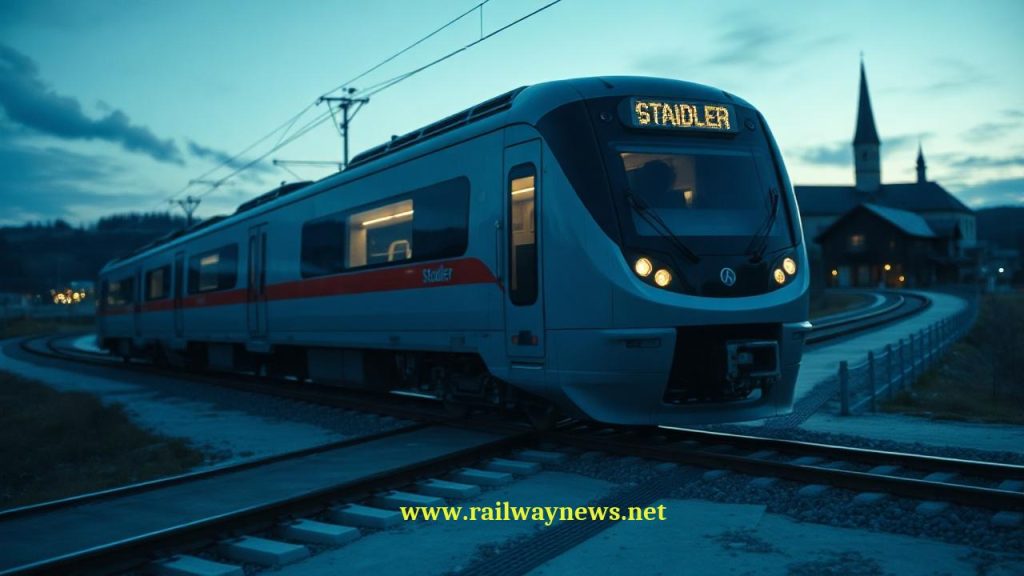
⚡ In Brief: Stadler and Sardinian operator ARST unveiled the world’s first hydrogen-powered train for narrow-gauge lines in Erlen, Switzerland, with 10 trains ordered to enter service in 2028, cutting over 2,100 metric tons of CO2 annually compared to diesel.
ERLEN, Switzerland – Stadler and Trasporti Regionali della Sardegna (ARST) unveiled the world’s first hydrogen-powered train designed specifically for narrow-gauge railways on 24 March 2026. The 10 trains ordered will enter service in 2028 on Sardinia’s narrow-gauge network, connecting Alghero Airport to Mamuntanas and linking Sassari, Alghero, and Sorso. Stadler states the fleet will eliminate more than 2,100 metric tons of CO2 per year versus diesel equivalents.
What Are the Technical Specifications?
The traction system uses hydrogen fuel cells integrated into a central Power Pack module that converts hydrogen into electrical energy to charge the train’s onboard batteries. The vehicles are engineered as lightweight units to meet the lower axle-load constraints of Italy’s narrow-gauge infrastructure, which imposes stricter weight limits than standard-gauge lines. Low-floor boarding, panoramic windows, a separate cab access door, and cab air conditioning are confirmed features. Stadler and ARST have not disclosed passenger capacity per train, range on a single hydrogen fill, maximum operating speed, fuel cell power output, or total contract value.
Key Technical Data
| Parameter | Value |
|---|---|
| Technology / System Name | Stadler narrow-gauge hydrogen fuel cell train (name not yet designated) |
| Total Value | Not disclosed |
| Parties Involved | Stadler (manufacturer), ARST (operator), Region of Sardinia, Italian Ministry of Transport |
| Timeline / Completion | 10 trains entering service in 2028; testing per ANSFISA requirements before entry |
| Country / Corridor | Italy — Sardinia narrow-gauge network (Alghero–Sassari–Sorso corridor) |
Where Does This Technology Stand in the Market?
Stadler is the only manufacturer worldwide producing hydrogen-powered trains for narrow-gauge lines. For standard-gauge applications, three competing platforms exist. Alstom’s Coradia iLint entered commercial service in Germany in 2018 and operates on regional lines in Lower Saxony and Hesse with a range of approximately 1,000 km per hydrogen fill (Source: Alstom, 2018). Siemens Mobility’s Mireo Plus H offers a comparable range of up to 1,000 km and has been ordered by multiple German operators for delivery from 2024 onward (Source: Siemens Mobility, 2022). Stadler’s own FLIRT H2 for standard-gauge lines set a Guinness World Record of 2,803 km on a single hydrogen tank in March 2024 and has been ordered by San Bernardino County Transportation Authority in California (Source: Stadler, 2024). The ARST narrow-gauge variant differs from all three in its lightweight construction for constrained axle loads and its integration into a fully solar-powered hydrogen production ecosystem — a zero-emission loop from generation to traction that none of the standard-gauge deployments currently replicate at commercial scale. Stadler is also building 2 hydrogen trains for Ferrovia Circumetnea in Sicily and 9 for Ferrovie della Calabria in Calabria, bringing the total Italian narrow-gauge hydrogen fleet to 21 units across three regions.
Note: Independent verification of the 2,100-metric-ton annual CO2 reduction figure was not available at time of publication. The figure originates from Stadler and ARST’s joint announcement and has not been validated by a third-party environmental auditor. Range, passenger capacity, and contract value were not disclosed.
Editor’s Analysis
The ARST order represents more than a fleet replacement — it signals an operator repositioning itself as an integrated energy utility. ARST chief executive Carlo Poledrini explicitly frames the transition as moving “from a transportation company to an energy company,” with hydrogen production facilities in Mandas, Alghero, and Macomer already under construction using 100% solar power. This vertically integrated model eliminates exposure to hydrogen supply-chain volatility that has slowed deployments elsewhere in Europe. The Italian government’s backing of hydrogen for southern Italy’s non-electrified lines also reflects a pragmatic concession that full overhead electrification of low-density narrow-gauge routes fails cost-benefit analysis — a calculus relevant to similar networks in Switzerland, where Stadler builds these trains at its Bussnang headquarters and where SBB continues expanding high-speed corridors while leaving secondary lines unelectrified (Source: Swiss Federal Railways, 2025).
FAQ
Q: When will Sardinia’s hydrogen trains enter passenger service?
A: The 10 trains are scheduled to enter service in 2028, following rigorous safety testing overseen by ANSFISA, Italy’s rail and highway safety agency. No phased delivery timeline has been confirmed.
Q: How is the hydrogen fuel produced for these trains?
A: Hydrogen will be produced using 100% solar energy at facilities currently under construction in Mandas, Alghero, and Macomer. This creates a closed zero-emission system from energy generation through to train operation.
Q: What routes will the hydrogen trains serve in Sardinia?
A: The trains will operate between Alghero Airport and the suburb of Mamuntanas, and on connections linking the province of Sassari, the city of Alghero, and the coastal town of Sorso. They are designed for ARST’s full narrow-gauge network.

Railway infrastructure, rolling stock and transport technologies specialist focused on global rail industry developments, high-speed rail systems, signaling technologies and freight transportation. Covering railway investments, public transport modernization, rail operations and international mobility projects across Europe, Asia and North America.
RELATED POSTS
September 6, 2026 5:19 am
Hitachi delivered Taiwan's first N700ST high-speed train from Japan in...
September 6, 2026 6:17 am
Hungary ordered a national ban on most freight trains from...
September 6, 2026 1:17 am
Hitachi Toshiba Supreme Consortium confirmed the first of 12 N700ST...

September 5, 2026 4:19 pm
CPK launched formal tender talks with four consortia to design...
September 7, 2026 8:16 am
Midea, Gree and TCL shipped air conditioners via China Railway...

September 5, 2026 7:14 pm
HS2 Ltd signed renegotiated civils contracts with EKFB and Align...