
BEML Confirms B28 High-Speed Train Prototype for Early 2027
BEML confirmed its first B28 high-speed train prototype for early 2027, targeting 280 km/h operation on India’s Surat–Vapi route by August 2027.
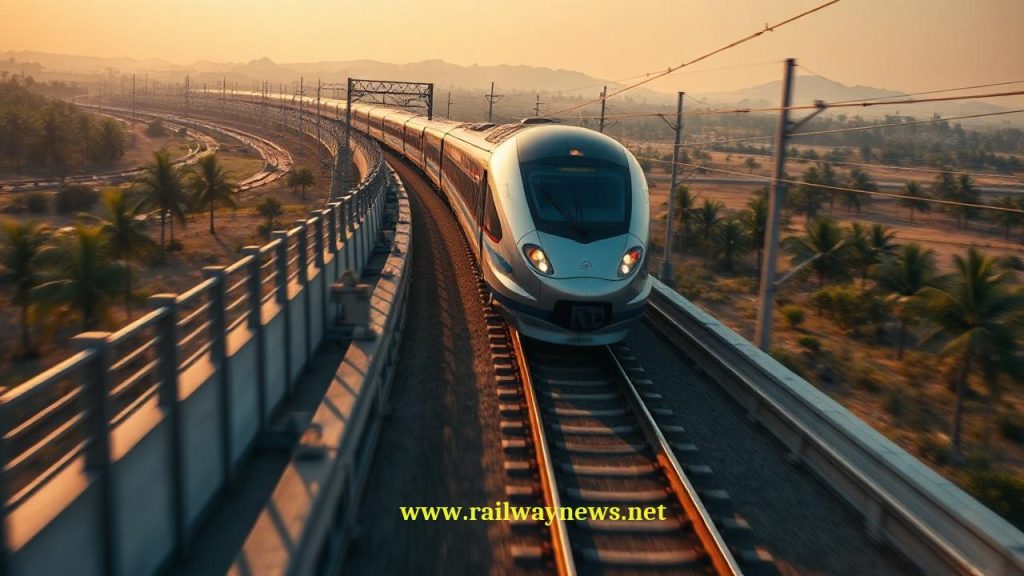
⚡ In Brief: BEML’s first B28 high-speed train prototype is expected by early 2027 at its Bengaluru plant, with commercial service on the 97 km Surat–Vapi section targeted for August 2027.
BENGALURU, INDIA – State-owned BEML is manufacturing India’s first locally developed high-speed train at its Aditya plant in Bengaluru, inaugurated on April 25, 2026, by Railways Minister Ashwini Vaishnaw. The first B28 prototype is expected by the beginning of calendar year 2027, followed by 4 to 6 months of testing before commercial operations commence in August 2027. The Ministry of Railways has set a formal manufacturing deadline of March 2027 for the train, which is designed for speeds of 280 km/h.
What Is the Full Scope of This Project?
The B28 train—named for “Bharat-made Bullet” at 280 km/h—is the first high-speed rolling stock designed and manufactured entirely in India, under a contract awarded to BEML by Integral Coach Factory (ICF) of Chennai in October 2024 for two initial trainsets. The trains will enter revenue service on the 97 km Surat–Vapi section of the 508 km Mumbai–Ahmedabad High-Speed Rail (MAHSR) corridor, which is being built to Japanese Shinkansen standards with a design speed of 350 km/h and an operational speed of 320 km/h. The full corridor traverses Maharashtra, Gujarat, and Dadra & Nagar Haveli, with 12 stations and approximately 90% of the route on elevated viaducts. A 21 km tunnel section in Maharashtra includes a 7 km undersea crossing beneath Thane Creek—India’s first underwater railway tunnel—using a tunnel boring machine with a 13.6-metre cutting head, the largest ever deployed on an Indian railway project. Three rolling stock depots are under construction at Sabarmati, Surat, and Thane.
Key Project Data
| Parameter | Value |
|---|---|
| Project / Contract Name | B28 High-Speed Train (Bharat-made Bullet) |
| Total Value | Not disclosed |
| Parties Involved | BEML, Integral Coach Factory (ICF), National High-Speed Rail Corporation Ltd (NHSRCL), Ministry of Railways |
| Timeline / Completion | Prototype: early 2027; Testing: 4–6 months; Commercial launch: August 2027 |
| Country / Corridor | India / Mumbai–Ahmedabad High-Speed Rail Corridor (MAHSR), 508 km |
How Does This Compare to Similar Projects?
The B28 programme places India in a small group of countries with domestic high-speed train manufacturing capability. Japan’s N700S Shinkansen—the technological basis for the MAHSR corridor’s infrastructure—required approximately 24 months from prototype unveiling to commercial service entry in 2020 (Source: JR Central, 2020). China’s Fuxing CR400 series followed a similar 22–26 month development-to-deployment cycle (Source: CRRC, 2017). BEML’s compressed 4–6 month testing window, if achieved, would be notably shorter than these benchmarks. In parallel regional infrastructure development, the UAE passenger rail network is executing a phased rollout beginning 30 June 2026 on the Abu Dhabi–Fujairah route, with Dubai, Al Dhaid, and Sharjah stations activating sequentially through March 2027—a timeline that overlaps with B28 testing (Source: Etihad Rail, 2025). Both projects reflect accelerating rail infrastructure investment across the Indian Ocean region, though India faces a distinct workforce challenge: a growing shortage of skilled construction professionals with practical site experience and digital construction skills is flagged as a risk to productivity across the country’s infrastructure portfolio (Source: Outlook India, 2025). The Indian government’s planned sale of up to a 2% stake in Indian Railway Finance Corporation (IRFC) to meet a ₹800 billion divestment target for fiscal year 2027 signals that multiple funding mechanisms are being activated to sustain this capital expenditure trajectory (Source: Reuters, 2026).
Editor’s Analysis
India’s decision to compress the B28 testing cycle to 4–6 months reflects an operational priority to demonstrate domestic manufacturing capability ahead of the August 2027 service deadline, but it also concentrates execution risk on a single prototype and a single corridor segment. The MAHSR project’s combination of Japanese infrastructure standards with Indian rolling stock creates a hybrid technical environment that has no direct precedent—the corridor’s J-Slab ballastless track, 2×25 kV traction system, and 28-seismometer early earthquake detection array are all Shinkansen-derived, while the B28 train is an indigenous design. If the seven-corridor, 4,000 km high-speed network announced in the 2026–2027 budget proceeds, the domestic industrial ecosystem being built around MAHSR will face sustained demand, but the skilled workforce gap identified across India’s construction sector could become a binding constraint on timeline adherence across multiple concurrent corridors.
FAQ
Q: Is Tata Motors involved in manufacturing the B28 high-speed train?
A: No. The contract for India’s first locally developed high-speed train was awarded to BEML by Integral Coach Factory in October 2024. No credible sourcing links Tata Motors to the B28 programme.
Q: What is the expected travel time reduction when the full Mumbai–Ahmedabad corridor opens?
A: The journey between Mumbai and Ahmedabad is projected to take approximately 1 hour and 58 minutes, compared to 8–9 hours by road and roughly 4–5 hours by air including airport procedures.
Q: How many high-speed trains has BEML been contracted to build initially?
A: The October 2024 contract from ICF covers the design, manufacture, and commissioning of two high-speed trains. Additional orders have not been publicly confirmed.

Railway infrastructure, rolling stock and transport technologies specialist focused on global rail industry developments, high-speed rail systems, signaling technologies and freight transportation. Covering railway investments, public transport modernization, rail operations and international mobility projects across Europe, Asia and North America.
RELATED POSTS
September 6, 2026 5:19 am
Hitachi delivered Taiwan's first N700ST high-speed train from Japan in...
September 6, 2026 6:17 am
Hungary ordered a national ban on most freight trains from...
September 6, 2026 1:17 am
Hitachi Toshiba Supreme Consortium confirmed the first of 12 N700ST...

September 5, 2026 4:19 pm
CPK launched formal tender talks with four consortia to design...
September 7, 2026 8:16 am
Midea, Gree and TCL shipped air conditioners via China Railway...

September 6, 2026 4:12 am
Alstom delivered the first of 100 new G Class trams...