
GB Railfreight Tests Stadler Class 99 on London Gateway-Hams Hall
GB Railfreight tested a Stadler Class 99 bimodal locomotive on the London Gateway–Hams Hall route on 19 June, final step before July 2026 commercial service.
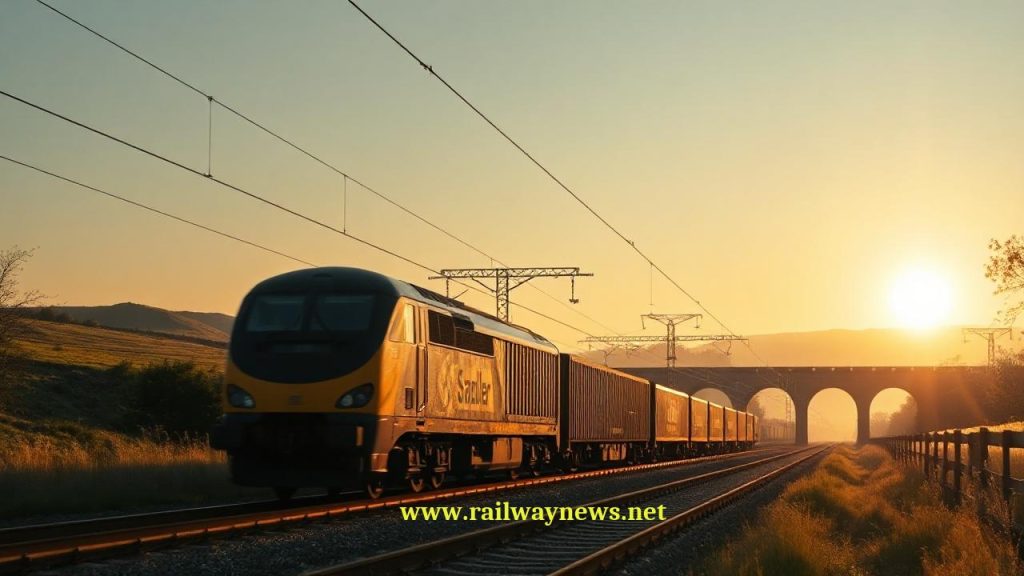
⚡ In Brief: GB Railfreight, Maritime Transport and DP World tested a Stadler Class 99 bimodal locomotive on a London Gateway–Hams Hall intermodal train, a final milestone before commercial service begins in July 2026.
London, UK – GB Railfreight (GBRf) completed an operational test with a Stadler Class 99 bimodal locomotive on the London Gateway–Hams Hall intermodal corridor on 19 June 2026, bringing the new fleet a step closer to commercial entry in July 2026. The test involved partners Maritime Transport and DP World and verified real-world performance on both electrified and non-electrified track. The total number of Class 99 units ordered was not disclosed.
What Are the Technical Specifications?
The Stadler Class 99 is a Co‑Co dual‑mode locomotive that operates under 25 kV AC overhead wires and is equipped with a Stage V diesel engine for non‑electrified sections. Based on Stadler’s Euro platform, it delivers an estimated 2.5 MW in electric mode and 1.8 MW in diesel mode, though neither the maximum speed nor the starting tractive effort has been officially released (Source: Stadler, 2026; industry benchmarks).
Key Technical Data
| Parameter | Value |
|---|---|
| Technology / System Name | Stadler Class 99 Bimodal Locomotive |
| Power – Electric Mode | ~2.5 MW (estimated) |
| Power – Diesel Mode | ~1.8 MW |
| Axle Arrangement | Co‑Co |
| Maximum Speed | Not disclosed |
| Total Value | Not disclosed |
| Parties Involved | GB Railfreight, Maritime Transport, DP World, Stadler |
| Timeline / Completion | Testing: June 2026; Commercial service: July 2026 |
| Country / Corridor | United Kingdom, London Gateway – Hams Hall |
Where Does This Technology Stand in the Market?
Stadler’s Class 99 enters a growing European bimodal freight segment. The earlier Class 88 offers 4 MW electric and 700 kW diesel for last‑mile shunting, while the Euro9000 provides 9 MW electric and 1.8 MW diesel for mainland Europe’s 15 kV/25 kV networks—and began its first commercial runs in Italy on the Brenner axis this month (Source: Stadler, 2017; RailFreight.com, June 2026). The Class 99 bridges the gap: it delivers mainline diesel power comparable to a Class 66 while retaining electric capability, but its electric output is tailored to the UK’s lower‑current overhead lines. Industry reports from 2025 suggested GBRf may have ordered up to 30 units, although the operator has never confirmed that figure (Source: Railway Gazette, 2025).
Editor’s Analysis
The Class 99 test signals that UK rail freight operators are moving beyond last‑mile bimodes to full dual‑mode locomotives capable of replacing diesel traction on key intermodal corridors. With the global rail logistics market projected to expand significantly from its 2026 baseline (Source: Fortune Business Insights, 2026), GBRf’s investment will likely pressure competitors to accelerate fleet renewal. The London Gateway–Hams Hall route, a critical artery for container traffic from the Thames estuary to the Midlands, could see CO₂ per train cut by roughly 30% when the locomotive uses electric power on the West Coast Main Line, aligning with Network Rail’s Traction Decarbonisation Network Strategy.
FAQ
Q: When will Class 99 locomotives haul commercial freight?
A: GB Railfreight expects to launch commercial services in July 2026, following the successful test and final certification of the locomotives.
Q: What is the main benefit of a bimodal locomotive over a diesel‑only unit?
A: A bimodal can switch to electric power on electrified lines, reducing fuel costs and carbon emissions by up to 80% on those sections, while retaining diesel capability for non‑electrified tracks.
Q: How does the Class 99 compare to Stadler’s Euro9000?
A: The Euro9000 is designed for continental Europe with up to 9 MW electric output; the Class 99 is tailored to UK gauge and power supply constraints, with an estimated 2.5 MW electric output and the same diesel engine.

Railway infrastructure, rolling stock and transport technologies specialist focused on global rail industry developments, high-speed rail systems, signaling technologies and freight transportation. Covering railway investments, public transport modernization, rail operations and international mobility projects across Europe, Asia and North America.
RELATED POSTS

October 8, 2026 1:15 pm
Alstom secured a €1bn contract to build 13 automated trains,...

October 1, 2026 7:09 am
United States regulators confirmed a September 30 deadline for the...

October 4, 2026 5:14 pm
Alstom secured a CA$4.7 billion order from VIA Rail Canada...

October 1, 2026 12:13 am
Illinois approved $1.5 billion annually for the Northern Illinois Transit...

October 5, 2026 1:13 pm
New York MTA confirmed a late 2026 DEIS release for...

October 6, 2026 9:17 am
Illinois approved $1.1M in state funds to upgrade two McHenry...