
voestalpine Wins Rail Baltica Turnout Contract in Lithuania
voestalpine Railway Systems signed centralized agreements to supply turnouts for the 870-km Rail Baltica corridor, with first deliveries from its Lithuanian plant in autumn 2025.
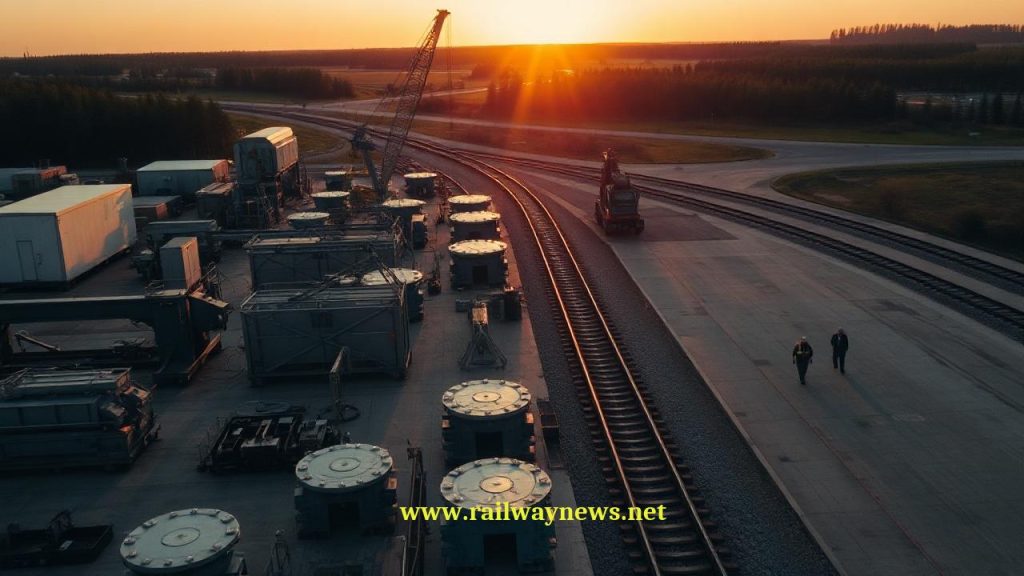
⚡ In Brief: Rail Baltica implementers signed centralized framework agreements with voestalpine Railway Systems for turnout production at the Valčiūnai, Lithuania facility, with first deliveries scheduled for autumn 2025.
VALČIŪNAI, LITHUANIA – Rail Baltica’s national implementers from Estonia, Latvia, and Lithuania, together with RB Rail AS, signed framework agreements for the centralized supply of high-speed and standard turnouts at a symbolic production launch held at voestalpine Railway Systems’ Valčiūnai facility. The event, attended by Lithuania’s Deputy Minister of Transport and Communications Roderikas Žiobakas and LTG Group interim CEO Arūnas Rumskas, marks the first time turnout manufacturing for the 870-kilometre European-gauge corridor will occur within one of the three Baltic states. First deliveries are scheduled for autumn 2025, targeting installation on the Jonava section—the most advanced segment of the Lithuanian alignment.
What Does This Contract Cover?
The framework agreements cover centralized design, manufacturing, and supply of high-speed and standard turnouts, along with associated components required for long-term infrastructure operation across the entire Rail Baltica corridor. Turnouts—the mechanical systems that allow trains to switch between tracks and access stations, terminals, and depots—represent one of the most technically demanding elements of high-speed rail construction, requiring precision engineering to meet safety and reliability standards at speeds exceeding 200 km/h. Under the centralized procurement model, a single technical solution will govern turnout specifications across all three Baltic states, ensuring interoperability between infrastructure, signalling, and control-command subsystems. The agreements are structured with provisions tied to phased implementation requirements and the availability of national and EU funding tranches.
Key Contract Data
| Parameter | Value |
|---|---|
| Contract Name | Rail Baltica Centralized Turnouts Framework Agreement |
| Total Value | Not disclosed |
| Parties Involved | RB Rail AS, Rail Baltic Estonia, LTG Group (Lithuania), Latvian implementer, voestalpine Railway Systems |
| Timeline / Completion | First deliveries: autumn 2025; full delivery tied to phased funding availability |
| Country / Corridor | Estonia–Latvia–Lithuania (Rail Baltica, 870 km European-gauge corridor) |
How Does This Compare to Similar Contracts?
Centralized turnout procurement for a multi-country high-speed corridor places Rail Baltica in company with Europe’s largest cross-border rail programmes. The Brenner Base Tunnel project, connecting Austria and Italy, adopted a comparable unified procurement strategy for track superstructure components, with voestalpine supplying turnouts designed for 250 km/h operation through the 64-kilometre tunnel system (Source: BBT SE, 2023). On a per-kilometre basis, high-speed turnout contracts typically range between €150,000 and €400,000 per unit depending on speed rating and complexity, though Rail Baltica’s total turnout quantity and unit pricing were not disclosed. Separately, the broader European high-speed rail supply chain continues to attract investment: Forsee Power and Wabtec announced a collaboration in mid-2025 to integrate advanced battery systems into locomotive platforms, signalling that Tier 1 suppliers are positioning for multi-modal electrification demand alongside fixed-infrastructure contracts like Rail Baltica’s turnout programme (Source: Forsee Power / Wabtec, June 2025). Global high-speed rail funding trends for 2025 show sustained capital deployment across Asia and Europe, with Germany recording all-time-high battery production figures that support the electrification ecosystem underpinning modern rail corridors (Source: German Battery Lobby / Reuters, 2025).
Editor’s Analysis
Localising turnout production at Valčiūnai signals a calculated shift in Rail Baltica’s procurement strategy—prioritising regional manufacturing capacity over imports from voestalpine’s Austrian or German plants. This aligns with the broader EU military mobility and dual-use infrastructure logic that has gained urgency since 2022, where supply chain sovereignty for strategic transport corridors is no longer treated as optional. The Jonava section, set to receive the first turnouts this autumn, will function as a de facto reference installation; its performance data will likely influence the final technical specifications for the remaining 80% of the corridor still in design or early works phases. However, the absence of disclosed contract value and turnout quantities makes independent cost-per-unit benchmarking impossible at this stage—a transparency gap that contrasts with comparable EU-funded programmes like the Lyon–Turin base tunnel, which published detailed trackwork contract values at award stage (Source: TELT, 2024).
FAQ
Q: When will the first Rail Baltica turnouts be installed on the main line?
A: First deliveries from the Valčiūnai facility are scheduled for autumn 2025, with installation prioritised on the Jonava section in Lithuania—the corridor’s most advanced construction segment.
Q: What is the total value of the framework agreements with voestalpine Railway Systems?
A: The total contract value has not been publicly disclosed. The agreements are structured with phased delivery provisions tied to the availability of national and EU funding.
Q: Which countries will receive turnouts manufactured under this centralized procurement model?
A: All three Baltic states—Estonia, Latvia, and Lithuania—will receive turnouts supplied through the centralized framework, ensuring a unified technical specification across the entire 870-kilometre Rail Baltica corridor.

Adem Kaya is a railway news editor focused on global rail operations, infrastructure developments and freight transportation trends across international railway markets.His coverage includes railway investments, rolling stock projects, metro and urban transit systems, freight rail operations and next-generation transportation infrastructure. With a strong interest in operational efficiency and railway modernization, he follows industry developments from Europe, Asia-Pacific and North America.Through RailwayNews, Adem Kaya contributes industry-focused reporting and accessible analysis designed for railway professionals, transport stakeholders and rail enthusiasts worldwide.
RELATED POSTS

October 8, 2026 1:15 pm
Alstom secured a €1bn contract to build 13 automated trains,...

October 1, 2026 7:09 am
United States regulators confirmed a September 30 deadline for the...

October 8, 2026 12:18 pm
Siemens Mobility signed an agreement with VinSpeed to supply 350...

October 4, 2026 5:14 pm
Alstom secured a CA$4.7 billion order from VIA Rail Canada...

October 5, 2026 6:12 pm
AECOM and Jacobs secured a contract in September 2026 to...

October 1, 2026 12:13 am
Illinois approved $1.5 billion annually for the Northern Illinois Transit...