
Stadler Euro9000 Tests Brenner and Domodossola Corridors
ELP and RTC launched Italian validation trials of Stadler Euro9000 locomotives with 190 kW diesel module on the Brenner and Domodossola corridors in June 2025.
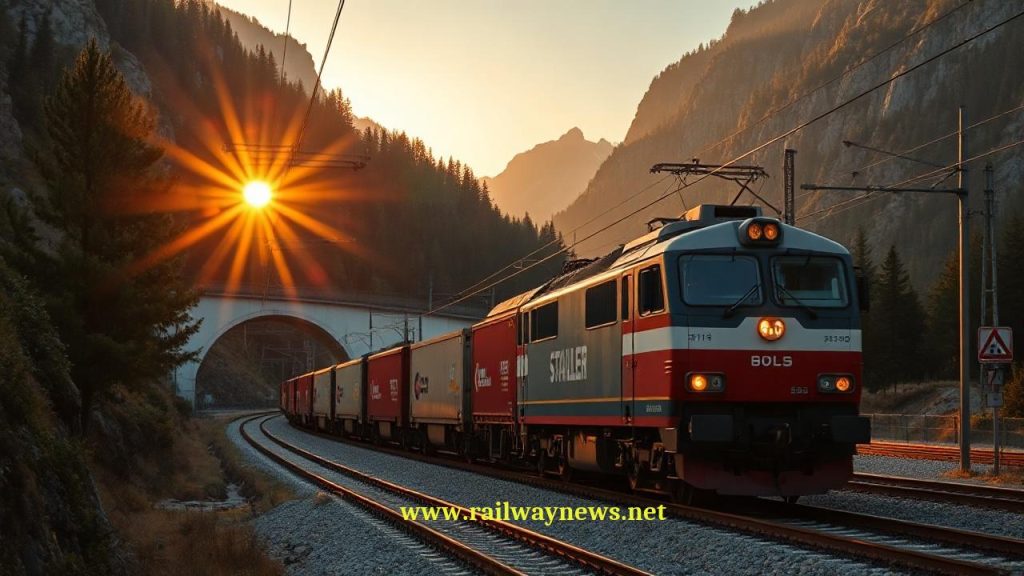
⚡ In Brief: European Loc Pool and Rail Traction Company launched Italian tests for the Stadler Euro9000 multi-system locomotive on the Brenner and Domodossola corridors following national approval.
BOLZANO, ITALY – European Loc Pool (ELP) and operator Rail Traction Company (RTC) have commenced the first in-service validation trials of the Stadler-manufactured Euro9000 locomotive in Italy. The six-axle, multi-system electric locomotive received official Italian approval prior to the tests, which began in June 2025. The trials cover the Brenner corridor linking Germany, Austria, and Italy, plus the Domodossola route between Switzerland and Italy, targeting real-world freight performance metrics.
What Are the Technical Specifications?
The Euro9000 locomotive combines electric multi-system capability across four European voltages—25 kV AC, 15 kV AC, 3 kV DC, and 1.5 kV DC—with a supplementary 190 kW diesel power module for first- and last-mile operations. Under 3 kV DC infrastructure typical of Italian conventional lines, the locomotive delivers full tractive effort without voltage limiations, while the diesel mode provides operational flexibility on non-electrified sidings and industrial spurs. The unit is equipped with ETCS Baseline 3 for cross-border interoperability.
Key Technical Data
| Parameter | Value |
|---|---|
| Technology / System Name | Stadler Euro9000 multi-system locomotive |
| Total Value | Not disclosed |
| Parties Involved | European Loc Pool (owner), Rail Traction Company (operator), Stadler (manufacturer) |
| Timeline / Completion | Testing commenced June 2025; completion date not officially disclosed |
| Country / Corridor | Brenner corridor (DE-AT-IT) and Domodossola route (CH-IT) |
Where Does This Technology Stand in the Market?
The Euro9000 enters a competitive multi-system locomotive segment. Siemens’ Vectron MS, with approximately 2,200 units sold across Europe as of 2024, offers 6.4 MW maximum power and covers the same four voltage systems but lacks a diesel last-mile module as standard equipment. Alstom’s Traxx Universal delivers 5.6 MW with an optional 180 kW diesel shunting module—10 kW less than the Euro9000’s auxiliary output. In the Italian corridor market specifically, the Euro9000’s 3 kV DC performance and integrated diesel capability are designed to eliminate locomotive changes at border stations, a persistent bottleneck on the Brenner axis where traffic is projected to reach 40 million tons by 2030, according to the Brenner Corridor Platform. (Source: Siemens Mobility, 2024; Alstom, 2023; Brenner Corridor Platform, 2024)
Editor’s Analysis
Martin Ausserdorfer’s statement that locomotives must “run seamlessly across all networks” reflects operator frustration with traction changes that add 60–90 minutes to Brenner transit times. The Euro9000 trials in Italy close a regulatory gap that previously forced operators to swap locomotives at the Italian border regardless of multi-voltage capability. U.S. rail freight data from May 2025 showed broad-based growth across consumer goods and intermodal sectors, signaling resilient demand that historically correlates with European rail freight volumes in subsequent quarters. (Source: AAR, June 2025)
FAQ
Q: Which European countries can the Euro9000 operate in without locomotive changes?
A: The Euro9000 is approved for Germany, Austria, Switzerland, Italy, Belgium, Netherlands, and Luxembourg, covering the four main European railway electrification standards.
Q: What is the diesel power module used for during operations?
A: The 190 kW diesel module provides traction on non-electrified terminal tracks and industrial sidings, eliminating the need for separate shunting locomotives during first- and last-mile movements.
Q: When will the Euro9000 tests conclude and commercial operations begin in Italy?
A: No formal test conclusion date or commercial launch date has been officially disclosed by European Loc Pool or Rail Traction Company.

Railway infrastructure, rolling stock and transport technologies specialist focused on global rail industry developments, high-speed rail systems, signaling technologies and freight transportation. Covering railway investments, public transport modernization, rail operations and international mobility projects across Europe, Asia and North America.
RELATED POSTS

October 8, 2026 1:15 pm
Alstom secured a €1bn contract to build 13 automated trains,...

October 1, 2026 7:09 am
United States regulators confirmed a September 30 deadline for the...

October 8, 2026 12:18 pm
Siemens Mobility signed an agreement with VinSpeed to supply 350...

October 4, 2026 5:14 pm
Alstom secured a CA$4.7 billion order from VIA Rail Canada...

October 5, 2026 6:12 pm
AECOM and Jacobs secured a contract in September 2026 to...

October 1, 2026 12:13 am
Illinois approved $1.5 billion annually for the Northern Illinois Transit...