
Georgia Ports Authority Expands $5 Billion Port Savannah
Georgia Ports Authority invests $5 billion into Port Savannah, constructing five berths to accommodate 54% traffic growth.
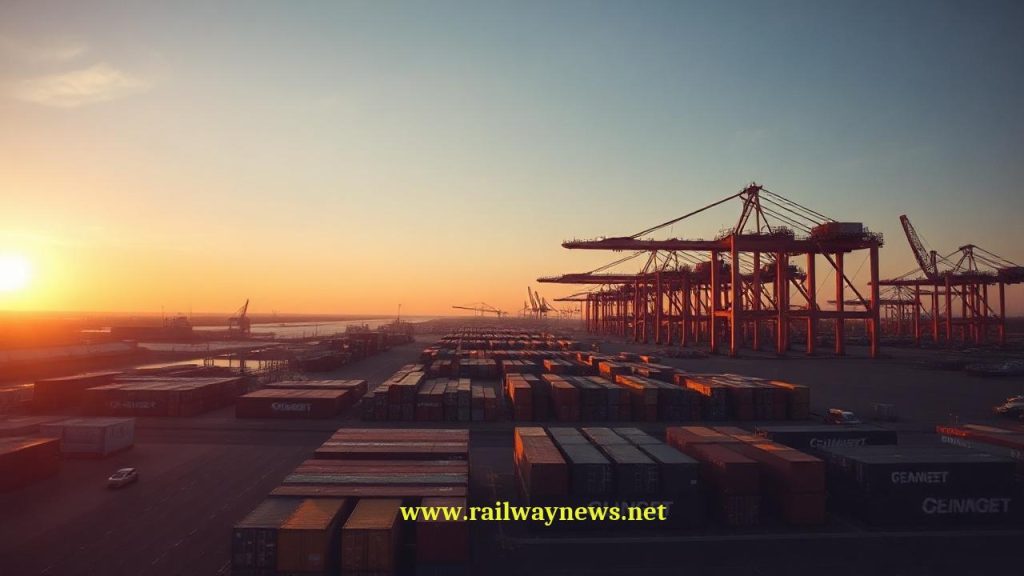
⚡ In Brief: The Georgia Ports Authority is executing a $5 billion infrastructure expansion at the Port of Savannah to construct five new container berths and handle a projected 54% traffic increase over the next decade.
SAVANNAH, UNITED STATES – The Georgia Ports Authority announced in May 2026 that the Port of Savannah handled 4.7 million twenty-foot equivalent units during the first ten months of fiscal year 2026. This throughput represents a 2.5% decrease compared to the same period in fiscal year 2025, driven by a softer global market. To accommodate long-term growth, the authority is moving forward with a $5 billion capital investment plan.
What Is the Full Scope of This Project?
The $5 billion capital improvement plan expands maritime and intermodal capacity across the Georgia Ports Authority network through terminal expansions and harbor modifications. In addition to adding five new container berths at the Garden City Terminal in Savannah, the initiative allocates $100 million for a new roll-on/roll-off berth at the Port of Brunswick. The plan also funds upgraded outdoor storage for vehicles, harbor dredging, and channel modifications to accommodate larger neo-Panamax vessels. However, the specific funding allocation for direct rail yard expansions at the Mason Mega Rail Terminal was not disclosed.
Key Project Data
| Parameter | Value |
|---|---|
| Project / Contract Name | Georgia Ports Authority Capital Investment Plan |
| Total Value | $5 billion USD |
| Parties Involved | Georgia Ports Authority, Port of Savannah, Port of Brunswick |
| Timeline / Completion | 10-year forecast period (Specific completion date not disclosed) |
| Country / Corridor | United States / East Coast Corridor |
How Does This Compare to Similar Projects?
The $5 billion investment in Georgia’s port infrastructure represents one of the largest East Coast port expansions, positioning Savannah to compete directly with the Port Authority of New York and New Jersey’s $11 billion 10-year capital plan (Source: PANYNJ, 2024). While New York focuses heavily on channel deepening and air-draft clearance, Savannah’s strategy centers on expanding berth capacity and Class I rail integration. Nationally, this expansion coincides with the U.S. Department of Transportation’s new National Freight Strategic Plan, which aims to resolve landside bottlenecks by improving rail-to-port connections (Source: U.S. DOT, 2026). Furthermore, the 2.5% volume decline in Savannah aligns with a broader cooling in North American intermodal transport, where April intermodal volumes fell just short of projected annual growth targets (Source: IANA, 2026).
Editor’s Analysis
The temporary dip in Savannah’s container volume reflects a broader normalization of supply chains following the tariff-induced front-loading of 2025. By maintaining its $5 billion investment cycle during a market lull, the Georgia Ports Authority is positioning itself to capture a larger share of Class I rail intermodal traffic once industrial production rebounds. This counter-cyclical investment strategy aligns with projections that U.S. intermodal volumes will sustain a 1.25% annual growth trajectory through 2026 (Source: IANA, 2026).
FAQ
Q: What caused the volume decrease at the Port of Savannah in April 2026?
A: The Port of Savannah experienced a 14% drop in cargo volume in April 2026 compared to the historic highs of April 2025. This decrease was primarily due to the normalization of shipping patterns after importers heavily front-loaded cargo in 2025 to avoid anticipated federal tariffs.
Q: How much is being invested in the Port of Brunswick’s infrastructure?
A: The Georgia Ports Authority is investing $100 million specifically for a new roll-on/roll-off berth at the Port of Brunswick. This funding is part of a larger effort to improve outdoor vehicle storage and perform harbor dredging to support larger transport vessels.
Q: How will these port investments impact the regional rail freight network?
A: The expansion of container berths will generate higher container volumes that feed directly into the CSX and Norfolk Southern rail networks. This increased volume will support the projected 1.25% annual growth in U.S. intermodal freight traffic through 2026.

Railway infrastructure, rolling stock and transport technologies specialist focused on global rail industry developments, high-speed rail systems, signaling technologies and freight transportation. Covering railway investments, public transport modernization, rail operations and international mobility projects across Europe, Asia and North America.
RELATED POSTS

October 1, 2026 7:09 am
United States regulators confirmed a September 30 deadline for the...

October 1, 2026 12:13 am
Illinois approved $1.5 billion annually for the Northern Illinois Transit...

October 1, 2026 5:14 am
Siemens confirmed delivery of the first new S200 train to...

October 1, 2026 6:10 am
Amtrak approved a System Expansion Committee on July 30 to...

October 1, 2026 4:10 am
DART launched two public ridership dashboards in March 2026 to...

October 1, 2026 3:12 am
Greenbrier confirmed Brian Comstock as new president and CEO effective...