
Hafeet Rail Reports 40% Completion Oman-UAE Freight Corridor
Hafeet Rail announced 40% completion of the 238-kilometer joint Oman-UAE railway project, having moved 27 million cubic meters of earthworks connecting Sohar to Al Ain.
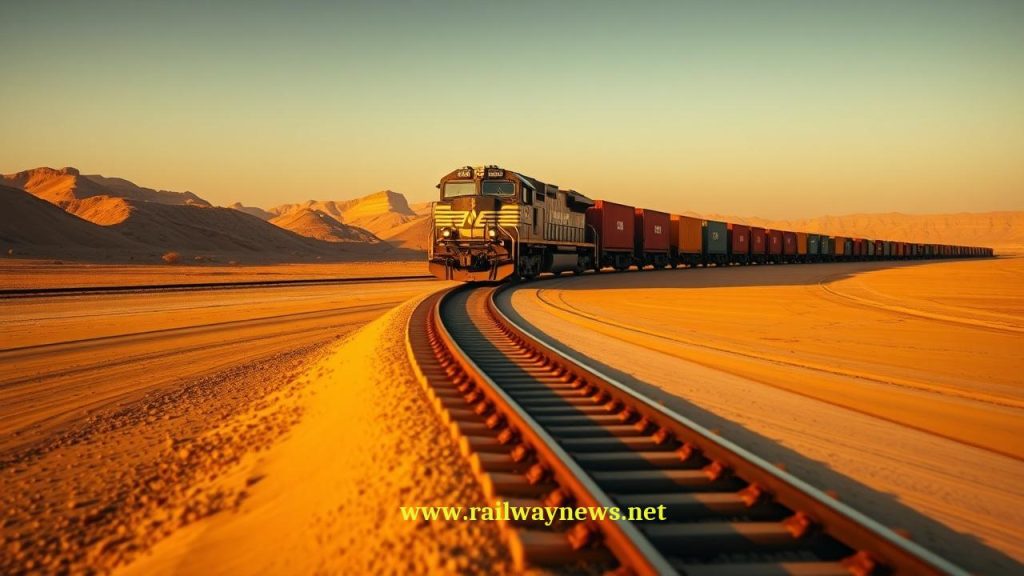
⚡ In Brief: Hafeet Rail announced that the 238-kilometer joint Oman-UAE railway project is 40% complete, having moved over 27 million cubic meters of earthworks to establish a new freight and logistics corridor connecting Sohar to Al Ain and beyond.
ABU DHABI, UAE – The Oman-UAE rail link, a joint infrastructure project, has reached 40% completion, according to project company Hafeet Rail. The 238-kilometer line is designed primarily for freight traffic, connecting key industrial areas and ports, with provisions for future passenger services. Construction has involved over 100,000 cubic meters of concrete work across the route.
What Is the Full Scope of This Project?
The project entails the construction of a 238-kilometer railway corridor connecting the port of Sohar in Oman to the UAE’s national rail network at Al Ain. The scope includes significant engineering works, such as tunnels and bridges to navigate mountainous terrain, alongside integrated flood protection systems. To date, construction has required over 27 million cubic meters of earthworks, with key facilities being developed in Sohar and Al Buraimi to link ports and industrial zones. The line will be equipped with advanced signaling, control, and communication systems compliant with international standards to ensure interoperability between the Omani and UAE networks.
Key Project Data
| Parameter | Value |
|---|---|
| Project / Contract Name | Hafeet Rail (Oman-UAE Railway Network) |
| Total Value | Not disclosed |
| Parties Involved | Hafeet Rail (Etihad Rail, Oman Rail, Mubadala Investment) |
| Timeline / Completion | Not disclosed |
| Country / Corridor | Oman / United Arab Emirates |
How Does This Compare to Similar Projects?
The Hafeet Rail project represents a significant and tangible segment of the long-proposed, wider GCC Railway network, which aims to connect all six Gulf states. While the full 2,177-kilometer GCC network has faced extensive delays since its 2009 approval, the Oman-UAE link is one of the first major cross-border components to show substantial construction progress. Unlike the high-speed Haramain railway in Saudi Arabia, which is focused exclusively on passenger traffic, Hafeet Rail prioritizes a freight-first model to support industrial and logistics development. Direct cost-per-kilometer comparisons with other regional projects are not possible, as the total project value for Hafeet Rail has not been made public.
Editor’s Analysis
The advancement of the Hafeet Rail link aligns with a broader strategic pivot by the UAE to diversify its economy beyond fossil fuels, a move underscored by its planned departure from OPEC in 2026 (Source: Interlochen Public Radio). By creating a new, efficient logistics corridor, the project directly addresses the growing trend of modal shift from road to rail, driven by rising fuel costs and supply chain vulnerabilities (Source: Sourcing Journal). This corridor also gains strategic importance as disruptions to traditional East-West routes, such as the Russian rail network, force a re-evaluation of global logistics pathways (Source: Inbound Logistics).
FAQ
Q: What is the main purpose of the Oman-UAE railway?
A: The primary objective is to create an efficient freight corridor to connect ports, industrial zones, and logistics hubs between Oman and the UAE. The infrastructure is also being designed to accommodate future passenger rail services.
Q: When will the Hafeet Rail project be finished?
A: An official completion date has not been disclosed by Hafeet Rail or its partners. The project was announced as 40% complete in mid-2024.
Q: Will this line connect to other countries in the future?
A: The line is a key part of the larger GCC Railway network vision, which aims to connect all six member states. This project’s interoperable systems are designed to facilitate integration with future cross-border rail extensions.

Railway infrastructure, rolling stock and transport technologies specialist focused on global rail industry developments, high-speed rail systems, signaling technologies and freight transportation. Covering railway investments, public transport modernization, rail operations and international mobility projects across Europe, Asia and North America.
RELATED POSTS
September 6, 2026 5:19 am
Hitachi delivered Taiwan's first N700ST high-speed train from Japan in...

September 5, 2026 4:19 pm
CPK launched formal tender talks with four consortia to design...

September 6, 2026 4:12 am
Alstom delivered the first of 100 new G Class trams...

September 5, 2026 7:14 pm
HS2 Ltd signed renegotiated civils contracts with EKFB and Align...
September 6, 2026 6:17 am
Hungary ordered a national ban on most freight trains from...
September 6, 2026 1:17 am
Hitachi Toshiba Supreme Consortium confirmed the first of 12 N700ST...