
Hitachi Rail Launches BV700 Validator with EMV Support in France
Hitachi Rail launched its modular BV700 validator in France, with EMV and QR code support, following 50,000 BV600 sales.
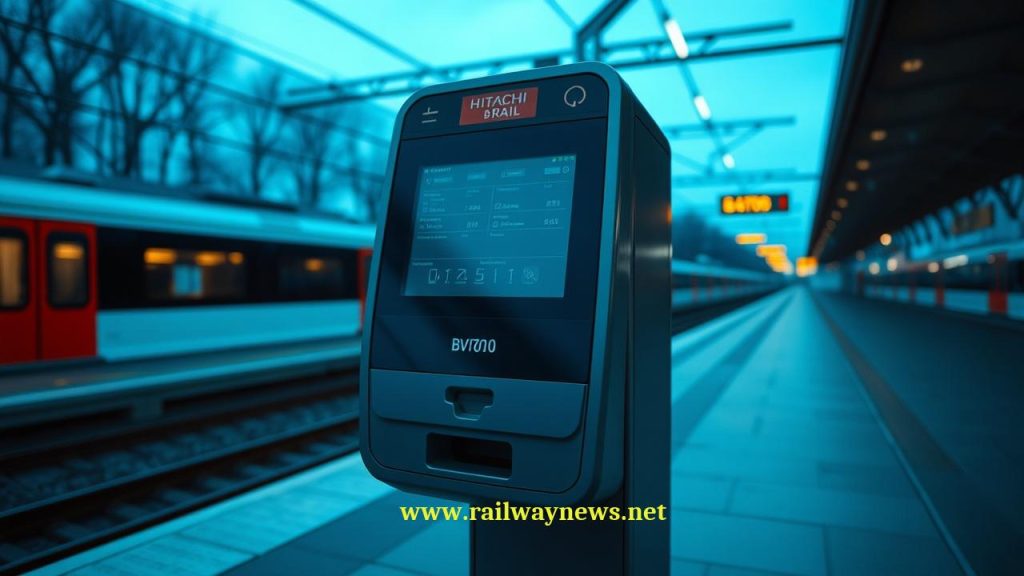
⚡ In Brief: Hitachi Rail has launched its new BV700 validator in France, featuring enhanced modularity and support for EMV and QR codes, building on the success of its predecessor which sold over 50,000 units globally.
PARIS, FRANCE – Hitachi Rail has introduced its new BV700 digital ticket validator, designed and manufactured in France. The system, which succeeds the BV600 model that has sold over 50,000 units in 10 countries, supports open-loop payments and will be publicly unveiled at Transport Ticketing Global in London on 17-18 March.
What Are the Technical Specifications?
The BV700 validator is designed for multimodal and multi-operator networks, integrating with Hitachi’s TRANSCITY platform. It is available with either a five-inch or seven-inch touchscreen and features a modular construction to improve maintainability and reduce servicing downtime. The system supports a wide range of fare media, including contactless EMV cards and QR codes, and is configured to support emerging technologies like ultra-wideband (UWB) hands-free ticketing and facial recognition.
Key Technical Data
| Parameter | Value |
|---|---|
| Technology / System Name | Hitachi Rail BV700 Validator |
| Total Value | Not disclosed |
| Parties Involved | Hitachi Rail |
| Timeline / Completion | Public launch at Transport Ticketing Global, 17-18 March |
| Country / Corridor | Designed and manufactured in France; for global deployment |
Where Does This Technology Stand in the Market?
The Hitachi BV700 enters a competitive market for automated fare collection hardware. Its features, such as EMV open-loop and QR code support, align it with major competitors like the Cubic Reader from Cubic Transportation Systems, a core component of large-scale systems in London and New York. While Hitachi highlights future UWB support, Conduent’s VPE 430 validator already offers a comparable suite of EMV, NFC, and QR code capabilities and is deployed across various US and European transit agencies. Hitachi’s primary differentiator is its emphasis on a modular, eco-design architecture aimed at reducing long-term operator maintenance costs and simplifying upgrades. (Source: Cubic Transportation Systems, 2024; Conduent, 2024).
Editor’s Analysis
The launch of the BV700 signals Hitachi’s intent to capture a larger share of the “Mobility as a Service” (MaaS) infrastructure market by focusing on future-proofing and operational efficiency. While open-loop payment is now a standard expectation, the built-in support for UWB and a modular design could appeal to operators planning long-term fleet upgrades. This product’s French origin positions it well to benefit from a wider trend of rail technology investment in Europe, where the signalling market alone is projected to grow at a CAGR of 4.54%. (Source: Market Data Forecast, 2024).
FAQ
Q: What is the main difference between the BV700 and the older BV600?
A: The primary differences are the BV700’s enhanced modular design for easier maintenance, larger touchscreen options (5″ and 7″), and built-in support for future technologies like UWB hands-free ticketing and facial recognition.
Q: Has a price for the new BV700 validator been announced?
A: No, Hitachi Rail has not disclosed the unit cost or any contract values associated with the new BV700 validator. Pricing is typically determined by the scale and specifics of an operator’s deployment.
Q: Which transport networks will be the first to use the BV700?
A: The initial operators and deployment locations for the BV700 have not been officially confirmed by Hitachi Rail. Its predecessor, the BV600, was deployed in 10 countries, suggesting a global target market.

Railway infrastructure, rolling stock and transport technologies specialist focused on global rail industry developments, high-speed rail systems, signaling technologies and freight transportation. Covering railway investments, public transport modernization, rail operations and international mobility projects across Europe, Asia and North America.
RELATED POSTS

October 8, 2026 1:15 pm
Alstom secured a €1bn contract to build 13 automated trains,...

October 1, 2026 7:09 am
United States regulators confirmed a September 30 deadline for the...

October 8, 2026 12:18 pm
Siemens Mobility signed an agreement with VinSpeed to supply 350...

October 4, 2026 5:14 pm
Alstom secured a CA$4.7 billion order from VIA Rail Canada...

October 5, 2026 6:12 pm
AECOM and Jacobs secured a contract in September 2026 to...

October 1, 2026 12:13 am
Illinois approved $1.5 billion annually for the Northern Illinois Transit...