
ContiTech Wins Award for 15x Stiffness Hydraulic Wheelset Bushes
ContiTech launched Hydraulic Wheelset Guiding Bushes in 2024, passively adjusting stiffness by 15x for enhanced railway vehicle stability.
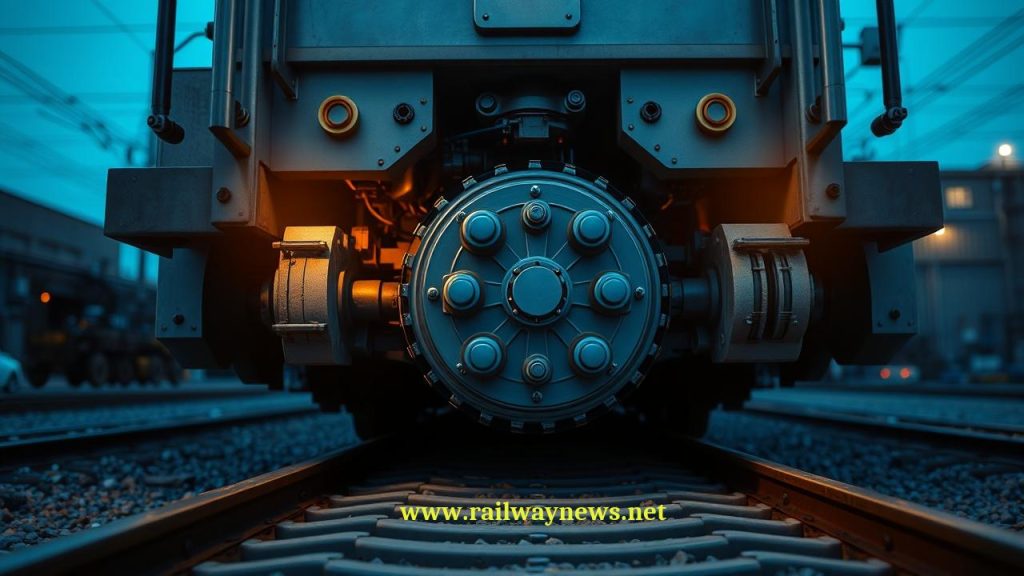
⚡ In Brief: Continental’s ContiTech division has been recognized for its new Hydraulic Wheelset Guiding Bushes, which passively adjust longitudinal stiffness by a factor of up to 15 to enhance high-speed stability and reduce wheel wear on railway vehicles.
FRANKFURT, GERMANY – Continental’s ContiTech group sector has won the Product Launches award in the 2025 Railway Technology Excellence Awards for a new generation of Hydraulic Wheelset Guiding Bushes. Launched in 2024, the component provides up to 15 times higher dynamic longitudinal stiffness compared to its quasi-static state, improving both high-speed performance and curve agility. The design aims to reduce wheel-rail wear and extend maintenance intervals for new and existing rolling stock fleets.
What Are the Technical Specifications?
The core technology is a passive hydraulic system that adapts longitudinal stiffness based on excitation frequency, eliminating the need for active controls or bogie modifications. At high frequencies, characteristic of straight-line running, the bush provides high stiffness for stability. At low frequencies, found in curves and switches, it exhibits lower stiffness for better track guidance. The component integrates vacuum-filled hydraulic chambers, laser-welded seals, and a proprietary hydraulic fluid with a fluorescent additive for leak detection, ensuring consistent performance and simplified inspection.
Key Technical Data
| Parameter | Value |
|---|---|
| Technology / System Name | Hydraulic Wheelset Guiding Bushes |
| Total Value | Not disclosed |
| Parties Involved | Continental (ContiTech group sector) |
| Timeline / Completion | Unveiled and launched in 2024 |
| Country / Corridor | Global Market |
Where Does This Technology Stand in the Market?
Comparable public data for recent supply contracts specifically for hydraulic suspension bushings was not available at the time of publication. ContiTech’s innovation enters a market for primary suspension components dominated by established players like Vibracoustic and Trelleborg, which offer a wide range of conventional rubber-metal and hydraulic solutions. The key differentiator for ContiTech’s product is the high ratio (up to 15:1) of dynamic-to-static stiffness achieved in a purely passive, non-controlled component. In contrast, competitors like Vibracoustic offer solutions such as V-shaped springs and hydro-mounts that also manage multi-axial forces but typically without this specific advertised range of passive stiffness differentiation. More advanced, complex solutions from suppliers like ZF Group may involve semi-active or active damping systems, which require power and control units, making them less suitable for simple retrofits on existing fleets. ContiTech’s design targets the gap between standard elastomeric parts and fully active systems, offering enhanced performance without the associated system complexity and cost.
Editor’s Analysis
ContiTech’s development addresses a fundamental compromise in bogie design: the conflict between stability at speed and flexibility in curves. By offering a passive, retrofit-ready solution, the company provides a direct pathway for operators to upgrade existing fleets, reduce long-term operational costs from wheel and rail wear, and improve passenger comfort. This focus on life-cycle cost reduction is particularly relevant for large-scale infrastructure investments, such as the California High-Speed Rail project, where minimizing long-term track and vehicle maintenance is critical to financial sustainability. (Source: Newsweek, 2024). The technology’s success will depend on demonstrating quantifiable wear reduction and reliability in diverse operational environments to justify the upgrade from conventional bushings.
FAQ
Q: What is the main benefit of this new bushing?
A: The primary benefit is its ability to automatically change its stiffness based on the train’s movement, providing high stiffness for stability on straight tracks and low stiffness for flexibility in curves. This dual function, achieved without external power, reduces wear on both wheels and rails.
Q: How does this technology reduce maintenance costs?
A: By enabling the wheelset to follow the track more flexibly in curves, the bushing reduces friction and impact forces, leading to significantly less wear on wheel profiles and railheads. This extends the time between wheel reprofiling and rail grinding, lowering material and labor costs over the vehicle’s life.
Q: Can these bushings be fitted to older trains?
A: Yes, the product is designed to be a retrofit solution. Its external dimensions and bolt geometry can be matched to conventional bushings, allowing installation into existing bogies during routine maintenance or overhauls without requiring structural modifications.

Railway infrastructure, rolling stock and transport technologies specialist focused on global rail industry developments, high-speed rail systems, signaling technologies and freight transportation. Covering railway investments, public transport modernization, rail operations and international mobility projects across Europe, Asia and North America.
RELATED POSTS
September 6, 2026 5:19 am
Hitachi delivered Taiwan's first N700ST high-speed train from Japan in...

September 5, 2026 4:19 pm
CPK launched formal tender talks with four consortia to design...

September 5, 2026 7:14 pm
HS2 Ltd signed renegotiated civils contracts with EKFB and Align...
September 6, 2026 6:17 am
Hungary ordered a national ban on most freight trains from...
September 6, 2026 4:12 am
Alstom delivered the first of 100 new G Class trams...
September 6, 2026 1:17 am
Hitachi Toshiba Supreme Consortium confirmed the first of 12 N700ST...