
LNER Reports Snake Misidentified as Rail Defect on ECML
LNER confirmed that its AI system misidentified a snake as a rail defect on 9 July 2026 on the East Coast Main Line, causing no disruption.
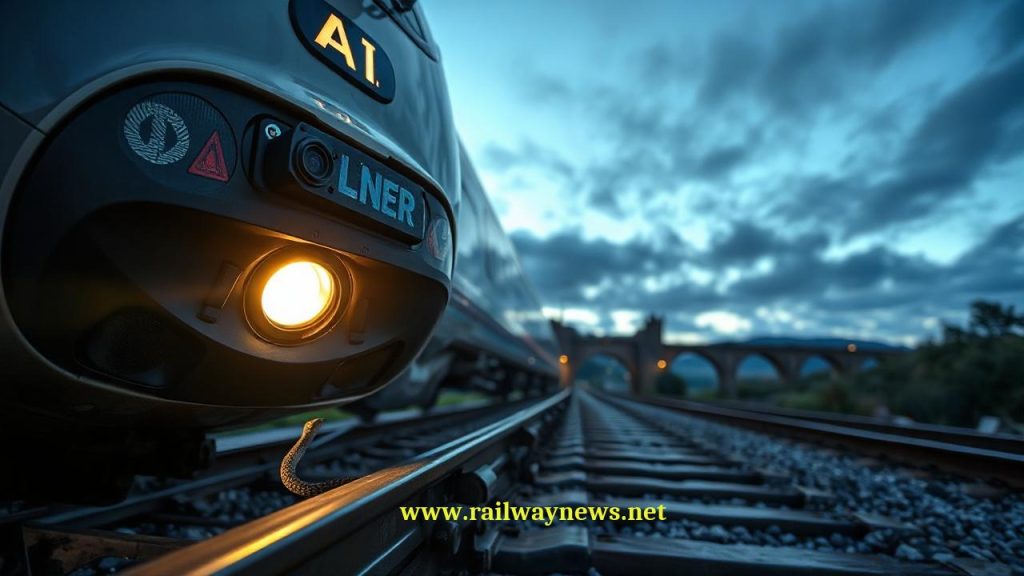
⚡ In Brief: LNER’s AI-powered track inspection system falsely flagged a snake on the East Coast Main Line as a rail defect on 9 July 2026, causing zero service disruption.
LONDON, UK – London North Eastern Railway (LNER) confirmed that its artificial intelligence-based infrastructure monitoring system misidentified a snake crossing the tracks as a potential rail defect on 9 July 2026. The false positive was captured by onboard cameras and reported to Network Rail, but no delays or cancellations occurred.
What Are the Technical Specifications?
LNER deploys two principal systems: the Pantograph Damage Assessment System (Pandas), which evaluates pantograph and overhead line condition, and the Automated Intelligent Video Review (AIVR), an AI-driven video analytics platform that scans live footage for track and lineside anomalies. Specific image-recognition accuracy metrics, false-positive thresholds, and model retraining intervals were not publicly disclosed by the operator.
Key Technical Data
| Parameter | Value |
|---|---|
| Technology / System Name | Automated Intelligent Video Review (AIVR) / Pandas |
| Total Value | Not disclosed |
| Parties Involved | LNER (operator), Network Rail (infrastructure manager) |
| Timeline / Completion | Deployed gradually; specific rollout completion not disclosed |
| Country / Corridor | United Kingdom, East Coast Main Line |
Where Does This Technology Stand in the Market?
LNER’s AIVR relies on conventional forward-facing CCTV processed by computer vision algorithms—a software-only approach that reduces hardware costs compared to dedicated wayside sensor arrays. Competing systems such as Wabtec’s Track IQ use acoustic and vibration sensors fixed at the trackside to detect wheel and rail defects, while Siemens’ Railigent platform aggregates data from multiple onboard and infrastructure sensors, including temperature and acceleration (Sources: Wabtec, 2023; Siemens Mobility, 2022). Both are generally less prone to classifying non-rail objects as defects, yet they require significant trackside installation. AIVR’s camera-based method can be retrofitted to existing rolling stock with minimal capital outlay, though it may encounter more false positives from wildlife, debris, or shadows—as the snake incident demonstrated. No comparative false-positive rate between these systems was publicly available at time of publication.
Editor’s Analysis
The misclassification, while operationally trivial, exposes a fundamental tension in automated infrastructure monitoring: the balance between sensitivity that catches early-stage faults and specificity that avoids unnecessary alarms. LNER’s own data illustrates both sides—the AIVR system detected a minor defect near Retford shortly after a major disruption in Cambridgeshire in January 2026, which had caused over 10,000 minutes of delays and a full day of cancellations. That same month, the UK’s HS2 programme underwent a £153 million management reset designed to improve cost control on a project now valued at £46.8 billion (Source: UK Department for Transport, 2025). Together, the two figures show an industry simultaneously tackling multibillion-pound megaprojects and lean digital tools; the latter can prevent repeat of the over £100 million economic hit from major track failures even if they occasionally mistake a snake for a crack.
FAQ
Q: Did the snake actually pose any risk to trains or passengers?
A: No. The reptile was simply crossing the tracks and did not cause any operational impact. The system flagged it as a potential defect, but no action was required.
Q: What is the difference between LNER’s AIVR and traditional track inspection methods?
A: AIVR uses existing onboard cameras and AI to automatically highlight anomalies in real time, whereas traditional methods rely on periodic manual inspections or dedicated measurement trains. AIVR checks the track every time a train runs, but specific accuracy figures were not released.
Q: Has similar AI misidentification happened on other UK railways?
A: LNER has not confirmed any other wildlife-related false positives. Comparable false alerts are common in early-stage machine vision systems across industries, but no cross-operator dataset was publicly available at time of writing.

Railway infrastructure, rolling stock and transport technologies specialist focused on global rail industry developments, high-speed rail systems, signaling technologies and freight transportation. Covering railway investments, public transport modernization, rail operations and international mobility projects across Europe, Asia and North America.
RELATED POSTS

October 8, 2026 1:15 pm
Alstom secured a €1bn contract to build 13 automated trains,...

October 1, 2026 7:09 am
United States regulators confirmed a September 30 deadline for the...

October 8, 2026 12:18 pm
Siemens Mobility signed an agreement with VinSpeed to supply 350...

October 4, 2026 5:14 pm
Alstom secured a CA$4.7 billion order from VIA Rail Canada...

October 5, 2026 6:12 pm
AECOM and Jacobs secured a contract in September 2026 to...

October 1, 2026 12:13 am
Illinois approved $1.5 billion annually for the Northern Illinois Transit...