
Network Rail Completes £4 Million Inverclyde Line Upgrade
Network Rail completed a £4 million infrastructure upgrade on Scotland’s Inverclyde line, strengthening bridges and structures in February 2026.
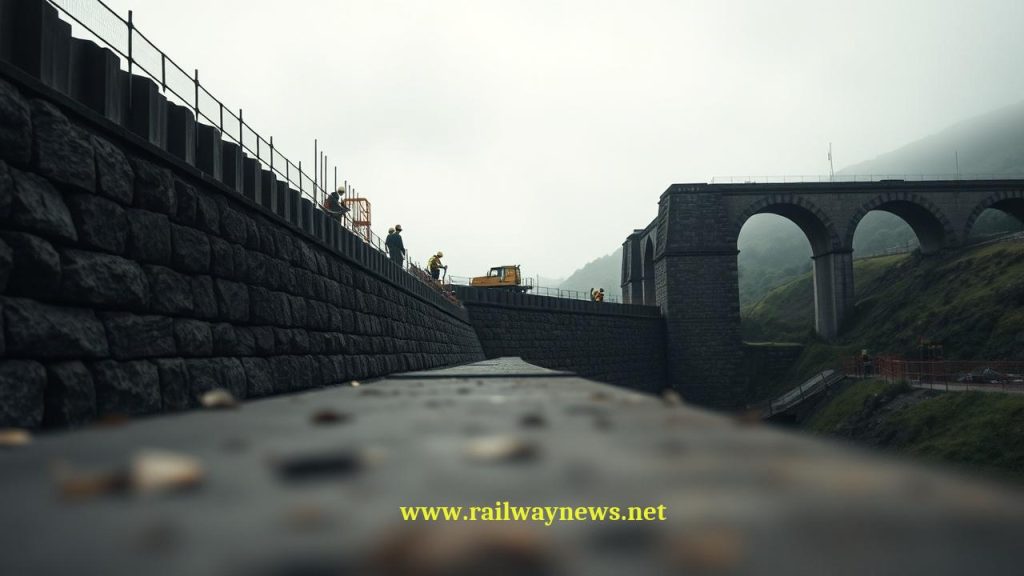
⚡ In Brief: Network Rail has completed a £4 million infrastructure upgrade on Scotland’s Inverclyde line, strengthening bridges and supporting structures over an eight-day programme to improve long-term resilience and reliability for passengers.
GLASGOW, UK – Network Rail has concluded a £4 million infrastructure enhancement project on the Inverclyde line in western Scotland. The work, completed over two consecutive weekends in February 2026, involved structural repairs to bridges, retaining walls, and a station platform. Key locations included Greenock, Georgetown, and Langbank.
What Is the Full Scope of This Project?
The project involved multiple sites along the Inverclyde line to enhance operational resilience and structural integrity. At Greenock, retaining walls supporting the railway were reinforced with new concrete elements, while the River Gryffe Bridge received a new main deck and additional steel repairs. Further steelwork repairs were conducted at Houston Road in Georgetown and Station Road in Langbank, where part of the station platform was also replaced. The specific engineering contractors for these works were not disclosed in the announcement.
Key Project Data
| Parameter | Value |
|---|---|
| Project / Contract Name | Inverclyde Line Infrastructure Upgrades |
| Total Value | £4 million |
| Parties Involved | Network Rail, ScotRail |
| Timeline / Completion | February 2026 (completed over 8 days) |
| Country / Corridor | United Kingdom / Inverclyde Line, Scotland |
How Does This Compare to Similar Projects?
This £4 million project represents a targeted, routine maintenance investment rather than a major capital expenditure. For scale, it is a small component of the wider national investment strategy; the UK’s updated Infrastructure Pipeline details £718 billion of planned public and private investment across all sectors (Source: edie.net, 2026). The Inverclyde work aligns with a continuous strategy of maintaining existing assets, a theme also seen in the complex restoration of historic structures like the Menai Strait bridge in Wales, which balances modern engineering with heritage preservation requirements (Source: CNN, 2026).
Editor’s Analysis
This project exemplifies the essential asset management required to maintain the UK’s rail network, even as the industry prepares for the structural transition to Great British Railways (GBR). Such resilience schemes are fundamental to the operational side of the network, which must continue uninterrupted while the GBR enabling legislation, introduced in late 2025, progresses. The investment is a minor fraction of the national infrastructure spend but is vital for ensuring service reliability and safety on a key regional Scottish route.
FAQ
Q: What specific locations were upgraded on the Inverclyde line?
A: The upgrades focused on several key locations, including Greenock for retaining wall repairs and the River Gryffe Bridge for a deck replacement. Steelwork was also strengthened at Houston Road in Georgetown and beneath the bridge at Station Road, Langbank.
Q: How does this £4 million project fit into the UK’s national rail strategy?
A: This project is part of Network Rail’s ongoing asset maintenance programme, which runs parallel to larger strategic initiatives. It ensures the existing network remains safe during the transition to the new Great British Railways (GBR) body, which is expected to become operational in late 2026 or early 2027.
Q: Were passengers affected by the engineering works?
A: Yes, the works were conducted over two consecutive weekends, which typically requires line closures and the use of replacement bus services. Both Network Rail and ScotRail acknowledged customer patience, indicating planned service disruptions were in place to allow the engineering to proceed.

Railway infrastructure, rolling stock and transport technologies specialist focused on global rail industry developments, high-speed rail systems, signaling technologies and freight transportation. Covering railway investments, public transport modernization, rail operations and international mobility projects across Europe, Asia and North America.
RELATED POSTS
September 6, 2026 5:19 am
Hitachi delivered Taiwan's first N700ST high-speed train from Japan in...

September 5, 2026 4:19 pm
CPK launched formal tender talks with four consortia to design...

September 5, 2026 7:14 pm
HS2 Ltd signed renegotiated civils contracts with EKFB and Align...
September 6, 2026 6:17 am
Hungary ordered a national ban on most freight trains from...
September 6, 2026 1:17 am
Hitachi Toshiba Supreme Consortium confirmed the first of 12 N700ST...
September 6, 2026 8:17 am
DB InfraGO reopened the Nuremberg-Regensburg line in Bavaria on 31...