
US Congress Acts: Tank Car Safety Bill Targets Derailments
New U.S. bill targets tank car safety! The Under Pressure Act mandates a study on pressure-relief device failures, aiming to prevent fiery derailment explosions and enhance rail safety.
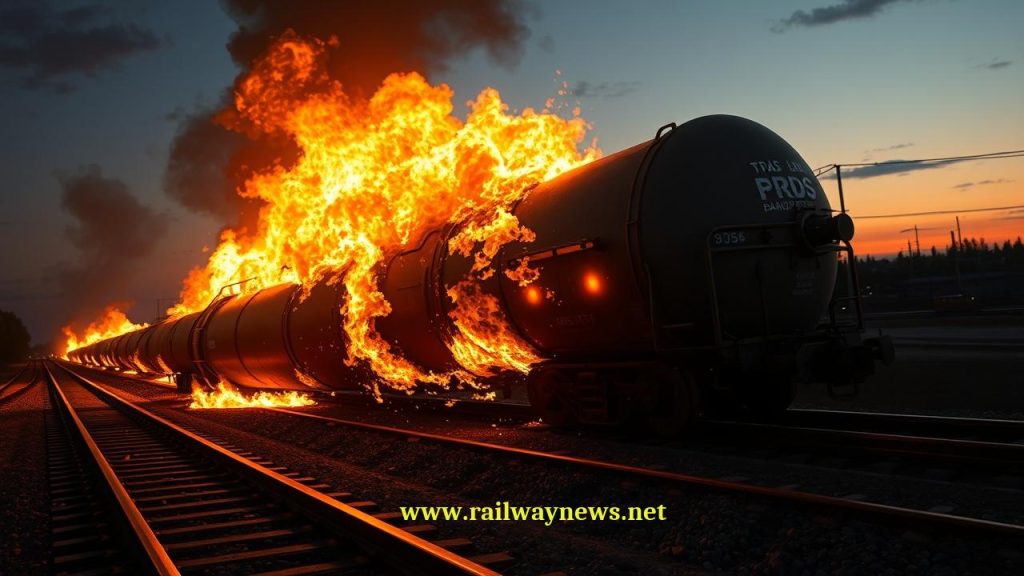
WASHINGTON D.C. – A bipartisan bill has been introduced in the U.S. Congress to mandate a federal study into the performance of tank car pressure-relief devices (PRDs) during fiery derailments, a critical safety issue gaining prominence. The proposed Under Pressure Act of 2026, sponsored by Reps. Chris Deluzio (D-Pa.) and Michael Rulli (R-Ohio), directs the Federal Railroad Administration (FRA) to deliver a detailed report with specific technical and cost parameters for the required research.
| Category | Details |
|---|---|
| Bill Name | Under Pressure Act of 2026 |
| Sponsors | Rep. Chris Deluzio (D-Pa.), Rep. Michael Rulli (R-Ohio) |
| Mandated Agency | Federal Railroad Administration (FRA) |
| Core Requirement | Study the rate and causes of tank car pressure-relief device failures in derailments. |
| Study Specifications | The FRA must provide Congress with the technical details, specifications, date, and cost for the study. |
Main Body:
In a joint announcement yesterday, Representatives Chris Deluzio and Michael Rulli formally introduced the Under Pressure Act of 2026, aiming to enhance the safety standards for transporting hazardous materials by rail. The legislation specifically targets the effectiveness of pressure-relief devices, which are designed to prevent catastrophic explosions when tank cars are exposed to fire. According to the lawmakers’ press release, the bill would compel the Federal Railroad Administration to report to Congress on the failure rates and underlying causes of these critical components during derailment scenarios. “We need better and more updated rules to keep communities and rail workers safe while the trains move freight across the country,” stated Rep. Deluzio.
Diving into the technical mandate, the bill goes beyond a simple request for data. It explicitly requires the FRA to outline a detailed framework for the study itself, including the technical specifications, timeline, and projected costs. This provision ensures a concrete and actionable research plan rather than a high-level summary. The study will focus on why PRDs, which are vital for venting pressure and averting Boiling Liquid Expanding Vapor Explosions (BLEVEs), may fail under the extreme thermal and mechanical stresses of a derailment fire. Additionally, the bill demands that the FRA’s final report include recommendations to prevent such failures and provide an update on the status of related, outstanding National Transportation Safety Board (NTSB) recommendations.
The introduction of this bill reflects a growing legislative focus on rail safety, particularly concerning the transportation of volatile chemicals through populated areas. The bipartisan nature of the legislation, co-sponsored by a Democrat from Pennsylvania and a Republican from Ohio, highlights the cross-party consensus on the urgency of the issue, likely influenced by recent high-profile derailments in the region. By calling for a review of unanswered NTSB recommendations, the bill also signals a potential frustration with the pace of regulatory implementation and seeks to bridge the gap between accident investigation findings and preventative federal rule-making.
Key Takeaways
- Bipartisan Action: The bill is co-sponsored by Democrat and Republican representatives, indicating broad support for stricter rail safety oversight.
- Targeted Technical Focus: The legislation zeroes in on a specific, critical safety component—pressure-relief devices—and their performance in high-risk fire scenarios.
- Accountability Mandate: It requires the FRA to not only conduct a study but also to report on the status of previously issued, unresolved NTSB safety recommendations.
Editor’s Analysis
The Under Pressure Act of 2026 represents a significant and sophisticated step in rail safety legislation. Rather than imposing prescriptive rules, it mandates the data-driven investigation necessary to formulate effective, modern regulations. This focus on the performance of a single, crucial component—the pressure-relief device—under real-world disaster conditions is critical. For the global rail industry, this U.S. initiative could serve as a new benchmark for hazardous materials transportation safety. If the study leads to new design or maintenance standards for tank cars, it could influence international regulations and push manufacturers worldwide to innovate for greater resilience against catastrophic failures.
Frequently Asked Questions
- What is the Under Pressure Act of 2026?
- It is a proposed U.S. bill that would require the Federal Railroad Administration (FRA) to conduct a detailed study on the performance and failure rates of pressure-relief devices on tank cars during fiery train derailments.
- Why are pressure-relief devices on tank cars important?
- These devices are critical safety features that vent pressure from a tank car when it is heated, such as in a fire. This prevents a catastrophic explosion known as a BLEVE (Boiling Liquid Expanding Vapor Explosion), which can dramatically escalate the severity of a derailment.
- Who is responsible for conducting the study?
- The bill mandates that the Federal Railroad Administration (FRA), the primary rail safety regulator in the United States, would be responsible for conducting the study and reporting its findings to Congress.

Railway infrastructure, rolling stock and transport technologies specialist focused on global rail industry developments, high-speed rail systems, signaling technologies and freight transportation. Covering railway investments, public transport modernization, rail operations and international mobility projects across Europe, Asia and North America.
RELATED POSTS

September 5, 2026 4:19 pm
CPK launched formal tender talks with four consortia to design...

September 5, 2026 7:14 pm
HS2 Ltd signed renegotiated civils contracts with EKFB and Align...

September 6, 2026 4:12 am
Alstom delivered the first of 100 new G Class trams...
September 5, 2026 6:17 pm
Universal Signalling won a deal to install its U-Cross system...
September 6, 2026 8:17 am
DB InfraGO reopened the Nuremberg-Regensburg line in Bavaria on 31...
September 7, 2026 11:16 pm
China Railway Tunnel Group completed the 11.3-km underwater Yangtze tunnel...