
EN 16116-1: Europe’s Blueprint for Safe Rail Staff Access
EN 16116-1 standardizes staff access design on railway vehicles, ensuring occupational safety and ergonomic well-being for drivers, crew, and maintenance technicians in all conditions.
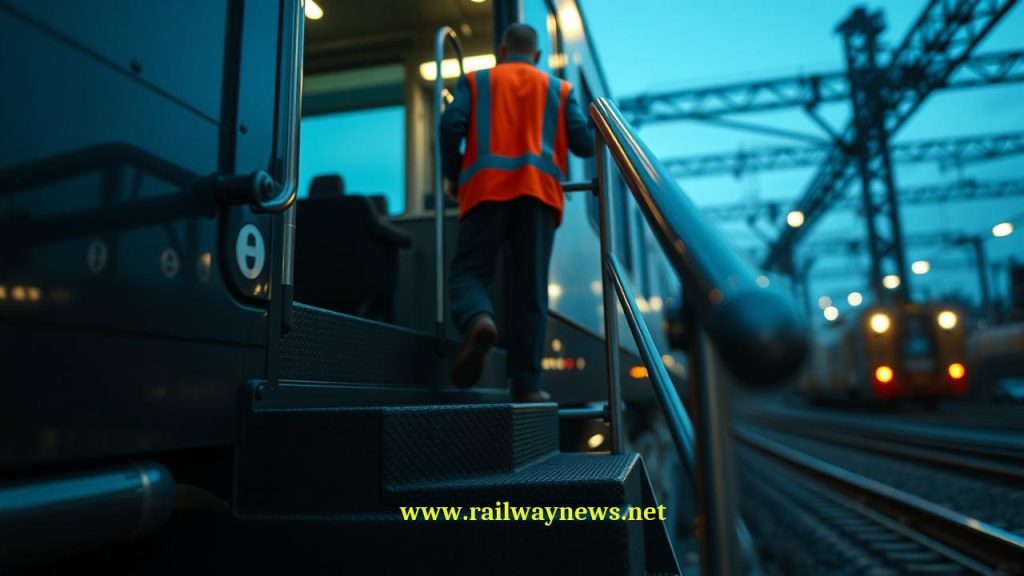
EN 16116-1: A Technical Guide to Staff Access Design in Railway Vehicles
EN 16116-1 is a European Standard that specifies the design requirements for steps, handrails, and associated access points used exclusively by staff on railway vehicles. This standard is a critical component in ensuring the occupational safety, efficiency, and ergonomic well-being of personnel such as drivers, train crew, and maintenance technicians. It applies specifically to passenger vehicles, service vans, and locomotives, forming a foundational document for vehicle manufacturers and operators in the railway industry.
The primary goal of EN 16116-1 is to mitigate risks associated with staff moving on, into, out of, and around a vehicle, often in challenging operational environments and adverse weather conditions. It achieves this by standardizing the geometry, strength, and material properties of access systems.
Scope and Applicability of the Standard
It is crucial to understand the precise scope of EN 16116-1 to apply it correctly. The standard covers access provisions intended only for staff use during operational, shunting, and maintenance duties. Key areas covered include:
- Driver’s Cab Access: Steps and handrails for entering and exiting the locomotive or driving trailer cab.
- External Access to Equipment: Ladders, steps, and grab handles used to reach external components, such as roof-mounted equipment or underframe apparatus.
- Inter-Vehicle Access (Gangways): Requirements for staff moving between coupled vehicles, focusing on the steps and handrails associated with the gangway environment.
- Access to Service Compartments: Design of steps and handrails for entering service vans or dedicated staff compartments within passenger vehicles.
The standard explicitly does not cover access for passengers, which is governed by separate regulations like the PRM-TSI (Persons with Reduced Mobility – Technical Specification for Interoperability). It also does not override specific requirements for emergency egress or access for staff with disabilities.
Core Technical Requirements and Design Principles
EN 16116-1 is built on fundamental principles of ergonomics and safety engineering. The requirements are detailed and prescriptive, ensuring consistency and a high level of safety across different vehicle types.
Steps and Foot-Holds
The design of steps is one of the most critical aspects of the standard, focusing on preventing slips, trips, and falls.
- Dimensional Geometry: The standard defines minimum dimensions for step depth (tread), width, and the maximum height between consecutive steps (riser). This ensures a natural and safe climbing motion.
- Slip Resistance: Step surfaces must provide a high degree of slip resistance. This is often achieved through the use of profiled, perforated, or gritted surfaces that allow for the drainage of water, snow, and oil, maintaining grip in all conditions.
- Visibility: The leading edge of steps, especially the first and last in a series, must have high-contrast markings to improve visibility, particularly in low-light conditions.
- Structural Integrity: Steps must be designed to withstand specified vertical and horizontal loads without permanent deformation, simulating the forces exerted by a staff member, potentially carrying heavy equipment.
Handrails, Hand-Holds, and Grab Rails
Handrails provide the necessary stability for staff, especially during vehicle movement or on uneven ground. The “three points of contact” principle is a core ergonomic concept underpinning these requirements.
- Profile and Diameter: Handrails must have a circular or suitably ergonomic profile with a diameter that allows for a firm, power grip. The standard specifies a permissible range (e.g., typically 25 mm to 40 mm).
- Clearance: There must be sufficient clearance between the handrail and any adjacent structure to prevent hand-trapping or knuckle injuries. This clearance is essential for a user wearing gloves.
- Positioning and Continuity: Handrails must be placed at logical heights and be continuous where possible, guiding the user safely through the entire access path. Their positioning must correspond directly with the steps.
- Load Bearing Capacity: Like steps, handrails must be able to withstand significant forces applied in any direction, ensuring they provide reliable support under dynamic conditions.
Access Pathways and Clearances
The standard also considers the overall space available for a person to move through. It defines minimum clearances for access doors, corridors, and walkways used by staff. This ensures that a person, potentially wearing bulky clothing or carrying tools, can pass through without obstruction or risk of injury.
Comparative Analysis of Key Requirements
The specific requirements within EN 16116-1 can vary depending on the type and location of the access point. The table below highlights some key dimensional differences for typical access scenarios.
| Design Element | Driver’s Cab Access (External Steps) | Inter-Vehicle Gangway Access | Roof Access Ladder (External) |
|---|---|---|---|
| Minimum Step Depth | Typically ≥ 150 mm to allow for secure foot placement. | Can be slightly less if part of a sloped gangway floor, but must ensure stability. | Reduced for rungs, but must provide adequate support (e.g., ≥ 20 mm diameter). |
| Maximum Riser Height | Strictly controlled to ensure a comfortable climbing angle (e.g., ≤ 300 mm). | Variable, depending on gangway design, but sharp level changes are minimized. | Consistent and tightly controlled, typically in the range of 250-300 mm. |
| Handrail Diameter | 30-40 mm, optimized for a strong, gloved grip during entry/exit. | May be integrated into the gangway structure, but must provide a grippable surface. | 25-35 mm, integrated as vertical stiles of the ladder. |
| Hand/Rail Clearance | Minimum clearance (e.g., ≥ 60 mm) to prevent knuckle trapping against the vehicle body. | Sufficient clearance from bellows or moving parts of the gangway. | Sufficient toe clearance and back clearance from the structure the ladder is mounted on. |
Integration with Railway Safety and Interoperability
EN 16116-1 does not exist in isolation. It is a harmonized standard, meaning compliance with it provides a “presumption of conformity” with the essential health and safety requirements of relevant European directives. It is frequently referenced within the Technical Specifications for Interoperability (TSIs), particularly those related to rolling stock (RST TSI). For vehicle manufacturers, adhering to this standard is a critical step in the certification and authorization process for placing new or refurbished rolling stock on the market.
To summarize, EN 16116-1 is a highly detailed and technically specific standard that forms the bedrock of staff safety for railway vehicle access. By mandating proven ergonomic principles for the design of steps and handrails, it plays an indispensable role in preventing accidents and ensuring the operational integrity of the modern railway network.

Railway infrastructure, rolling stock and transport technologies specialist focused on global rail industry developments, high-speed rail systems, signaling technologies and freight transportation. Covering railway investments, public transport modernization, rail operations and international mobility projects across Europe, Asia and North America.