
EN 15807: Europe’s Key to Seamless, Safe Rail Interoperability
Learn how EN 15807 standardizes railway pneumatic half couplings, ensuring vital interoperability, safety, and reliable braking for all train fleets.
Understanding EN 15807: The Standard for Railway Pneumatic Half Couplings
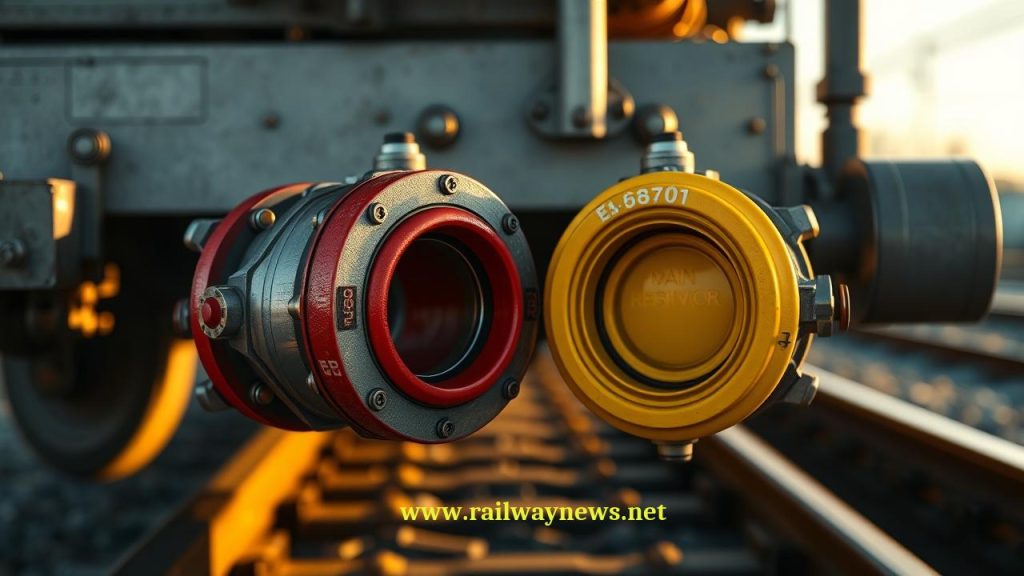
EN 15807 is a European Standard that specifies the functional, dimensional, and testing requirements for pneumatic half couplings used in railway vehicles. These components are critical for the interoperability and safety of the train’s compressed air systems, primarily the automatic brake system.
The standard ensures that any two rail vehicles, regardless of their manufacturer or country of origin within the European network, can be reliably and safely coupled. This guarantees the integrity of the continuous brake pipe and main reservoir pipe throughout the entire train consist.
The Core Purpose and Significance of EN 15807
The primary objective of EN 15807 is to establish a unified technical specification for the interface of pneumatic systems between railway vehicles. This standardization is crucial for several key reasons:
- Interoperability: It allows rolling stock from different operators and manufacturers to be seamlessly integrated into a single train, which is fundamental for cross-border and mixed-fleet operations.
- Safety: By defining strict performance and material requirements, the standard ensures the reliability of the braking system’s pneumatic connections. A failure in these couplings could lead to a loss of braking capability.
- Reliability and Maintenance: Standardized components simplify maintenance, repair, and replacement procedures. Maintenance staff can rely on interchangeable parts, reducing vehicle downtime and operational costs.
Key Technical Specifications and Requirements
EN 15807 is a deeply technical document that outlines precise requirements for every aspect of the half coupling’s design and performance. These can be categorized into several main areas.
Dimensional and Geometric Requirements
This is the cornerstone of interoperability. The standard meticulously defines the critical dimensions and tolerances of the coupling head, including the position of the coupling lugs, the sealing face geometry, and the overall profile. This ensures that any EN 15807 compliant half coupling can physically mate with another, forming a secure and airtight seal.
Material and Performance Specifications
Railway environments are harsh, and these components must perform reliably under extreme conditions. The standard specifies requirements for:
- Materials: Materials used, typically ductile cast iron or forged steel for the body, must possess sufficient mechanical strength, impact resistance (especially at low temperatures), and corrosion resistance.
- Sealing Elements: The rubber or elastomeric seals must remain flexible and effective across a wide operating temperature range (e.g., -40°C to +70°C) and be resistant to oil and ozone degradation.
- Pressure Integrity: The assembled coupling must withstand specified pneumatic test pressures without leakage or structural failure. This includes both static pressure tests and cyclic pressure endurance tests.
- Coupling Force: The standard defines the maximum force required to couple and uncouple the half couplings to ensure they can be operated manually by railway staff without excessive effort.
Testing and Validation Protocols
To verify compliance, EN 15807 mandates a rigorous series of type tests for new designs and routine tests for production units. These tests simulate the demanding operational life of the component and include:
- Leakage Test: The most critical test, ensuring the airtightness of the connection at various operating pressures.
- Pressure Strength Test: Applying a high pressure to verify the mechanical integrity of the coupling body.
- Endurance Test: Subjecting the coupling to thousands of coupling/uncoupling cycles to test for wear and long-term durability.
- Vibration and Shock Test: Simulating the dynamic forces experienced during train operation to ensure the connection remains secure.
Comparison of Brake Pipe (BP) and Main Reservoir Pipe (MRP) Couplings
A critical safety feature mandated by EN 15807 is the physical distinction between the half couplings for the Brake Pipe and the Main Reservoir Pipe. This is designed to make it physically impossible to connect them incorrectly, which would render the train’s braking system inoperable. The table below highlights these key differences.
| Feature | Brake Pipe (BP) Half Coupling | Main Reservoir Pipe (MRP) Half Coupling |
|---|---|---|
| Primary Function | Controls the application and release of the train’s automatic air brake. Connected to the driver’s brake valve. | Supplies compressed air from the locomotive’s main reservoirs to the entire train for auxiliary systems (e.g., air suspension, door systems) and to charge the brake reservoirs. |
| Identification (Convention) | Typically identified with the color Red. | Typically identified with the color Yellow or White/Silver. |
| Mechanical Keying | The coupling lugs and head are arranged in a specific orientation (e.g., “left-hand” configuration). | The coupling lugs and head are arranged in a mirrored or opposite orientation (e.g., “right-hand” configuration). |
| Purpose of Distinction | The mirrored mechanical design makes it physically impossible to connect a Brake Pipe hose to a Main Reservoir Pipe hose, preventing a critical and dangerous operational error. | |
Conclusion: The Role of EN 15807 in Modern Railways
EN 15807 is more than just a component specification; it is a foundational standard for the safety and efficiency of European rail transport. By enforcing strict rules on dimensions, materials, and performance, it provides a robust framework that manufacturers must adhere to. For railway operators, it delivers the confidence that their diverse fleets of rolling stock can operate together as a single, safe, and reliable system, ensuring the seamless flow of passengers and goods across the network.

Railway infrastructure, rolling stock and transport technologies specialist focused on global rail industry developments, high-speed rail systems, signaling technologies and freight transportation. Covering railway investments, public transport modernization, rail operations and international mobility projects across Europe, Asia and North America.