
Europe’s EN 15624: Boosting Freight Rail Safety & Interoperability
EN 15624 standardizes empty-loaded changeover devices for railway freight braking. It ensures safe, efficient stops by precisely adjusting brake force to wagon weight.
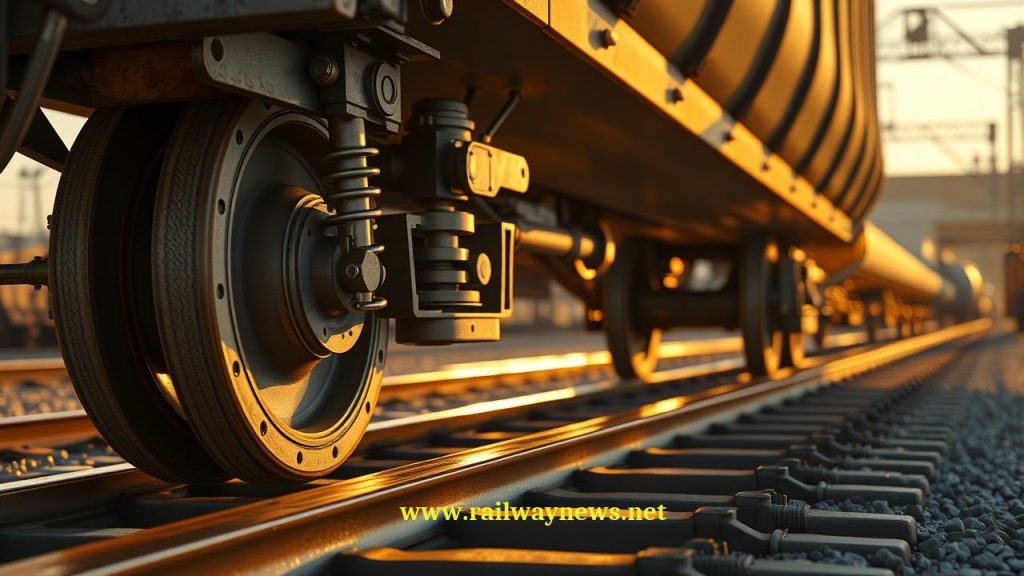
Understanding EN 15624: Empty-Loaded Changeover Devices in Railway Braking
EN 15624 is a European Standard that specifies the requirements for the design, performance, and testing of empty-loaded changeover devices used in the braking systems of railway freight wagons. These devices are critical for ensuring safe, efficient, and reliable braking performance across a wide range of operational loads.
The primary function of an empty-loaded changeover device is to adjust the braking force applied to the wheels based on the weight of the wagon. This ensures optimal braking without risking wheel damage, which is a fundamental challenge in freight rail operations where the weight difference between an empty and a fully loaded wagon can be substantial.
The Core Principle: Why Brake Force Adjustment is Critical
The braking force required to stop a freight wagon is directly proportional to its mass. A fully loaded wagon requires a significantly higher braking force to decelerate safely compared to an empty one. If the maximum braking force (designed for a loaded wagon) were applied to an empty wagon, the wheels would likely lock up and slide along the rails. This phenomenon, known as wheel slide, can cause significant damage to the wheel tread, creating flat spots (“wheel flats”) that lead to intense vibrations, noise, and increased maintenance costs. Conversely, applying a low braking force (designed for an empty wagon) to a loaded one would result in dangerously long stopping distances.
An empty-loaded changeover device solves this problem by acting as a load-sensing valve. It mechanically detects the wagon’s load state, typically by measuring the deflection of the suspension springs, and adjusts the pneumatic pressure in the brake cylinder accordingly. This ensures that the applied brake force is always appropriate for the wagon’s current weight.
Key Technical Requirements Specified in EN 15624
EN 15624 outlines a detailed set of technical specifications to ensure these devices are safe, reliable, and interoperable across the European rail network. The requirements cover performance, design, durability, and testing.
Performance and Functional Criteria
- Changeover Threshold: The standard defines the specific wagon mass at which the device must switch from the “empty” to the “loaded” braking mode. This threshold is crucial for ensuring the transition happens at the correct point.
- Pneumatic Performance: It specifies the permissible brake cylinder pressures for both the empty and loaded settings. This guarantees that the braking force is within the calculated safe limits for each state.
- Response Time: The device must react and change its state within a specified time frame after the load condition changes to ensure the correct braking force is available when needed.
- Leakage Rates: Strict limits on air leakage are defined to maintain the integrity and efficiency of the entire pneumatic braking system.
Design and Construction
- Materials: Materials used must be resistant to corrosion, UV radiation, and common operational fluids (e.g., oils, greases). This ensures a long service life in harsh railway environments.
- Environmental Sealing: The device must be sealed to prevent the ingress of contaminants such as dust, water, and ice, which could impair its mechanical or pneumatic function.
- Mechanical Interfaces: The standard specifies dimensions for mounting points and connections to ensure physical compatibility and interoperability with different wagon types and brake rigging designs.
Durability and Reliability
- Endurance Testing: Devices must withstand a high number of operating cycles to simulate a long service life without degradation in performance.
- Vibration and Shock Resistance: The standard mandates rigorous testing to ensure the device can withstand the constant vibrations and shocks experienced during normal railway operations, as specified in EN 61373.
- Temperature Range: The device must function reliably across a wide ambient temperature range, typically from -40°C to +70°C, to be suitable for operation in all European climates.
Comparison of Changeover Device Types
While most modern devices are automatic, the standard covers different operational principles. The main distinction is between automatic and manual systems.
| Feature | Automatic Changeover Device | Manual Changeover Device |
|---|---|---|
| Activation Mechanism | Senses wagon load via suspension deflection. A sensor arm connected to the bogie or axle box moves as the wagon body lowers under load. | A lever or handle is manually moved by an operator. |
| Operational Principle | The mechanical movement of the sensor arm operates a pneumatic valve, which selects the appropriate pressure setting. | The manual lever directly actuates the pneumatic valve. |
| Human Intervention | None required during loading/unloading. The system is self-adjusting. | Requires an operator to correctly set the device’s position based on the wagon’s load state. |
| Risk of Error | Low. Primarily subject to mechanical failure. | High. Prone to human error (e.g., forgetting to switch the lever), which can lead to severe braking incidents. |
| Typical Application | Standard on nearly all modern freight wagons for safety and efficiency. | Found on older rolling stock; now largely obsolete for new builds due to safety concerns. |
Testing and Certification According to EN 15624
To comply with EN 15624, an empty-loaded changeover device must undergo a stringent series of tests to validate its design and manufacturing quality. This process is essential for obtaining the necessary certification for use on the European rail network.
- Type Tests: An exhaustive set of tests performed on a new design to prove it meets every requirement of the standard. This includes functional, endurance, environmental, and vibration tests.
- Routine Tests: Simpler functional tests performed on every unit produced to ensure consistent manufacturing quality and to catch any production defects.
- Functional Verification: Tests to confirm that the device switches at the correct changeover mass and delivers the specified pneumatic pressures in both empty and loaded modes.
- Environmental Simulation: The device is subjected to extreme temperatures, humidity, and salt spray in climatic chambers to verify its robustness and long-term reliability.
Importance and Impact on the Rail Industry
The standardization provided by EN 15624 is fundamental to the modern freight railway industry for several key reasons:
- Enhanced Safety: By ensuring predictable and appropriate braking force, the standard significantly reduces the risk of wheel lock-ups, wheel damage, and potential derailments, making freight transport safer.
- Interoperability: It allows wagon and component manufacturers across Europe to produce devices that are fully compatible with each other. This is essential for the seamless operation of international freight trains.
- Economic Efficiency: Preventing wheel flats reduces the need for costly wheel re-profiling or replacement and minimizes wagon downtime. Standardized components also simplify maintenance and spare parts logistics.

Railway infrastructure, rolling stock and transport technologies specialist focused on global rail industry developments, high-speed rail systems, signaling technologies and freight transportation. Covering railway investments, public transport modernization, rail operations and international mobility projects across Europe, Asia and North America.