
EN 15551: Europe’s Key To Rail Safety & Interoperability
Discover EN 15551, the vital standard for railway buffers. It ensures rolling stock safety, interoperability, and performance through rigorous design, testing, and classification.
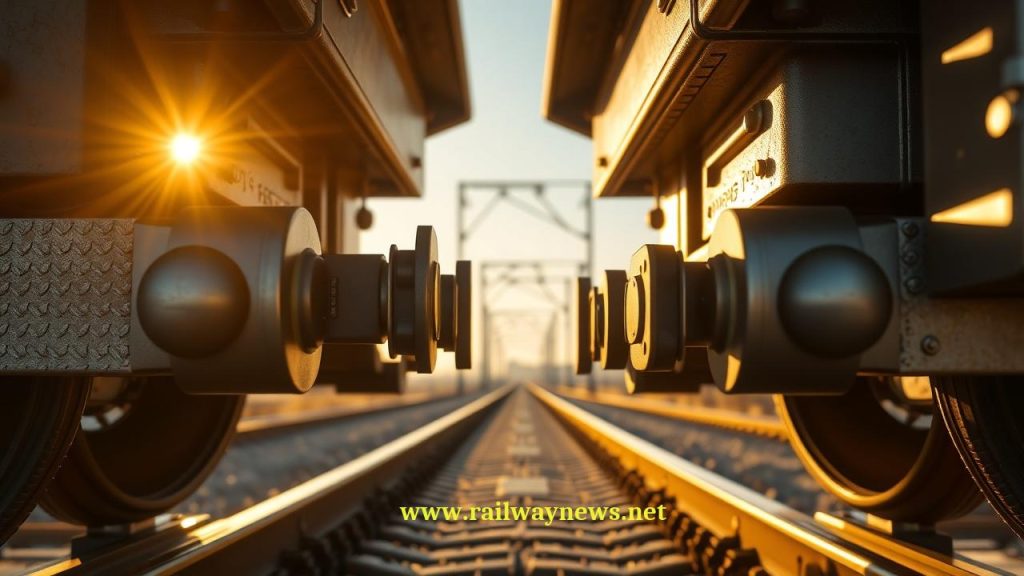
What is EN 15551: Railway Rolling Stock Buffers?
EN 15551 is a European Standard that specifies the technical requirements for the design, manufacturing, testing, and performance of buffers used on railway rolling stock. This standard is crucial for ensuring the safety, reliability, and interoperability of rail vehicles by defining how longitudinal forces during coupling, traction, and braking are managed and absorbed.
The primary function of buffers, as governed by this standard, is to act as energy-absorbing devices. They are mounted at the ends of railway vehicles to cushion impacts, protect the vehicle structure and its contents (cargo or passengers) from excessive shock, and maintain a safe distance between vehicles. EN 15551 applies to buffers installed on locomotives, freight wagons, passenger coaches, and other special-purpose railway vehicles.
Key Technical Aspects of EN 15551
The standard delves deep into the technical specifications that a buffer must meet. These requirements are broken down into several key areas, from material selection to rigorous performance testing protocols.
Buffer Categories and Classification
EN 15551 classifies buffers into different categories based on their energy absorption capacity and application. This classification ensures that the correct type of buffer is used for the specific operational demands of a vehicle. The categories are critical for matching the buffer’s performance with the vehicle’s mass and typical operational speeds.
- Category A: Standard buffers typically used for conventional freight wagons.
- Category B: Buffers with a higher energy absorption capacity, often used for wagons carrying sensitive goods or in specific operational contexts.
- Category C: High-performance buffers designed for heavy-duty applications, such as wagons in block trains or those subjected to harsh shunting operations.
- Category L: Buffers specifically designed for locomotives and power heads, which have unique interface and performance requirements.
Performance and Design Criteria
The core of the standard outlines strict performance criteria that buffers must satisfy. These are verified through detailed testing procedures.
- Energy Absorption Capacity: This is the fundamental performance metric, measured in kilojoules (kJ). The standard defines the minimum energy a buffer must be able to absorb and dissipate without permanent deformation.
- Static and Dynamic Characteristics: The relationship between the applied force and the buffer’s compression (stroke) is defined by a force-stroke diagram. EN 15551 specifies the acceptable shape of this curve under both slow (static) and rapid (dynamic) compression to ensure predictable performance.
- Stroke Length: The standard specifies the nominal and maximum travel distance of the buffer plunger. A typical stroke length for freight buffers is 105 mm.
- Geometric and Interface Dimensions: To ensure interoperability across the European rail network, the standard mandates precise dimensions for the buffer casing, buffer plate (head), and mounting flange. This guarantees that buffers from different manufacturers can be interchanged and that they will couple correctly with other vehicles.
- Material Requirements: Materials used must demonstrate high durability, resistance to fatigue, and the ability to perform reliably across a wide range of environmental conditions, including extreme temperatures (-40°C to +70°C) and exposure to corrosion.
Testing and Validation Procedures
To prove compliance with EN 15551, buffers must undergo a series of rigorous type tests. These tests validate the design and manufacturing quality.
- Static Test: The buffer is slowly compressed to its maximum stroke to verify its force-stroke characteristics and ensure no component yields prematurely.
- Dynamic Test (Buffing Test): This involves impacting the buffer with a specified mass at a certain velocity (often using a drop hammer or a test rig) to measure its energy absorption capacity and dynamic response. This test simulates real-world coupling and shunting impacts.
- Endurance Test: The buffer is subjected to thousands of compression cycles to simulate its operational lifetime and test for fatigue resistance and long-term performance degradation.
- Environmental Tests: Components may be tested for performance at extreme high and low temperatures to ensure the damping medium (e.g., hydraulic fluid, friction springs) functions correctly.
Comparison of Standard Buffer Categories
The choice of buffer category is critical for the safe and efficient operation of rolling stock. The following table provides a simplified comparison of the primary categories defined within EN 15551.
| Buffer Category | Minimum Energy Absorption Capacity (kJ) | Typical Application |
|---|---|---|
| Category A | 30 kJ | General purpose freight wagons, standard traffic. |
| Category B | 50 kJ | Freight wagons carrying sensitive or dangerous goods, or for more demanding operational conditions. |
| Category C | 75 kJ | Heavy-duty freight wagons, container wagons in block trains, and vehicles subject to severe shunting. |
| Category L | Varies (Typically > 70 kJ) | Locomotives, power cars, and driving trailers, designed to protect the primary vehicle structure. |
The Significance of EN 15551 for Interoperability and Safety
EN 15551 is a cornerstone of the European rail system’s Technical Specifications for Interoperability (TSI). Its importance cannot be overstated.
- Enhanced Safety: By standardizing the energy absorption capabilities, the standard minimizes the risk of vehicle damage, cargo shifting, and derailment during in-train force events and coupling operations. It provides a predictable and reliable cushion against longitudinal shocks.
- Guaranteed Interoperability: Adherence to EN 15551 ensures that a freight wagon from one country can be safely and mechanically coupled to a locomotive or other wagons from any other country within the network. Standardized dimensions and performance prevent mismatches that could lead to dangerous operating conditions.
- Lifecycle Reliability: The stringent testing requirements for endurance and material quality mean that buffers compliant with the standard offer a long and predictable service life. This reduces maintenance costs and vehicle downtime for railway operators.
- Regulatory Compliance: For rolling stock intended to operate on the trans-European network, compliance with EN 15551 is often a mandatory requirement for obtaining operational authorization.

Railway infrastructure, rolling stock and transport technologies specialist focused on global rail industry developments, high-speed rail systems, signaling technologies and freight transportation. Covering railway investments, public transport modernization, rail operations and international mobility projects across Europe, Asia and North America.