
Why EN 14587-2 Changes Europe’s Rail Safety & Efficiency
EN 14587-2 standardizes mobile flash butt welding for new rails on-site, guaranteeing safe, reliable, and efficient Continuous Welded Rail infrastructure across Europe.
What is EN 14587-2? A Technical Overview
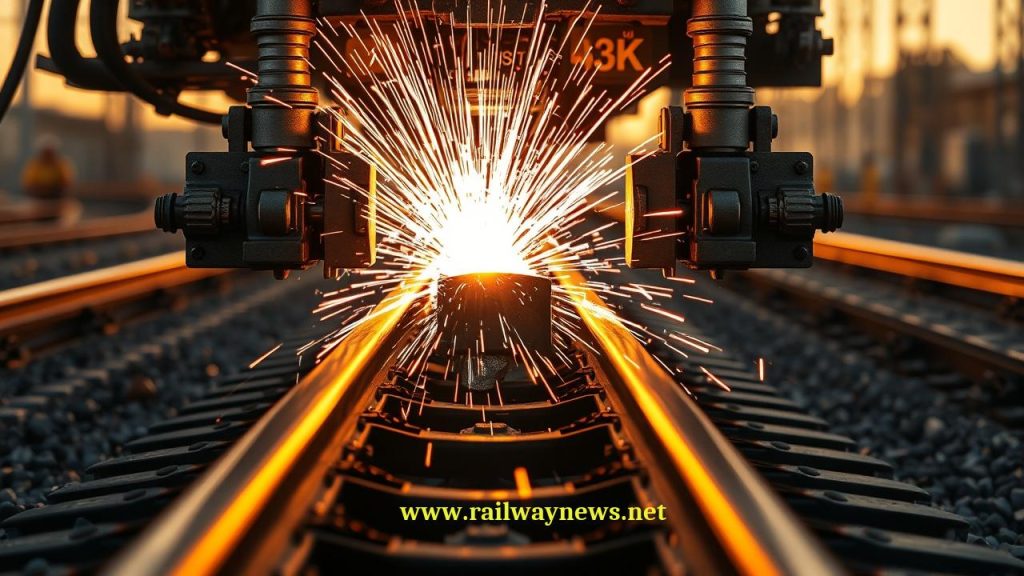
EN 14587-2 is a crucial European standard that specifies the requirements for the flash butt welding of new rails using mobile welding machines at locations other than a fixed plant. This process, often conducted directly on the track (in-situ), is fundamental to creating safe, reliable, and long-lasting Continuous Welded Rail (CWR) infrastructure. The standard provides a detailed framework for ensuring the quality, consistency, and structural integrity of welds performed in the challenging and variable conditions of a live railway environment.
The scope of this standard is highly specific, covering a wide range of modern, high-performance rail grades. It outlines the entire procedure, from the initial preparation of the rail ends and machine calibration to the final inspection and approval of the completed weld. Adherence to EN 14587-2 ensures that welds possess mechanical properties, particularly fatigue resistance, that are comparable to the parent rail, thus preventing premature failures and maintaining track geometry.
Key Technical Aspects of the Mobile Flash Butt Welding Process
EN 14587-2 meticulously details every stage of the on-site welding procedure to guarantee a high-quality, repeatable outcome. The process can be broken down into three primary phases: pre-welding, welding execution, and post-welding quality assurance.
H3: Pre-Welding Procedures and Preparation
Proper preparation is critical for a successful weld. The standard mandates several key steps before the welding process can begin:
- Rail End Preparation: The rail ends must be clean, free from contaminants like grease, rust, or moisture, and cut precisely square. Any geometric imperfections can lead to a defective weld.
- Alignment: The mobile welding machine clamps the two rail ends and aligns them with extreme precision. The standard specifies tight tolerances for vertical and horizontal alignment to ensure a straight and smooth running surface after welding.
- Machine Calibration: The mobile welding machine’s parameters (current, force, time, and displacement) must be precisely calibrated for the specific rail profile and steel grade being welded. This “welding program” is developed and approved based on rigorous testing.
- Environmental Checks: On-site conditions such as ambient temperature, wind, and precipitation can affect the weld’s cooling rate and overall quality. The standard sets limits on permissible conditions for welding to proceed.
H3: The Flash Butt Welding Execution
The core of the standard, the welding process itself, is an automated sequence controlled by the mobile welding head. It consists of three main stages:
- Flashing (Pre-heating): The rail ends are brought close together and a high electrical current is passed through them. This creates an arc, or “flashing,” which heats the rail ends to a forging temperature (typically over 1000°C) and burns off any remaining surface impurities.
- Upsetting (Forging): Once the optimal temperature is reached, the rail ends are rapidly and forcefully pushed together under immense hydraulic pressure (forging force). This action fuses the metal at a molecular level and expels molten steel and impurities outwards, forming a bulge of excess material known as the “upset” or “flash.”
- Controlled Cooling: After the current is shut off, the weld is allowed to cool. For high-strength and heat-treated rails (like R350HT), this cooling process may need to be controlled (e.g., using air or water mist) to achieve the desired microstructure and hardness in the Heat-Affected Zone (HAZ).
H3: Post-Welding Procedures and Quality Assurance
A weld is not complete until it has passed a series of stringent quality checks defined by the standard:
- Shearing (Trimming): While the weld is still hot and malleable, integrated shearing blades on the welding head remove the majority of the upset material from the rail head, web, and foot.
- Profile Grinding: After cooling, the weld area is meticulously ground to match the exact profile of the parent rail. This is crucial for ride comfort, reducing wheel-rail impact forces, and preventing noise and vibration. The final surface finish and geometry must meet strict tolerances.
- Inspection and Testing: Every weld undergoes a series of inspections. This includes a thorough visual inspection for surface defects and precise dimensional checks for alignment. Critically, Non-Destructive Testing (NDT), typically using ultrasonic methods, is employed to detect any internal flaws like cracks or lack of fusion that could compromise the weld’s integrity.
Rail Grades Covered by EN 14587-2
This part of the standard applies to a detailed list of new rails used in modern railway networks, from standard carbon grades to advanced, high-strength, heat-treated rails designed for heavy haul or high-speed lines. The table below summarizes the rail grades within its scope.
| Rail Grade | Typical Hardness (HBW) | Key Characteristics & Applications |
|---|---|---|
| R200 | 200-240 | Standard carbon steel rail, typically used in low-tonnage or less demanding applications. |
| R220 | 220-260 | A slightly harder carbon steel rail for general use on main lines with moderate traffic. |
| R260 | 260-300 | The most common “standard grade” carbon steel rail used widely across conventional networks. |
| R260Mn | 260-300 | A manganese-alloyed variant of R260, offering improved wear resistance. |
| R320Cr | 320-360 | Chromium-alloyed steel, providing superior wear resistance for curved track and turnouts. |
| R350HT | 350-390 | A fine-pearlitic, heat-treated rail offering excellent resistance to wear and rolling contact fatigue. Used in heavy haul and high-traffic lines. |
| R350LHT | 350-390 | Low-alloy, heat-treated rail with enhanced weldability and fracture toughness compared to R350HT. |
| R370CrHT | 370-410 | A premium, high-strength, heat-treated chromium alloy rail for the most demanding applications, such as sharp curves on heavy haul routes. |
| R400HT | ≥400 | Hyper-eutectoid heat-treated rail with the highest hardness, designed for extreme wear resistance in specific high-stress locations. |
Importance in the Railway Industry
EN 14587-2 is more than just a procedural document; it is a cornerstone of modern railway infrastructure safety and efficiency. By standardizing the on-site welding process, it provides several key benefits:
- Safety and Reliability: It ensures that welds, which are often the weakest points in a track structure, are produced to a consistently high standard, drastically reducing the risk of weld failure and potential derailments.
- Track Longevity: High-quality welds that mimic the properties of the parent rail ensure even wear and extend the operational life of the track, reducing long-term maintenance costs.
- Operational Efficiency: Mobile welding machines allow for rapid construction of CWR and efficient repairs directly on-site, minimizing track possession times and network disruption.
- Interoperability: As a European Norm (EN), it provides a unified quality benchmark for contractors and railway operators across Europe, ensuring consistent standards on cross-border routes.
Conclusion
EN 14587-2 provides a detailed and technically robust framework for the mobile flash butt welding of a wide array of new rail grades. It governs every step, from meticulous preparation to advanced post-weld inspection, to ensure that each weld is a seamless, strong, and durable continuation of the rail. For railway engineers and infrastructure managers, this standard is an indispensable tool for building and maintaining the safe, high-performance rail networks of today and tomorrow.

Railway infrastructure, rolling stock and transport technologies specialist focused on global rail industry developments, high-speed rail systems, signaling technologies and freight transportation. Covering railway investments, public transport modernization, rail operations and international mobility projects across Europe, Asia and North America.