
Europe’s EN 13803-2: Managing Abrupt Track Changes Safely
EN 13803-2 defines critical design parameters for railway switches and crossings. It ensures safety, comfort, and stability by managing abrupt curvature changes in complex track.
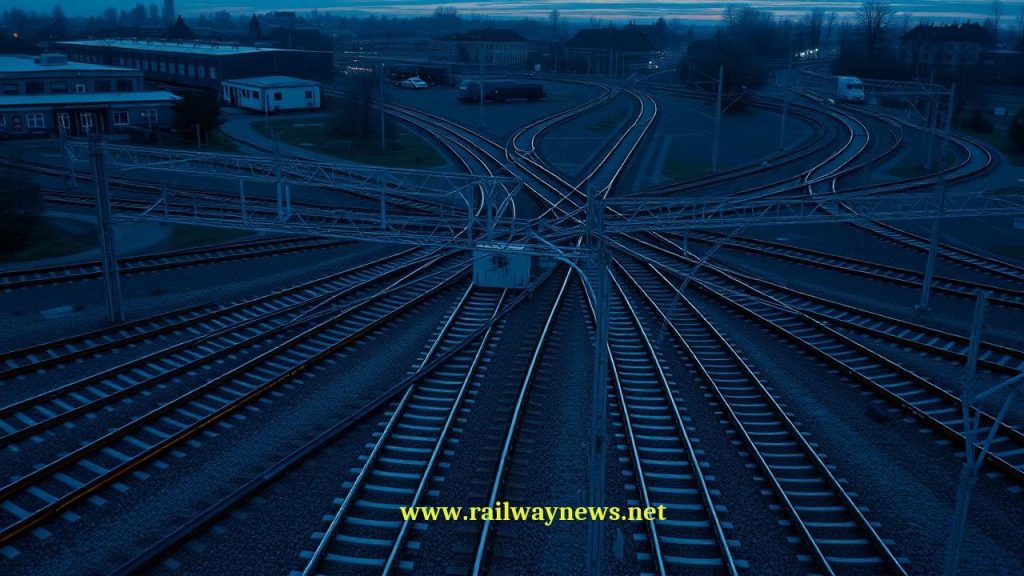
Understanding EN 13803-2: Design Parameters for Switches and Crossings
EN 13803-2 is a key European technical standard within the railway sector that specifies the design parameters for track alignment in complex geometries. Specifically, it addresses switches and crossings (S&C) and other situations involving abrupt changes of curvature on tracks with gauges of 1,435 mm and wider.
This standard is a crucial part of the EN 13803 series, which governs track alignment design. While Part 1 of the standard deals with plain line track (continuous, straight or curved sections), EN 13803-2 provides the necessary rules and limits for the unique dynamic and geometric challenges posed by turnouts and complex track layouts where vehicles are guided through sudden changes in direction and superelevation.
Core Purpose and Scope
The primary goal of EN 13803-2 is to ensure the safety, performance, and passenger comfort of rail vehicles as they navigate through the most geometrically demanding parts of a railway network. Its rules are designed to control the dynamic forces acting on the vehicle and track, minimizing wear and the risk of derailment.
Key Areas of Application
- Switches and Crossings (Turnouts): This is the primary application, covering the design of the through-route and the diverging route of a switch, including the switch panel, closure rails, and the crossing panel.
- Reverse Curves with No Intermediate Straight: Situations where a curve in one direction is immediately followed by a curve in the opposite direction without a straight track segment to transition.
- Connections to Sidings and Depots: Track sections with low speeds but often very tight curves and abrupt changes.
* Crossovers and Junctions: Complex layouts where multiple tracks intersect or diverge, requiring careful management of vehicle dynamics.
Fundamental Technical Parameters Defined in EN 13803-2
The standard defines a set of limiting values for critical parameters that govern vehicle behaviour. These parameters are based on vehicle dynamics, passenger comfort thresholds, and mechanical constraints of the wheel-rail interface.
The Most Critical Parameters
- Cant Deficiency (I): This is the shortfall in superelevation (cant) on a curve for a given speed. In switches and crossings, where cant is often zero for practical reasons, cant deficiency becomes a primary measure of the uncompensated lateral acceleration felt by the vehicle and passengers. The standard sets strict limits on its maximum value.
- Abrupt Change of Cant Deficiency (ΔI): This is a cornerstone of EN 13803-2. It measures the instantaneous change in lateral acceleration experienced when a vehicle enters a section with a different radius of curvature, such as moving from the straight switch rail to the curved closure rail. Large abrupt changes can cause significant jolts, impacting comfort and increasing dynamic loads on the track.
- Rate of Change of Cant Deficiency (dI/dt): This parameter measures how quickly the cant deficiency changes over time as a vehicle travels through a transition. While more relevant for transition curves on plain line (covered in Part 1), it is still considered in the entry and exit of complex S&C layouts to ensure a smooth dynamic response.
- Vertical Acceleration (avz): As a vehicle’s wheelset moves through a crossing nose or over irregularities, it can experience vertical accelerations. The standard provides limits to ensure wheel unloading does not reach a dangerous level, which could compromise contact and lead to derailment.
- Track Twist: Defined as the algebraic difference in the cant of two track cross-sections divided by the distance between them. In S&C, unintended twist can arise from geometric imperfections and can cause dangerous wheel load shifting. The standard sets limits for twist over defined base lengths to ensure vehicle stability.
The Significance of Abrupt Changes in Curvature
A standard track alignment uses a transition curve (e.g., a clothoid) to smoothly change from a straight section (infinite radius) to a circular curve (constant radius). This allows cant and cant deficiency to be applied gradually.
In switches and crossings, this is often not possible. A vehicle’s wheelset is abruptly guided from a straight path to a curved one at the switch toe. This creates an “abrupt change of curvature,” which in turn leads to an abrupt change in cant deficiency. EN 13803-2 is specifically designed to manage this effect by setting clear limits based on the design speed of the turnout. Adhering to these limits is fundamental to preventing excessive dynamic forces that could damage both the vehicle and the track infrastructure, while also maintaining an acceptable level of passenger comfort.
Comparative Table of Key Parameter Limits
The standard defines different limiting values based on the required level of performance and safety. The values below are illustrative of the principles in EN 13803-2, distinguishing between a normal design limit and a more permissive exceptional limit for special cases.
| Parameter | Symbol | Normal Limit | Exceptional Limit | Context and Technical Notes |
|---|---|---|---|---|
| Cant Deficiency | I | Typically ≤ 100 mm | Up to 150 mm | Applies to the diverging route. Depends on vehicle type and operational speed. Higher values increase lateral forces and wear. |
| Abrupt Change of Cant Deficiency | ΔI | Typically ≤ 85 mm | Up to 120 mm | The defining parameter for S&C design. This value is critical for managing the dynamic jolt at the entry to the diverging track. |
| Rate of Change of Cant Deficiency | dI/dt | Typically ≤ 35 mm/s | Up to 55 mm/s | Measures passenger comfort. A lower value provides a smoother, more comfortable ride through the turnout’s transition zones. |
| Minimum Radius of Curvature | Rmin | ≥ 190 m | ≥ 150 m | Applies to the diverging track. A smaller radius leads to higher cant deficiency for a given speed and increases wheel/rail wear. |
| Track Twist (on 3m base) | – | ≤ 5 mm/m | ≤ 7 mm/m | Critical for preventing wheel unloading and maintaining vehicle stability, especially through the complex geometry of the crossing panel. |
Relationship with EN 13803-1
It is impossible to correctly apply EN 13803-2 without understanding its relationship with Part 1. The two standards are complementary:
- EN 13803-1: Covers plain line track. It focuses on the design of alignments with gradual transitions, defining parameters like cant, cant deficiency, and their rates of change over transition curves. This is the “standard” case for mainline railway track.
- EN 13803-2: Covers the “special” cases. It takes precedence where the smooth, gradual changes defined in Part 1 are not geometrically possible, such as in the confined and complex space of a switch or crossing. It provides the rules for managing the unavoidable abrupt changes in these specific locations.
In practice, a track designer uses EN 13803-1 for the main alignment leading up to a junction, and then applies the specific rules and tighter constraints of EN 13803-2 to design the S&C unit itself, ensuring a safe and compliant transition between the two regimes.
Conclusion: A Standard for Safety in Complexity
EN 13803-2 is a highly specialized and indispensable standard for modern railway engineering. It provides a robust, physics-based framework for designing the most complex and safety-critical elements of track infrastructure. By placing clear limits on dynamic parameters like abrupt changes in cant deficiency, it ensures that switches, crossings, and junctions can be traversed safely at design speed, while also managing passenger comfort and minimizing long-term wear on both rolling stock and the track itself. Its application is fundamental to achieving an interoperable and reliable European railway network.
Frequently Asked Questions (FAQ) about EN 13803-2

Railway infrastructure, rolling stock and transport technologies specialist focused on global rail industry developments, high-speed rail systems, signaling technologies and freight transportation. Covering railway investments, public transport modernization, rail operations and international mobility projects across Europe, Asia and North America.