
The Solo Pilot: Understanding Driver Only Operation (DOO)
Efficiency or risk? Unpack the debate behind Driver Only Operation (DOO). Learn how modern CCTV and sensors allow drivers to control doors without a conductor’s aid.
⚡ IN BRIEF
- 2013 Santiago de Compostela – The Human Factor: On 24 July 2013, a high‑speed train derailed at a curve near Santiago de Compostela, Spain, killing 79 passengers. The driver had been distracted by a phone call and entered a 80 km/h curve at 190 km/h. The train was operating in Driver Only mode, with no second person in the cab to monitor speed or intervene. The accident reignited the global debate on whether DOO inherently increases risk by removing a second safety‑critical set of eyes.
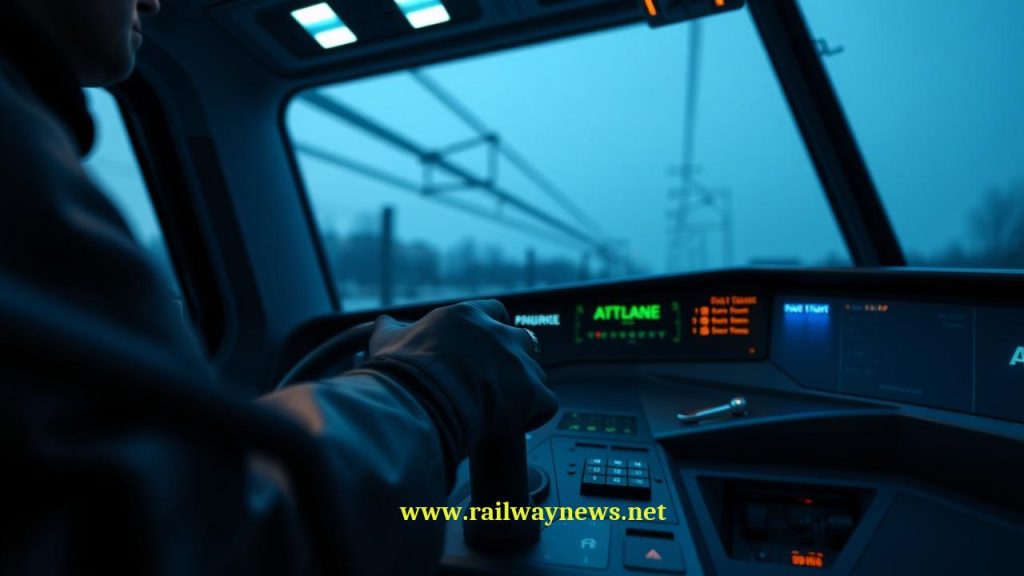
- Definition – One Person Operation: Driver Only Operation (DOO), also known as One Person Operation (OPO), is a mode of train operation where the driver is the sole crew member responsible for both train movement and door control. The traditional role of the conductor or guard – closing doors, verifying safety, and dispatching the train – is transferred to the driver using technological aids: in‑cab CCTV monitors, platform screens, and door obstruction sensors.
- The Technology Stack – Replacing the Guard’s Eyes: DOO relies on a suite of technologies: monitor systems (multiple cameras per car, displaying a composite side view in the cab); platform sensors (laser scanners at door level to detect passengers trapped in doors); door interlock systems (prevents traction power if any door is not closed and locked); and dispatch aids (driver‑controlled door opening and closing with visual confirmation). Systems must meet SIL 2 or SIL 4 depending on the safety‑criticality of door interlocking.
- Dwell Time Reduction – The Efficiency Argument: DOO typically reduces station dwell time by 20‑30% compared to guard‑operated trains. This is because the driver can close doors immediately after boarding is complete, without waiting for a guard’s “buzzer” signal. On high‑frequency metro lines, this translates to 2‑3 extra trains per hour – a 15‑20% capacity increase without infrastructure investment.
- The Safety Debate – Union vs. Operator: The debate centres on two opposing views: operators argue that technology can replicate the guard’s safety functions at lower cost, and that DOO reduces human‑error risks in communication. Unions counter that a guard provides essential passenger assistance (especially for disabled travellers), manages onboard security, and serves as a second safety‑critical team member in emergencies (e.g., evacuations, fire). The balance of evidence is mixed: a 2021 UK Department for Transport study found no statistically significant difference in passenger injury rates between DOO and guard‑operated trains, but did find higher passenger satisfaction on services with a guard.
On a warm summer evening in 2013, the Alvia 151 high‑speed train was nearing its final destination of Santiago de Compostela, Spain. The driver, alone in the cab, took a call from the onboard ticket inspector. Distracted, he missed a 80 km/h speed warning and entered the curve at 190 km/h. The train derailed, killing 79 passengers and injuring over 140. The investigation, while focusing on the driver’s error, also highlighted a systemic question: would a second person in the cab – a conductor or assistant driver – have noticed the overspeed and intervened? This question lies at the heart of the global debate on Driver Only Operation (DOO). DOO is not simply about reducing staffing; it is a fundamental re‑architecture of how safety responsibilities are allocated. Proponents argue that modern technology can replicate and even surpass the guard’s safety functions, enabling faster operations and lower costs. Critics contend that no camera can replace a human’s situational awareness, especially in emergencies or when assisting vulnerable passengers. This article examines the technical, operational, and safety dimensions of DOO, the technologies that enable it, and the evidence from decades of experience in metro, suburban, and mainline operations.
What Is Driver Only Operation (DOO)?
Driver Only Operation (DOO) is a railway operating mode where the train driver is the sole safety‑critical crew member responsible for both controlling the train’s movement (acceleration, braking) and managing the passenger doors (opening, closing, and verifying that it is safe to depart). In traditional guard‑operated trains, the driver focuses on driving, while a conductor or guard is responsible for door operation, passenger safety on the platform, and dispatching the train. DOO transfers these duties to the driver, aided by a suite of technologies: in‑cab CCTV systems that display a composite view of the train side, platform sensors (e.g., infrared or laser scanners) that detect obstacles in the door closing path, door interlock systems that prevent traction if any door is open, and often automatic train operation (ATO) overlays that assist with precise stopping and door alignment. DOO is mandated by many metro systems (e.g., London Underground, New York Subway) and is increasingly used on mainline railways, particularly in the UK, Australia, and parts of Europe. It is often seen as a stepping stone to fully driverless operation (Grade of Automation 4). The regulatory framework for DOO is defined by national safety authorities (e.g., the UK’s Office of Rail and Road) and must satisfy that the technology provides at least an equivalent level of safety to a guard’s manual checks.
1. The Technology Enabling DOO: From CCTV to Obstacle Detection
DOO replaces the guard’s visual inspection with a combination of cameras, sensors, and interlocking systems. Key components include:
- In‑Cab CCTV Monitors: Cameras mounted on each carriage (typically 2‑4 per car) provide a real‑time composite view of the train’s side. The driver sees a split‑screen or stitched image showing the entire platform‑train interface. The system must have a resolution sufficient to detect a person trapped in the door (< 0.5 m resolution), and the display must be visible under all lighting conditions (including direct sunlight and dark tunnels). Frame rate is typically 25 fps with latency < 200 ms.
- Platform Sensors – Laser Scanners & Infrared: To provide a second layer of safety, many DOO systems use fixed platform sensors that scan the door closing area. These sensors (often LiDAR or active infrared) detect any obstacle > 25 mm in the door path. If an obstacle is detected, the sensor sends a signal to the train’s door control system, preventing the doors from closing or triggering a re‑open. These sensors must be calibrated to avoid false positives (e.g., from rain or birds) and must meet SIL 2 (for obstacle detection) or SIL 4 (if integrated with door interlocking).
- Door Interlock & Traction Cut‑Off: The train’s door control system must ensure that traction power cannot be applied unless all doors are closed and locked. This is achieved through a door interlock circuit that physically cuts the “traction enable” signal. In DOO, this circuit is directly linked to the driver’s door control switch, bypassing the guard’s panel. The system must be fail‑safe: any fault in the door interlock (e.g., a broken wire) must be interpreted as “doors not locked,” preventing the train from moving.
- Dispatch Assistance – Ready‑to‑Start Indication: In some DOO systems, the driver is assisted by a “ready to start” indicator (e.g., a green light at the platform end) that automatically activates when all doors are closed and the platform sensors confirm no obstruction. This reduces driver workload and eliminates the need for a guard’s buzzer. The indicator is often interlocked with the signaling system to prevent dispatch if the signal is at danger.
These systems must be type‑tested according to EN 50126 (RAMS) and EN 50128 (software) to ensure reliability. For example, the UK’s Rail Safety and Standards Board (RSSB) requires that the probability of a dangerous failure (e.g., a door closing on a passenger without detection) be < 10⁻⁸ per door operation.
2. Operational Impact: Dwell Time, Capacity, and Punctuality
The primary driver for DOO is operational efficiency. By eliminating the guard’s role in door dispatch, dwell times can be reduced significantly. A comparison based on UK mainline data shows:
|
| Operation Mode | Typical Dwell Time (peak station) | Trains per hour (maximum) | Annual staffing cost per train |
|---|---|---|---|
| Guard‑operated (with communication delay) \n | 40‑50 seconds \n | 18‑20 \n | €90,000 (guard salary + training) \n |
| Driver Only Operation (with CCTV) \n | 25‑35 seconds \n | 22‑25 \n | €0 (no guard) \n |
The reduction in dwell time is most critical in high‑frequency urban railways. For example, London Overground, which converted to DOO in 2016, reported a 20% increase in peak capacity (from 8 to 10 trains per hour) and a 10% improvement in punctuality. However, the efficiency gain comes with trade‑offs: some studies suggest that passengers with disabilities or heavy luggage may experience longer boarding times without a guard to assist, partially offsetting dwell time benefits.
3. Safety Debate: Evidence from Incidents and Studies
The safety impact of DOO is hotly contested. Proponents point to safety data showing that DOO metro systems (e.g., London Underground’s Victoria line) have some of the lowest passenger injury rates in the world. Opponents cite incidents where a guard prevented an accident or where DOO technology failed.
- Guard‑prevented incidents: In 2019, a guard on a UK Southern Railway train spotted a passenger trapped in the doors and used the emergency buzzer to stop the train before it departed, preventing a potential fall. Such incidents are cited as evidence that a human’s situational awareness cannot be fully replicated by CCTV.
- Technology failures: In 2016, a DOO train on the Thameslink route departed with a door open because a camera cable had been damaged, leaving the driver unaware. The train was stopped within 100 m by an emergency brake application triggered by a door interlock alarm, but the incident highlighted the vulnerability of the system to sensor failures. The investigation led to mandatory daily camera inspection routines.
- Statistical studies: A 2021 study by the UK’s Department for Transport analysed 10 years of incident data across DOO and guard‑operated routes. It found no statistically significant difference in passenger injury rates per passenger‑mile. However, it did find that passenger satisfaction scores were 8‑12% higher on services with a guard, due to perceived safety and assistance availability.
The debate has led to “compromise” models in some countries, such as “Driver Controlled Operation” (DCO) where the guard is retained for passenger service and emergencies but does not operate the doors – a model used by many Swiss regional trains.
4. The Transition to Full Automation (GoA 3 & 4)
DOO is often a transitional stage toward higher grades of automation. The International Association of Public Transport (UITP) defines Grades of Automation (GoA) as follows:
- GoA 2: Semi‑automated – driver operates doors and supervises train, but speed control is automatic. This is typical of many DOO systems.
- GoA 3: Driverless – train operates automatically, but a “train attendant” is present to manage doors, emergency response, and passenger assistance. The driver’s role is eliminated, but a guard‑like role remains. (Example: Paris Metro Line 1).
- GoA 4: Unattended train operation (UTO) – no staff on board; all functions are automated. (Example: Copenhagen Metro, Dubai Metro).
For mainline railways, the move to GoA 3/4 is slower due to mixed traffic, long distances, and higher speeds. However, many new metro lines are built to GoA 4 from the outset, while existing lines are retrofitting. DOO can be seen as a step that consolidates operational roles before removing the driver entirely. The debate over DOO thus often extends to the future of the guard’s role in an increasingly automated railway.
Comparison: Guard‑Operated vs. Driver Only Operation (DOO)
|
| Aspect | Guard‑Operated (Traditional) | Driver Only Operation (DOO) |
|---|---|---|
| Door control \n | Guard operates doors from platform or rear cab \n | Driver operates doors from front cab using CCTV \n |
| Dispatch signal \n | Guard gives “right away” buzzer or radio signal \n | Driver self‑dispatches after visual check \n |
| Safety verification \n | Guard walks platform, visually checks doors \n | Cameras + sensors (laser/infrared) detect obstacles \n |
| Dwell time \n | Slower (communication delay) \n | Faster (direct control, no handshake) \n |
| Staffing cost \n | Higher (two safety‑critical staff) \n | Lower (one safety‑critical staff) \n |
| Passenger assistance \n | Guard on board to assist disabled, handle disruptions \n | No onboard staff; driver in cab may be inaccessible \n |
| Emergency response \n | Guard assists with evacuation, first aid \n | Driver may be only staff; remote control centre may assist \n |
| Technology reliance \n | Low – manual checks \n | High – depends on cameras, sensors, door interlock \n |
Editor’s Analysis: The False Dichotomy – Technology vs. Human Presence
The debate over DOO is often framed as a binary choice: either we keep the guard (and accept lower efficiency) or we replace them with technology (and accept higher risk). This is a false dichotomy. The most successful DOO implementations are those that have invested not only in cameras and sensors, but also in new human roles – such as roving train attendants, platform hosts, and remote monitoring centres – that provide the assistance and situational awareness that a guard once offered. For example, the Thameslink route in London operates with DOO but has customer service assistants on trains during peak hours and a 24/7 control centre that can view platform cameras and communicate directly with passengers via onboard intercoms.
The real issue is not whether DOO is safe, but whether the safety and service functions once provided by the guard have been demonstrably replaced by equivalent or better systems. In many cases, the answer is no: operators have implemented DOO to cut costs but have not invested in the necessary redundancy in camera systems, nor in the customer service staff that vulnerable passengers need. A 2022 study by the UK’s Rail Safety and Standards Board (RSSB) found that 70% of passenger complaints on DOO services related to lack of assistance at stations and on trains – a direct consequence of removing the guard without replacing their function. The way forward is not to roll back DOO, but to recognise that the guard’s role encompasses safety, service, and security – and that each of these must be explicitly re‑allocated, whether to technology or to new staff roles. Until this holistic approach is taken, DOO will continue to be a source of conflict, and its potential benefits will remain only partially realised.
— Railway News Editorial
Frequently Asked Questions (FAQ)
1. Does Driver Only Operation (DOO) reduce safety?
The safety impact of DOO is a matter of ongoing debate and varies by implementation. Statistical studies have not found a significant increase in passenger injury rates on DOO‑operated lines compared to guard‑operated lines when the technology is properly maintained. However, the UK’s Rail Safety and Standards Board (RSSB) has noted that DOO systems are less tolerant of failures – a camera failure, for example, can lead to dispatch delays or, if not detected, a safety risk. The key is that DOO requires a higher level of technology reliability and maintenance oversight. In practice, many DOO systems achieve safety records comparable to guard‑operated systems, but at the cost of increased investment in technology redundancy and training. The trade‑off is not safety versus efficiency, but rather a shift in how safety is delivered – from human monitoring to engineered systems.
2. How do drivers see the entire train when closing doors?
Drivers use a system of CCTV monitors mounted in the cab. Typically, there are 2‑4 cameras per carriage, placed at intervals to cover the full length of the train. The feed is displayed on high‑resolution monitors (often split‑screen or stitched into a continuous panoramic view). The driver watches the screens as they press the door close button; if they see any passenger obstructing the doors or any unsafe condition, they release the button and re‑open the doors. In many systems, a second layer of safety is provided by platform‑mounted sensors (laser scanners or infrared beams) that automatically detect any object > 25 mm in the door closing area; if an obstruction is detected, the door closing sequence is automatically interrupted. The driver must also visually check the monitors before applying traction. The camera system must meet strict latency (< 200 ms) and resolution standards to ensure the driver can see small obstructions (e.g., a strap or cane).
3. What happens if a passenger is trapped in the doors under DOO?
If a passenger becomes trapped in the doors, the door interlock system prevents the train from moving. The doors are equipped with a “door‑open” circuit that cuts the traction enable signal. In modern rolling stock, the doors also have “obstruction detection” – if the door closes on an object, it automatically re‑opens. The driver sees a door open indication on the cab display and cannot apply power until all doors are closed and locked. If the obstruction is detected by platform sensors, the system may also automatically re‑open the doors. The driver can also manually re‑open the doors using the cab controls. Once the obstruction is cleared, the driver closes the doors again. In the unlikely event that the door interlock system fails and the train moves with a door open, the door’s mechanical interlock (a separate safety circuit) will trigger an emergency brake application, bringing the train to a halt within seconds. This “back‑up” interlock is required by safety standards (e.g., EN 14752).
4. How does DOO affect passengers with disabilities?
This is one of the most contentious issues. Under guard‑operated systems, the guard can assist disabled passengers with boarding, securing wheelchairs, and providing information. Under DOO, the driver is often the only staff member, and they are confined to the cab, making them inaccessible to passengers on the platform or train. To address this, many operators have implemented “customer service” roles alongside DOO: roving attendants on platforms, help points at stations, and onboard hosts on some services. The UK’s Rail Delivery Group requires that DOO services provide “equivalent or better” assistance to disabled passengers, which has led to the creation of “Station Host” roles. However, passenger satisfaction surveys consistently show lower scores for accessibility on DOO services. The European Union’s TSI PRM (Persons with Reduced Mobility) requires that operators have a plan for assistance; for DOO, this often means a “turn up and go” service where station staff provide boarding assistance, but this is less reliable on unmanned stations.
5. Is Driver Only Operation the same as driverless trains (ATO)?
No. Driver Only Operation still has a driver in the cab who is responsible for supervising the train, operating the doors, and taking control in emergencies. Driverless trains (Grade of Automation 3 or 4) operate without a driver; they may have a “train attendant” on board (GoA 3) or no staff at all (GoA 4). DOO is often seen as a transition to GoA 3: once the driver’s role is reduced to door operation and emergency response, it is a smaller step to replace them with a less‑qualified attendant. However, many mainline DOO systems remain at GoA 2 (the driver still controls acceleration and braking manually). The move to full automation requires additional infrastructure (e.g., platform screen doors, automatic train supervision) and is typically only implemented on new metro lines. For mainline railways, DOO is likely to remain the dominant model for the foreseeable future, with automation introduced incrementally (e.g., through Automatic Train Operation (ATO) overlays on high‑speed lines).

Railway infrastructure, rolling stock and transport technologies specialist focused on global rail industry developments, high-speed rail systems, signaling technologies and freight transportation. Covering railway investments, public transport modernization, rail operations and international mobility projects across Europe, Asia and North America.
RELATED POSTS
August 4, 2026 1:11 pm
Hitachi Rail Canada secured a $407.7M contract to install CBTC...
August 1, 2026 7:56 am
BMZ delivered two new TEM18DM diesel shunting locos to RZD...
August 4, 2026 11:12 am
MBTA confirmed a $150.8 million overhaul of the 85-year-old Green...
August 1, 2026 7:14 pm
€205 billion funding shortfall threatens the TEN-T rail network's completion...
August 1, 2026 7:11 pm
An Ipsos survey across 29 countries found that 33% of...
August 1, 2026 8:06 pm
European Commission approved a regulation on 9 July 2026 requiring...