
Stadler’s Swiss Green Rail: Heat Pump & Sustainable Strategy
Stadler’s new heat pump installation significantly reduces CO₂ emissions at its Swiss facility. The **railway** manufacturer targets climate neutrality through **sustainable** initiatives.
Introduction
Stadler’s facility in Bussnang, Switzerland, has implemented a new heat pump, reducing its CO₂ emissions by approximately 280 tonnes annually. This initiative is part of Stadler’s broader sustainability strategy, which targets a 50 percent reduction in direct emissions by 2030 and full climate neutrality by 2050.
CO₂ Emission Reduction
The commissioning of the new heat pump at Stadler’s Bussnang facility in the Canton of Thurgau is a key step in reducing CO₂ emissions. The heat pump installation allows 40 percent of the buildings to be heated using renewable energy. The company aims to cut its direct emissions by 50 percent by 2030 and achieve full climate neutrality by 2050.
Renewable Energy Initiatives
In addition to the heat pump, approximately 7 percent of the total electricity consumption at the Bussnang site is covered by the photovoltaic system on the factory roofs. Stadler is also utilizing solar energy at its St. Margrethen site in Switzerland, where a quarter of the total electricity consumption is covered by the factory’s photovoltaic system. Additionally, a new solar power system was commissioned in Winterthur in 2024, generating around 275,000 kilowatt-hours of electricity annually, which is equivalent to the needs of about 60 detached homes per year.
Heat Pump Technology
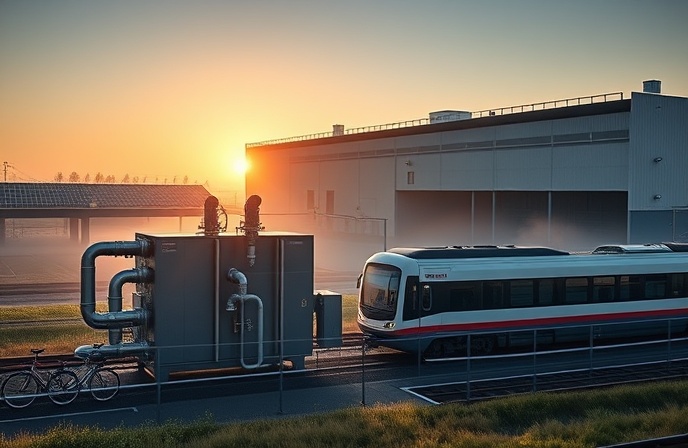
The new heating system at Stadler’s Bussnang headquarters is based on an air-to-water heat pump. This system extracts heat from the outside air, even at low temperatures, to warm water for heating. A refrigerant absorbs the heat, evaporates, and is then compressed, producing heat that is transferred to the heating water. The refrigerant cools, condenses, and the cycle repeats. In summer, the process reverses to cool the factory halls without conventional air conditioning. The heat pump provides up to 580 kilowatts of heating output, and the main unit is divided into five sections to operate only the necessary portion based on demand. Construction of the system began in April this year, with a new concrete platform built for the installation, including a bike parking area.
Sustainability Strategy
These measures are integral to Stadler’s sustainability strategy. The company aims to halve its CO₂ emissions by 2030 and achieve climate neutrality by 2050. Lucius Gerig, Head of the Swiss Division, stated that Stadler takes a holistic approach to sustainability, emphasizing that sustainability efforts begin in production, and the new heat pump is a concrete step towards achieving the company’s climate goals.
Conclusion
Stadler is actively reducing its CO₂ emissions through the implementation of a new heat pump at its Bussnang facility and the use of solar energy at multiple sites. These initiatives are part of a broader strategy aimed at significantly reducing emissions by 2030 and achieving climate neutrality by 2050.
Company Summary
Stadler: Stadler is focused on sustainability, aiming to reduce CO₂ emissions through various initiatives, including heat pumps and solar energy. The company has set ambitious climate goals, targeting a 50 percent reduction in direct emissions by 2030 and full climate neutrality by 2050.
Technology
Air-to-water heat pump: This system extracts heat from the outside air to warm water for heating. It uses a refrigerant that absorbs heat, evaporates, is compressed, and then transfers the heat to the heating water. The refrigerant then cools and condenses, repeating the cycle. The process can also be reversed for cooling.

Railway infrastructure, rolling stock and transport technologies specialist focused on global rail industry developments, high-speed rail systems, signaling technologies and freight transportation. Covering railway investments, public transport modernization, rail operations and international mobility projects across Europe, Asia and North America.
RELATED POSTS

October 8, 2026 1:15 pm
Alstom secured a €1bn contract to build 13 automated trains,...

October 1, 2026 7:09 am
United States regulators confirmed a September 30 deadline for the...

October 8, 2026 12:18 pm
Siemens Mobility signed an agreement with VinSpeed to supply 350...

October 4, 2026 5:14 pm
Alstom secured a CA$4.7 billion order from VIA Rail Canada...

October 5, 2026 6:12 pm
AECOM and Jacobs secured a contract in September 2026 to...

October 1, 2026 12:13 am
Illinois approved $1.5 billion annually for the Northern Illinois Transit...