
HS2 Fossil Finds: Jurassic Rail History Revealed
HS2 construction unearths Jurassic ichthyosaur fossils, showcasing geological history linked to railway development.
Introduction
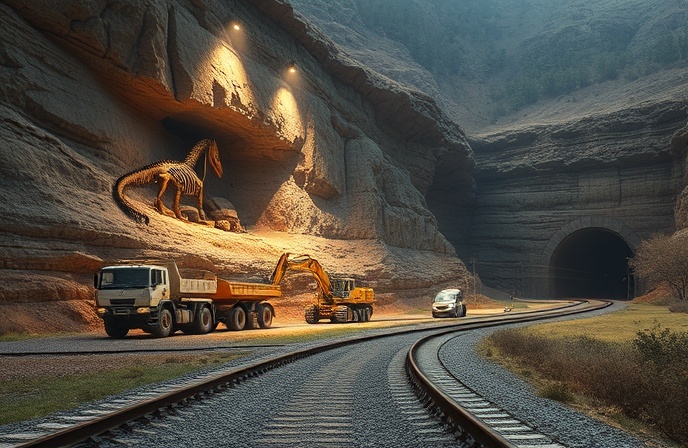
A temporary display at the Oxford University Museum of Natural History (OUMNH) features fossil finds from railway construction projects in Buckinghamshire, Oxfordshire, and West Northants. These include the remains of marine reptiles, specifically ichthyosaurs, and other creatures from the Jurassic Period (201 to 145 million years ago).
Fossil Discoveries
The display includes fossils discovered by contractors during the construction of cuttings and tunnels across Buckinghamshire, Oxfordshire, and West Northants. These discoveries provide insight into life beneath the seas that covered central England during the Jurassic Period. The oldest ichthyosaur found during the project is estimated to be around 183 million years old. The remains were discovered near Greatworth in Northamptonshire, during the construction of a cut and cover ‘green tunnel’. The remains consist of a well-preserved section of tail and lower body. The animal, which would have fed on crustaceans and fish, was between 3 to 4 metres long. The remains of a second ichthyosaur were discovered near Waddesdon in Buckinghamshire. It is thought to be around 25 million years younger and would have been around 5 to 6 metres long. The remains consist of 18 vertebrae along with several neural spines and ribs, indicating that the Waddesdon ichthyosaur was likely scavenged by other predators after it died, with the bones scattered across the seabed.
Historical Context
The display also showcases archive material from Professor John Phillips (1800-1874), the OUMNH’s first Keeper. Phillips, a field geologist and palaeontologist, recognized the opportunities for geological study presented by the construction of the British railway network during the 19th century. He collected fossils during railway construction between London and Oxford and authored “Railway Excursions from York, Leeds and Hull” (1855), which combined geological observations with commentary on the changing landscape.
HS2 Project and Collaboration
The discovery of the HS2 fossils was coordinated by engineering geologists working for HS2’s main works contractor EKFB – a team made up of Eiffage, Kier, Ferrovial Construction and Bam Nuttall. EKFB is building an 80km stretch of the new railway from the Chilterns to South Warwickshire, passing through a 200-million-year cross-section of Jurassic geology. The contractor team facilitates visits by academic geologists and researchers to allow for sample collection and study. The first ichthyosaur was found during a site visit by Dr Murray Edmonds, Sally Hollingsworth and Dr Neville Hollingworth, and recovered for preservation by natural history conservator Nigel Larkin, and ichthyosaur expert Dr Dean Lomax.
Last June 2025, we published an article about Renfe’s cutting-edge Aranjuez maintenance hub that’s boosting Cercanías efficiency. Click here to read – Future of Rail: Renfe’s Railway Technology Hub, Aranjuez: Essential Guide
Future of the Finds
EKFB’s Lead Geologist, Giles Hemmings, stated that all specimens uncovered during the HS2 project will be offered to museum collections, including OUMNH, for future research. Once the temporary display finishes, the remains of the Waddesdon ichthyosaur will be donated to Discover Bucks, in Aylesbury.
Conclusion
The Oxford University Museum of Natural History is displaying fossil finds from railway construction projects, including ichthyosaur remains, offering insight into the Jurassic Period and highlighting the historical link between railway development and geological discovery. The finds from the HS2 project will be preserved for future research and education.
Company Summary
EKFB: EKFB is HS2’s main works contractor. The team is made up of Eiffage, Kier, Ferrovial Construction and Bam Nuttall, responsible for building an 80km stretch of the new railway from the Chilterns to South Warwickshire.
Oxford University Museum of Natural History (OUMNH): Established in 1860, the OUMNH houses scientific collections and hosts public exhibitions and research.
Discover Bucks: The destination for the Waddesdon ichthyosaur once the temporary display is over.

Railway infrastructure, rolling stock and transport technologies specialist focused on global rail industry developments, high-speed rail systems, signaling technologies and freight transportation. Covering railway investments, public transport modernization, rail operations and international mobility projects across Europe, Asia and North America.
RELATED POSTS
August 4, 2026 1:11 pm
Hitachi Rail Canada secured a $407.7M contract to install CBTC...

August 4, 2026 11:12 am
MBTA confirmed a $150.8 million overhaul of the 85-year-old Green...
August 1, 2026 7:56 am
BMZ delivered two new TEM18DM diesel shunting locos to RZD...

August 5, 2026 7:11 pm
JR Central secured Shizuoka governor approval July 7, 2026 for...
August 1, 2026 3:17 pm
A UK firm since 2008 launched QR Shinkansen tickets for...
August 1, 2026 8:06 pm
European Commission approved a regulation on 9 July 2026 requiring...