
Poland’s Małaszewicze Terminal: Rail Logistics Transformation
Poland’s Container Terminal Mala to build intermodal terminal, boosting EU transport. Project, with TorKol, aims to connect East and West via rail.
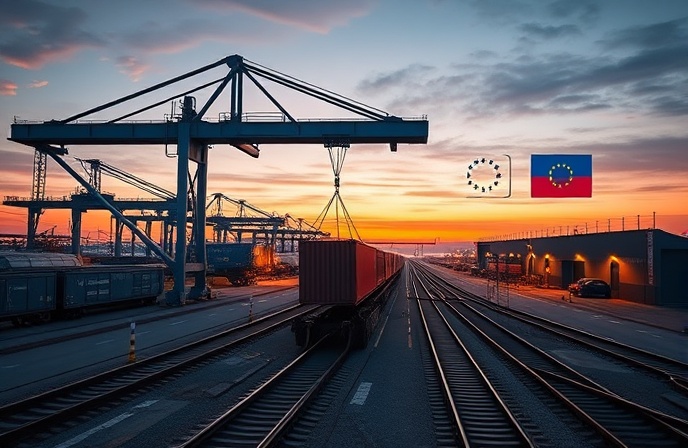
Major Intermodal Terminal Poised to Transform Poland’s Logistics Landscape
In a move set to significantly bolster Poland’s strategic position within the European Union’s (EU) transport infrastructure, Container Terminal Mala, a subsidiary of CLIP Group, has contracted Polish infrastructure giant TorKol to construct a state-of-the-art intermodal terminal in Małaszewicze. This project, officially commencing with the signing of an agreement between the two companies, is slated for completion by June 2026. Located on the EU border, specifically within the Małaszewicze Free Customs Area, the terminal is strategically positioned to serve as a pivotal gateway, facilitating the crucial flow of goods between East and West. The project represents one of the most substantial logistics investments in Central and Eastern Europe in recent years. This article explores the specifics of this landmark undertaking, examining its planned operational capabilities, the technological advancements it will incorporate, and the broader implications for Poland’s role in global trade.
Strategic Location and Operational Scope
The Małaszewicze terminal’s location is paramount to its strategic importance. Positioned at a vital junction, it directly straddles the border between the EU customs area and the extensive Eurasian transport corridors. This advantageous placement allows for efficient handling of major freight flows. The facility will be designed to accommodate two principal transit streams: those originating from China and destined for Europe, and vice-versa. It will provide extensive capabilities for both rail–road and rail–rail transfers, importantly including transfers between broad-gauge (1,520 mm) and standard-gauge (1,435 mm) rail systems. This dual-gauge capability is essential for seamless cargo transitions between the differing rail systems used in Eastern and Western Europe. The handling of both direct and indirect flows will significantly enhance the efficiency of transshipment activities.
Infrastructure Development and Technological Integration
The project’s detailed scope highlights the commitment to establishing a fully modern and efficient terminal. The infrastructure development incorporates the creation of entirely new track infrastructure, alongside upgrades to existing arrival and departure tracks. Additionally, the plans include the construction of extensive yards, access roads equipped with detailed technical facilities, the integration of advanced handling equipment, and the implementation of next-generation IT systems. This combination of upgraded legacy infrastructure and advanced technology will ensure the facility operates smoothly, efficiently and with high-throughput capacity. The integrated IT systems are anticipated to streamline operations, manage inventory effectively, and provide real-time visibility to supply chain participants, further enhancing efficiency and performance.
TorKol’s Expertise and Design-and-Build Approach
TorKol, with its headquarters in Tychy, Poland, will undertake the project as the main contractor, utilizing a design-and-build approach. The company is bringing its extensive experience in railway line construction and modernization, as well as in the development of logistics facilities. The design-and-build model simplifies project management, increasing the chances of it remaining within budget. TorKol’s responsibility encompasses the entire design and build process, ensuring close coordination, the maintenance of high-quality standards, and the timely completion of the terminal by June 2026. This approach streamlines the construction timeline and allows for the efficient integration of innovative technologies and infrastructure, leading to optimized terminal functionality.
Industry Implications and Future Outlook
The successful completion of the Małaszewicze terminal promises to reshape the logistics landscape in Poland and beyond. This infrastructure enhancement will undoubtedly boost East–West rail freight capacity, offering a more sustainable and efficient alternative to road transport. The project is expected to generate significant employment opportunities, fostering regional economic growth and reinforcing Poland’s position as a key transport hub within Europe. The strategic location of the terminal makes it ideally suited to handle the growing volume of cargo traveling between Asia and Europe, cementing Poland’s importance in international trade. Additionally, the adoption of advanced technologies will likely drive innovation in other infrastructure projects and improve efficiency standards across the European rail network, setting a new benchmark for intermodal terminals.
Company Summary
CLIP Group: An established logistics operator with a significant presence in intermodal transport and freight forwarding across Central and Eastern Europe. Specializes in optimizing supply chains through integrated solutions.
TorKol: A Polish infrastructure company recognized for its expertise in railway construction, modernization and large-scale logistics projects. Known for delivering complex projects on time and within budget, with a strong commitment to quality.

Railway infrastructure, rolling stock and transport technologies specialist focused on global rail industry developments, high-speed rail systems, signaling technologies and freight transportation. Covering railway investments, public transport modernization, rail operations and international mobility projects across Europe, Asia and North America.
RELATED POSTS

October 8, 2026 1:15 pm
Alstom secured a €1bn contract to build 13 automated trains,...

October 1, 2026 7:09 am
United States regulators confirmed a September 30 deadline for the...

October 4, 2026 5:14 pm
Alstom secured a CA$4.7 billion order from VIA Rail Canada...

October 5, 2026 6:12 pm
AECOM and Jacobs secured a contract in September 2026 to...

October 1, 2026 12:13 am
Illinois approved $1.5 billion annually for the Northern Illinois Transit...

October 4, 2026 11:08 pm
Sound Transit confirmed the September 30 opening of Seattle Pinehurst...