
Amtrak Completes $250M Seattle Maintenance Facility
Amtrak invested $250 million in a Seattle maintenance facility, opening the site $50 million under budget to service new Airo trainsets on the Cascades route.
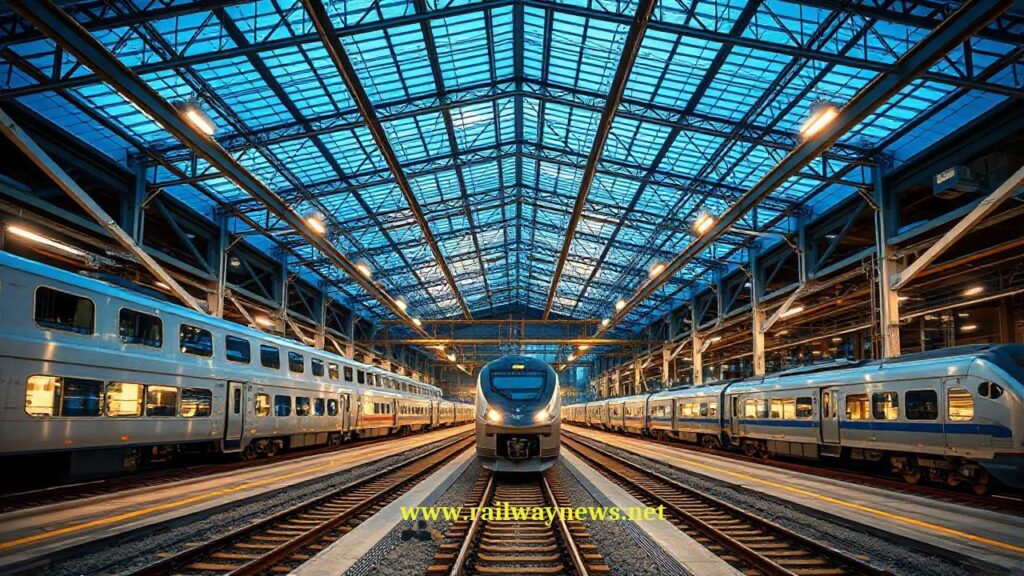
⚡ In Brief: Amtrak completed a $250 million, 100,000-square-foot maintenance and inspection facility in Seattle $50 million under budget to service its newly introduced Airo trainsets operating along the Pacific Northwest Cascades corridor.
SEATTLE, UNITED STATES – Amtrak opened its new $250 million Seattle Maintenance and Inspection Facility on schedule to service the newly deployed Airo passenger trainsets operating along the Cascades corridor. The site represents the first completed facility of six planned fleet maintenance hubs across the national passenger network. Commercial maintenance operations will scale up across the site in sequential phases through the end of 2026.
What Is the Full Scope of This Project?
The Seattle Rail Yard development adds a nearly 100,000-square-foot facility capable of servicing entire trainsets under a single roof. The building incorporates three continuous tracks equipped with a drop table, a split rail system, an overhead bridge crane, a monorail crane, an automated sanding system, and a dedicated diesel exhaust extraction system. While the initial capital plan budgeted $300 million for the works, execution wrapped up at $250 million, yielding a $50 million savings. The facility will execute primary maintenance, mandatory daily inspections, and heavy overhaul operations for the multi-powered Airo equipment manufactured by Siemens Mobility. Specific contractor allocations and construction joint venture member identities were not disclosed by Amtrak at the time of publication.
Key Project Data
| Parameter | Value |
|---|---|
| Project / Contract Name | Seattle Maintenance and Inspection Facility |
| Total Value | $250 million (completed $50 million under budget) |
| Parties Involved | Amtrak, Washington State Department of Transportation, Oregon Department of Transportation |
| Timeline / Completion | Phased commissioning through late 2026 |
| Country / Corridor | United States / Amtrak Cascades Corridor (Pacific Northwest) |
How Does This Compare to Similar Projects?
Delivering major North American passenger rail infrastructure under budget contrasts sharply with recent regional rail transit benchmarks. Maryland’s 16-mile Purple Line light rail project faced recurring construction disputes and testing setbacks, pushing its opening from an original target of spring 2022 to late 2027 at the earliest (Source: Bethesda Magazine, 2025). Amtrak avoided similar capital escalation in Seattle by building on brownfield land inside its existing operational yard, averting external right-of-way acquisition disputes. However, the capital expenditure profile for the remaining five regional support facilities across Amtrak’s national network remains unannounced. Independent verification of the budget totals for the upcoming five sites was not available at time of publication.
Editor’s Analysis
The Seattle opening reflects an operational shift toward preventative maintenance depots tailored to dual-power rolling stock fleets. As the global railway rolling stock market expands from $4.1 billion in 2025 toward $6.8 billion by 2035, operators must modernise maintenance facilities to handle integrated push-pull trainsets without uncoupling individual railcars (Source: Future Market Insights, 2025). Completing the site $50 million under budget gives Amtrak a credible template for its remaining five planned maintenance hubs across the United States.
FAQ
Q: What is the primary purpose of the new Seattle rail facility?
A: The facility provides three tracks for inspections, scheduled maintenance, and heavy overhauls for Amtrak’s new Airo trainsets. It allows workers to service an entire multi-car trainset indoors without decoupling individual carriages.
Q: When will the Seattle Maintenance and Inspection Facility become fully operational?
A: The building opened in late 2026 for initial operations following its ribbon-cutting ceremony. Operations will continue activating in phases through the end of 2026.
Q: Which passenger rail routes benefit from this infrastructure investment?
A: The facility directly maintains the Amtrak Cascades service operating between Vancouver, British Columbia, Seattle, Washington, and Eugene, Oregon. It serves as the primary base for the corridor’s newly deployed train fleet.

Railway infrastructure, rolling stock and transport technologies specialist focused on global rail industry developments, high-speed rail systems, signaling technologies and freight transportation. Covering railway investments, public transport modernization, rail operations and international mobility projects across Europe, Asia and North America.
RELATED POSTS
October 8, 2026 1:15 pm
Alstom secured a €1bn contract to build 13 automated trains,...
October 1, 2026 7:09 am
United States regulators confirmed a September 30 deadline for the...
October 4, 2026 5:14 pm
Alstom secured a CA$4.7 billion order from VIA Rail Canada...
October 5, 2026 6:12 pm
AECOM and Jacobs secured a contract in September 2026 to...
October 1, 2026 12:13 am
Illinois approved $1.5 billion annually for the Northern Illinois Transit...
October 4, 2026 11:08 pm
Sound Transit confirmed the September 30 opening of Seattle Pinehurst...