
Dhaka MRT Line 6: L&T’s Rail Tech Advancements
Dhaka’s MRT Line 6: L&T’s massive $470 million contract integrates cutting-edge rail technology, from CBTC signaling to ballastless track. Discover how!
This article examines the significant contract awarded to a Larsen & Toubro (L&T) and Marubeni joint venture (JV) for the design and construction of critical electrical and mechanical systems for Dhaka’s Mass Rapid Transit (MRT) Line 6. This $470 million project represents a substantial investment in Bangladesh’s burgeoning public transportation infrastructure and highlights the growing global demand for advanced, integrated rail solutions. The scope of the project extends beyond simply supplying equipment; it encompasses a detailed design-build approach, including a six-year maintenance agreement, showcasing a commitment to long-term operational efficiency and system reliability. This detailed analysis will explore the technological complexities involved, the strategic implications for L&T and Marubeni, and the wider impact on Dhaka’s urban development and transportation landscape. We’ll delve into the specific systems being implemented, the challenges of integrating various technologies, and the potential for future expansion of similar projects in developing nations.
System Integration and Technological Advancements
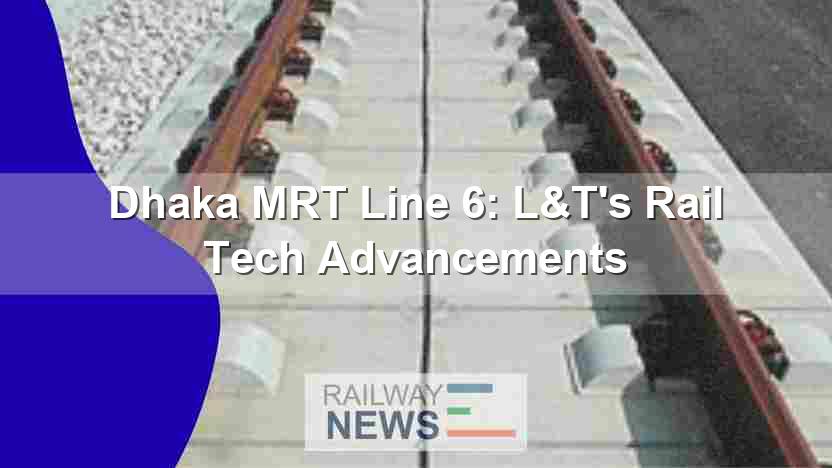
The L&T-Marubeni JV’s contract encompasses a wide range of sophisticated systems vital for a modern, efficient metro line. This includes the construction of a ballastless track system in the mainline, significantly enhancing operational smoothness and reducing maintenance needs compared to traditional ballasted track. Eight 1,500VDC traction substations (TSS) will provide the power for train operation. A feeder messenger type Direct Current Overhead Catenary System (OCS) will deliver power to the trains, while an Energy Storage System (ESS) will enhance grid stability and potentially improve energy efficiency. Additionally, the implementation of a Communication-Based Train Control (CBTC) signaling system is crucial for ensuring safe, efficient, and high-frequency train operations. The inclusion of a Long Term Evolution (LTE) based telecommunication system and a detailed radio communication system underpins reliable communication across the entire network. Finally, the project integrates an Automatic Fare Collection system, platform screen doors for passenger safety, and lifts and escalators for accessibility.
Power Infrastructure and Grid Integration
L&T’s power transmission and distribution unit plays a critical role in ensuring a reliable power supply for the MRT system. This involves constructing 132kV Geographic Information System (GIS)-based receiving substations, managing Extra High Voltage (EHV) cables from grid substations, and establishing auxiliary substations at stations and the depot. A 33kV cable network will run along the viaduct, and a Supervisory Control and Data Acquisition (SCADA) system will monitor and control the entire power supply network. This intricate power infrastructure is crucial for the consistent and dependable operation of the MRT Line 6. The integration of these components highlights the complex interplay between power systems and railway operations, necessitating seamless coordination and robust design.
Project Funding and Significance for Dhaka
The Dhaka Mass Rapid Transit Development Project (MRT Line 6) receives funding from the Japan International Cooperation Agency (JICA) under a bilateral aid agreement. This underscores the international collaboration vital for such large-scale infrastructure developments. The project connects Uttara and Motijheel, two key areas of Dhaka, traversing Pallabhi and Mirpur. The elevated system, incorporating 16 stations and a dedicated maintenance depot, promises significant improvements in Dhaka’s public transportation network. It addresses the city’s escalating traffic congestion and growing demand for efficient and reliable mass transit solutions. The 16 stations will serve a large population, improving commutes, accessibility, and overall quality of life. The modern system is expected to reduce travel time and alleviate traffic congestion in the city.
Strategic Implications and Future Prospects
For L&T, this contract builds upon their previous successes, aligning with their strategic vision of becoming a “Full Range Rail System Integrator.” Securing such a large-scale project through global competitive bidding demonstrates their expertise in delivering complex, integrated rail systems. The success of this project will likely open doors for future opportunities in similar developing markets, further establishing L&T as a key player in the global railway sector. The project’s successful completion serves as a benchmark for future mass transit projects within Bangladesh and beyond, potentially inspiring similar infrastructure developments in other rapidly urbanizing regions facing similar transportation challenges. The innovative use of technology like CBTC and ESS signals a shift towards more sustainable and advanced rail solutions for urban centers worldwide. The successful integration of diverse systems and technologies within a complex urban environment provides valuable lessons for future large-scale railway projects in similar contexts.
Conclusion
The L&T-Marubeni JV’s award of the $470 million contract for Dhaka’s MRT Line 6 represents a significant milestone in Bangladesh’s infrastructure development and underscores the increasing global demand for advanced rail systems. The project’s scope, encompassing a wide range of sophisticated technologies and systems, showcases the complexities of modern railway construction. From the ballastless track and CBTC signaling to the intricate power infrastructure and integrated fare collection, each component is vital for the efficient and safe operation of the system. The strategic importance of the project extends beyond immediate transportation improvements, impacting Dhaka’s urban development, economic growth, and the positioning of L&T as a leading global rail system integrator. The successful completion of this project, financed by JICA and executed with meticulous attention to detail, offers a blueprint for future large-scale transportation projects in developing nations worldwide. The adoption of state-of-the-art technologies such as LTE communication, sophisticated power management systems, and automated fare collection systems signifies a leap forward in urban transit infrastructure, paving the way for a more efficient, sustainable, and accessible transportation future for Dhaka and potentially for other cities facing similar challenges.

Railway infrastructure, rolling stock and transport technologies specialist focused on global rail industry developments, high-speed rail systems, signaling technologies and freight transportation. Covering railway investments, public transport modernization, rail operations and international mobility projects across Europe, Asia and North America.
RELATED POSTS

October 8, 2026 1:15 pm
Alstom secured a €1bn contract to build 13 automated trains,...

October 1, 2026 7:09 am
United States regulators confirmed a September 30 deadline for the...

October 8, 2026 12:18 pm
Siemens Mobility signed an agreement with VinSpeed to supply 350...

October 4, 2026 5:14 pm
Alstom secured a CA$4.7 billion order from VIA Rail Canada...

October 5, 2026 6:12 pm
AECOM and Jacobs secured a contract in September 2026 to...

October 1, 2026 12:13 am
Illinois approved $1.5 billion annually for the Northern Illinois Transit...