
Ipoh-Padang Besar Railway Project Completes Double Track Upgrade
Malaysia’s Ipoh-Padang Besar Electrified Double Track railway project is complete, boosting capacity and speed. This RM16.5 billion upgrade modernizes the nation’s rail network.
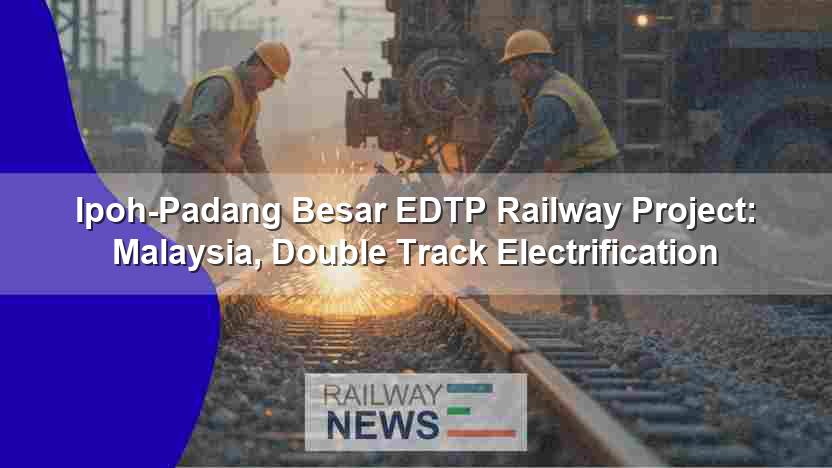
This article analyzes the Ipoh-Padang Besar Electrified Double Track (EDTP) project, a significant undertaking aimed at modernizing Malaysia’s railway infrastructure and bolstering its economic development. The project’s primary goals include enhancing passenger and freight capacity, improving journey times, and increasing the profitability of Keretapi Tanah Melayu Bhd (KTMB), Malaysia’s national railway operator. The project’s scale and complexity present substantial challenges, ranging from logistical hurdles to managing the financial implications of a project of this magnitude. This analysis will explore the project’s scope, the challenges encountered, and the potential long-term impacts on Malaysia’s transportation network and economy. A key focus will be on assessing the project’s success in achieving its stated objectives, and identifying potential lessons for future large-scale infrastructure projects.
Project Overview and Objectives
The EDTP project, spanning 329 kilometers, links Ipoh in Perak state to Padang Besar in Perlis state, a border town with Thailand. This ambitious undertaking aimed to replace the existing single-track line with a modern, electrified double-track system. The project’s primary objectives included significantly increasing passenger and freight capacity to meet projected demand growth, dramatically reducing journey times, and improving the overall efficiency and profitability of KTMB’s operations. The project was envisioned as a cornerstone of a larger national strategy to shift a significant portion of transportation away from congested road networks and towards a more efficient and sustainable rail system.
Construction and Challenges
The project’s construction faced numerous challenges. The multi-layer construction method, while allowing for simultaneous work across four states (Perak, Penang, Kedah, and Perlis), also presented complex logistical issues. The procurement and management of vast quantities of materials – including two million pre-cast concrete sleepers, 1.5 million tons of cement, and 400,000 tons of steel – were major undertakings. The project also involved the construction of numerous bridges (including a 282-meter swing bridge in Prai and a 3.5km marine viaduct at Bukit Merah), tunnels (including Southeast Asia’s longest railway tunnel at 3.3km in Bukit Berapit), and new stations (21 in total, including four major stations). Additionally, unforeseen circumstances, such as a flood caused by damage to a river bund, and delays related to land acquisition and resettlement of squatters, led to significant schedule slippage and cost overruns.
Financial Aspects and Cost Overruns
Initially budgeted at RM12.48 billion, the project’s final cost escalated to RM16.5 billion due to rising material costs (especially oil and steel) and unforeseen delays. The decision to not electrify the Butterworth-Padang Besar section, primarily used for freight, partially mitigated these cost overruns. The project was awarded to MMC-Gamuda, a joint venture, on a design-and-build basis, with a crucial stipulation that the contractor absorb any additional costs beyond the initial contract price. This demonstrates a high-risk approach, emphasizing the need for thorough cost estimation and risk management in large-scale infrastructure projects.
Rolling Stock and Operational Improvements
The EDTP project included significant upgrades to rolling stock. The project facilitated the transition from three-car to six-car Electric Multiple Units (EMUs), manufactured by Mitsubishi Electric and Rotem, boosting passenger capacity and comfort. These EMUs are designed for speeds of 160-180 km/h, though operational speeds are expected to be maintained between 140-160 km/h. The increased train frequency (from 15 to 10 minutes during peak hours) and the significant expansion in the number of daily services were intended to drastically improve the efficiency and passenger experience on the line. The project aimed to leverage these improvements to increase both passenger and freight volumes significantly.
Project Summary Table
| Project Parameter | Value |
|---|---|
| Project Name | Ipoh-Padang Besar Electrified Double Track (EDTP) |
| Project Length | 329 km |
| Total Project Cost | RM 16.5 billion |
| Type of Project | Railway Electrification and Double Tracking |
| Connecting Cities | Ipoh & Padang Besar |
| Number of Stations | 21 (4 major, 17 minor) |
| Contractor | MMC-Gamuda (Joint Venture) |
Conclusions
The Ipoh-Padang Besar EDTP project represents a significant investment in Malaysia’s railway infrastructure. While the project experienced cost overruns and delays, primarily due to unforeseen circumstances and escalating material prices, it achieved its core objective of establishing a modern, electrified double-track railway line. This improved line has significantly increased capacity for both passenger and freight transport, offering faster and more reliable service. The increased efficiency and capacity should lead to substantial economic benefits, including improved connectivity, reduced reliance on congested roads, and increased revenue for KTMB. The project highlights the complexities inherent in large-scale infrastructure projects, emphasizing the critical need for robust project management, detailed risk assessment, and meticulous cost estimation to ensure projects are completed within budget and on schedule. The project serves as a valuable case study in the challenges and rewards of modernizing a nation’s transportation infrastructure, providing insights that can inform future infrastructure development initiatives across the globe.
The success of the project ultimately hinges on its long-term performance and its ability to generate sufficient revenue to offset its substantial cost. The increased efficiency and capacity should lead to substantial economic benefits, including improved connectivity, reduced reliance on congested roads, and increased revenue for KTMB. Continued monitoring of passenger and freight volumes, operational efficiency, and the financial performance of KTMB will be crucial in evaluating the project’s overall success and long-term impact on Malaysia’s economy and transport system.
Company Information:
Keretapi Tanah Melayu Bhd (KTMB): Malaysia’s national railway operator.
MMC-Gamuda: A joint venture company that served as the main contractor for the EDTP project.
Mitsubishi Electric & Rotem: Companies that supplied the six-car EMUs for the project.

Railway infrastructure, rolling stock and transport technologies specialist focused on global rail industry developments, high-speed rail systems, signaling technologies and freight transportation. Covering railway investments, public transport modernization, rail operations and international mobility projects across Europe, Asia and North America.