
Murcia-Lorca HSR: Track Installation Contract Awarded
**Option:**
High-speed rail is accelerating! ADIF AV awards a track installation contract for the Murcia-Lorca section, part of the vital Murcia-Almería HSR project.
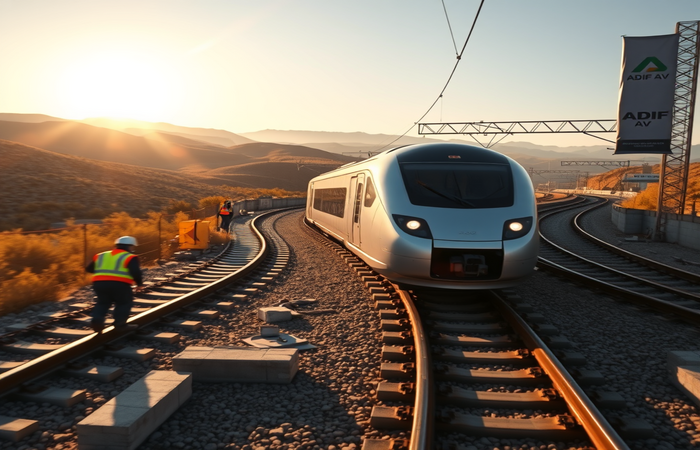
High-Speed Rail Development: Track Installation Contract Awarded on Murcia-Lorca Section
Murcia, Spain – October 26, 2023 – The advancement of high-speed rail infrastructure in Spain continues with a significant step forward on the Murcia-Almería High-Speed Railway (HSR) project. ADIF AV (Administrador de Infraestructuras Ferroviarias de Alta Velocidad), the Spanish railway infrastructure administrator, has awarded a substantial contract for track installation works on the Murcia-Lorca high-speed section. This 57.5 km stretch is a crucial segment of the broader 193 km Murcia-Almería HSR, representing the first half of the high-speed connection between the two cities. The EUR 38 million contract highlights the ongoing commitment to expanding Spain’s high-speed rail network, promising enhanced connectivity and economic benefits for the region. This article explores the details of the project, exploring the scope of the works, the progress made, and the future prospects for this vital transportation link.
Track Installation and Component Procurement
The recently awarded contract specifically focuses on the intricate task of laying the railway track between Nonduermas, marking the end of the Murcia integration section, and Lorca station. This involves the installation of all essential track components, including the rails, ballast, sleepers, and switches. These components are fundamental to ensuring the safety and efficiency of high-speed rail operations. The project’s scale is evident in the prior commitment by ADIF to secure these crucial components. The supply contracts for these items total EUR 97 million, demonstrating a significant investment in the project’s success. Additionally, the construction of a dedicated logistics base in Librilla, valued at EUR 26.8 million, will serve as the central hub for coordinating the track-laying works. Upon completion of the railway line, this facility will be repurposed as a maintenance depot, ensuring the long-term functionality and upkeep of the infrastructure.
Platform Construction and Sectional Progress
Simultaneously with the track installation works, significant progress is being made on constructing the railway platform, the base upon which the track will be laid. The platform construction has already been finalized on the Nonduermas–Sangonera subsection. The subsequent subsections, namely Sangonera–Totana, Totana–Totana, and Totana–Lorca, have reached advanced stages of completion, with construction progress ranging between 70% and 90%. This section of the HSR presents unique engineering challenges and includes several notable structures, such as the Alhama viaduct and its accompanying station. The route also encompasses key stations at Totana, Lorca San Diego, and La Hoya, designed to facilitate passenger access and promote regional connectivity. These developments signify a concerted effort to meet project deadlines and advance the completion of this critical high-speed rail link.
Electrification and Future Expansion
Beyond track installation and platform construction, the electrification of the line is also progressing in parallel. This includes the construction of the Totana electrical substation, a critical component for powering the high-speed trains. Simultaneously, the installation of the overhead catenary systems, essential for providing electrical power to the trains, is underway along the first half of the route. Moreover, preparatory works for track installation are also progressing on the second half of the high-speed line, between Lorca and Almería, which covers a distance of 138 km. The project design for the track-laying works is being drafted followed by the launch of the tender. The construction of the platform is also advancing on the Lorca – Almería section across six subsections, with work underway on the remaining sections, including the approaches to Almería and the section traversing Lorca. Additionally, the final design phase is nearing completion for the Pulpí–Águilas connection. These combined efforts demonstrate a detailed approach to building a modern high-speed rail network.
Conclusion
In summary, the award of the track installation contract on the Murcia-Lorca section marks a significant milestone in the Murcia-Almería HSR project. The EUR 38 million investment, coupled with the earlier procurement of track components and the construction of the Librilla logistics base, highlights the financial commitment and logistical planning underpinning this ambitious undertaking. The progress of platform construction on various subsections, along with ongoing electrification efforts, further demonstrates the multi-faceted approach being employed to realize this high-speed rail link. The project’s overall impact extends beyond mere infrastructure development. It will enhance regional connectivity, reduce travel times, and contribute to economic growth. The Murcia-Lorca section’s development, as the initial phase of the broader Murcia-Almería HSR, is instrumental in fostering improved transportation, creating employment opportunities, and facilitating tourism, thereby boosting the economic landscape of the region. The continuous advancements in the track-laying, electrification, and platform construction phases demonstrate the project’s commitment to schedule, ensuring the timely delivery of a modernized railway system that will cater to the demands of both passengers and freight in the coming years.
Short summary about companies:
ADIF AV (Administrador de Infraestructuras Ferroviarias de Alta Velocidad): The Spanish railway infrastructure administrator, responsible for the development and management of high-speed rail infrastructure in Spain. They are the client and awarding authority for the contracts discussed in the article.

Railway infrastructure, rolling stock and transport technologies specialist focused on global rail industry developments, high-speed rail systems, signaling technologies and freight transportation. Covering railway investments, public transport modernization, rail operations and international mobility projects across Europe, Asia and North America.
RELATED POSTS

September 5, 2026 4:19 pm
CPK launched formal tender talks with four consortia to design...
September 6, 2026 6:17 am
Hungary ordered a national ban on most freight trains from...
September 5, 2026 6:17 pm
Universal Signalling won a deal to install its U-Cross system...
September 6, 2026 8:17 am
DB InfraGO reopened the Nuremberg-Regensburg line in Bavaria on 31...
September 6, 2026 12:20 pm
Indian Railways ordered a probe after a fire destroyed 2...
September 7, 2026 11:16 pm
China Railway Tunnel Group completed the 11.3-km underwater Yangtze tunnel...