
VIA Rail Strike Looms: Impact on Passengers and Economy
Canada’s national passenger rail service, VIA Rail Canada, faces a potential strike due to significant union dissatisfaction with proposed concessions from the company following unsuccessful contract negotiations.
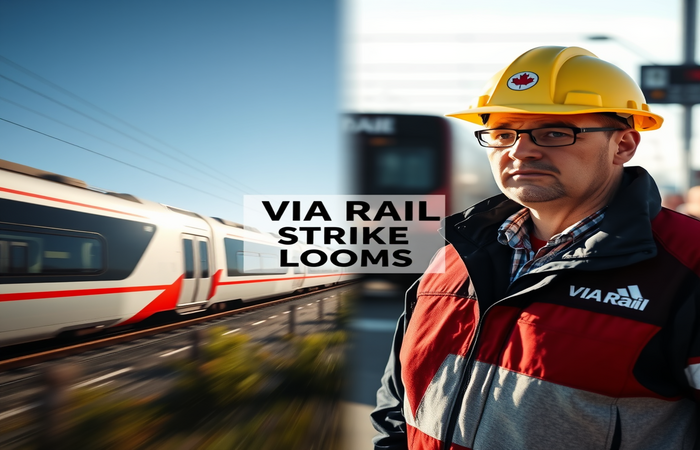
Canada, May 15, 2024 – A potential strike looms over VIA Rail Canada, the country’s national passenger rail service, as Unifor Council 4000 and Local 100, representing a significant portion of the railway’s workforce, have voted overwhelmingly in favor of strike action. The announcement follows unsuccessful contract negotiations between the union and VIA Rail. This development has the potential to disrupt passenger rail service across the country, impacting commuters, tourists, and businesses that rely on VIA Rail’s network. The current situation hinges on the outcome of a conciliation period facilitated by federal officers, which concludes at the end of May, and a subsequent cooling-off period. The core issues at the heart of the dispute revolve around the union’s dissatisfaction with VIA Rail’s proposals, which Unifor views as concessions, and the company’s alleged failure to adequately address the union’s monetary demands. The coming weeks will be crucial in determining whether a mutually agreeable contract can be reached, averting a strike that could bring significant operational challenges. The details of the negotiations and the potential impact on rail services are explored in the following chapters.
Negotiation Impasse: Unpacking the Core Issues
The breakdown in negotiations between Unifor (Unifor Council 4000 and Local 100) and VIA Rail stems from several key disagreements. Primarily, the union alleges that VIA Rail is pressing for major concessions, which the union is unwilling to accept. Concessions can encompass a range of issues, including changes to employee benefits, work rules, and wage structures, often aimed at reducing operational costs. Moreover, Unifor has expressed frustration over the company’s perceived lack of responsiveness to the union’s monetary proposals, which likely include demands for wage increases and improved benefits. The union’s press release highlights the crucial importance of reaching a “fair agreement,” indicating their commitment to protecting the interests of its members. The specific details of the disputed proposals are not yet public, but these are the central reasons behind the negotiations’ deadlock. The 60-day conciliation period facilitated by federal officers and the subsequent cooling-off period are mechanisms designed to help both sides reach an agreement.
The Legal Framework and Potential Timelines
The legal framework governing the labor dispute is critical in understanding the potential timelines and potential impact. In Canada, labor relations are typically governed by federal and provincial laws. In this case, given that VIA Rail is a federal crown corporation, the Canada Labour Code (CLC) applies. The CLC mandates specific procedures that must be followed before a legal strike or lockout can occur. The current situation has advanced through conciliation, a process overseen by federal officers whose role is to assist in mediating a settlement. The 60-day conciliation period must conclude before further action can be taken. Following conciliation, a 21-day cooling-off period is mandated. This period gives both parties time to reassess their positions and potentially seek a compromise. If no agreement is reached within the cooling-off period, the union can legally initiate a strike. In this scenario, Unifor members could begin a legal strike on June 22.
The Potential Consequences of a Strike
A strike by Unifor members would have significant repercussions for VIA Rail’s operations and the Canadian traveling public. VIA Rail operates a vast network, connecting major cities and regional centers across Canada. A work stoppage would likely lead to the cancellation of train services, severely disrupting passenger travel and freight transport, if applicable. This would affect a wide range of individuals, including commuters, tourists, business travelers, and those who rely on VIA Rail for essential transportation needs. In addition to passenger disruption, a strike could also impact the Canadian economy. Disrupted supply chains, reduced tourism revenue, and potential damage to the reputation of VIA Rail are all possible consequences. The extent of the impact would depend on the duration of the strike and the specific job functions of the workers involved.
Conclusion: Navigating the Crossroads
The situation between Unifor and VIA Rail is currently at a critical juncture, with the potential for a strike looming large over Canada’s passenger rail network. The central points of contention revolve around the union’s opposition to what it perceives as concessions and its dissatisfaction with VIA Rail’s response to monetary proposals. The 97.5% vote in favor of strike action demonstrates the strong resolve of Unifor members and their commitment to securing a favorable contract. The legal framework, as dictated by the Canada Labour Code, outlines a clear path of procedures that must be followed before a strike can occur. The ongoing conciliation and subsequent cooling-off period are crucial stages in determining whether the two sides can bridge their differences and reach an agreement. The outcome will not only affect the union membership and VIA Rail itself but also have implications for the broader Canadian public and economy. The potential disruptions to passenger travel and freight transport could be substantial, highlighting the importance of finding a resolution that is acceptable to both parties. The next few weeks will be critical in determining whether a mutually agreeable contract can be reached, averting a strike that could bring significant operational challenges. A successful negotiation outcome is crucial, and the willingness of both parties to compromise and address the concerns raised will ultimately dictate the future of VIA Rail’s operations.
Short summary about companies:
VIA Rail Canada is a Canadian Crown corporation that operates intercity passenger rail services across Canada. Unifor is a Canadian labor union representing workers in various sectors, including transportation. Unifor Council 4000 and Local 100 represent VIA Rail employees.

Railway infrastructure, rolling stock and transport technologies specialist focused on global rail industry developments, high-speed rail systems, signaling technologies and freight transportation. Covering railway investments, public transport modernization, rail operations and international mobility projects across Europe, Asia and North America.
RELATED POSTS

September 5, 2026 4:19 pm
CPK launched formal tender talks with four consortia to design...

September 6, 2026 4:12 am
Alstom delivered the first of 100 new G Class trams...
September 5, 2026 7:14 pm
HS2 Ltd signed renegotiated civils contracts with EKFB and Align...
September 5, 2026 6:17 pm
Universal Signalling won a deal to install its U-Cross system...

September 6, 2026 8:17 am
DB InfraGO reopened the Nuremberg-Regensburg line in Bavaria on 31...
September 6, 2026 12:20 pm
Indian Railways ordered a probe after a fire destroyed 2...