
Union Pacific vs Metra: Rail Access Dispute in Chicago
Chicago’s commuter rail service Metra is facing pressure from Union Pacific Railroad (UP) to accept a financial agreement reflecting market value for its use of UP’s rail lines, following over a decade of operating under below-market rates. This move underscores the ongoing negotiations surrounding shared infrastructure and highlights the complexities in balancing freight and passenger operators’ interests within a single network.
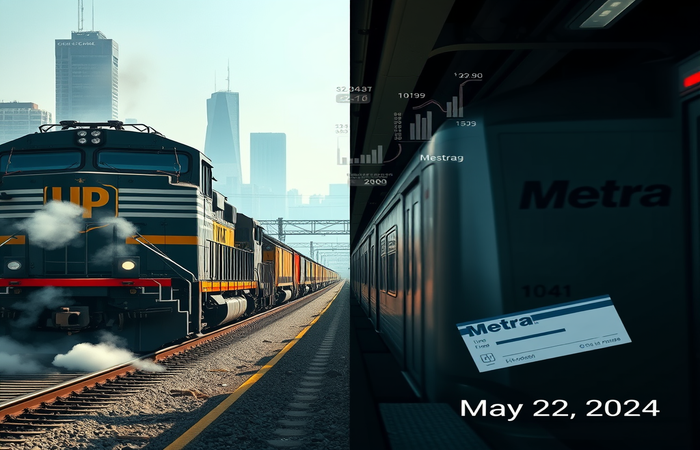
Chicago, USA – May 22, 2024
The intricate dance between freight and passenger rail operators in the United States has once again taken center stage. Union Pacific Railroad (UP), a major player in the North American rail network, has publicly issued a request for Chicago’s commuter rail service, Metra, to accept a financial agreement aligned with market value for the use of UP’s rail lines. This move underscores the ongoing negotiations surrounding track access and the financial implications for both entities. The crux of the matter lies in UP’s assertion that Metra has been operating under rates below commercial market value for over a decade. This article will delve into the details of this dispute, exploring the history of negotiations, the rationale behind UP’s decision, the potential ramifications for Metra, and the broader implications for the rail industry.
Negotiation Breakdown
For nearly six years, Union Pacific has been actively pursuing a revised agreement with Metra. The negotiations have involved various strategies, including direct offers, mediation attempts facilitated by the Surface Transportation Board (STB – the U.S. government agency that regulates railroads), and most recently, an offer to enter binding arbitration. Despite these efforts, a mutually agreeable solution has remained elusive. This lack of consensus has prompted UP to take a more decisive stance, publicly demanding a financial arrangement reflecting the current market value for track usage. This move highlights the complexities inherent in shared infrastructure arrangements, where the interests of freight and passenger operators can sometimes clash. The failure to reach an agreement through conventional means underscores the challenges in balancing the needs of both entities within a shared network.
UP’s Financial Justification
Union Pacific’s decision is driven by a fundamental responsibility to its stakeholders. As a private company, UP has a fiduciary duty to its shareholders, employees (30,000 strong), and the communities it serves across its 23-state network. The company argues that continuing to subsidize Metra’s operations at below-market rates is unsustainable. This stance aligns with standard business practices, where companies must ensure their operations are profitable and generate a return on investment. The specific details of the proposed rate increases were not publicly disclosed, but UP has stated that the new rates will be comparable to those paid by other passenger rail authorities in other states. This suggests a benchmark approach, aiming to align Metra’s payments with prevailing market conditions for similar services.
Operational and Contractual Details
The current agreement between UP and Metra is set to expire on July 1. The new rates proposed by UP are scheduled to take effect after this date. Simultaneously, UP recently transferred several of its commuter lines and approximately 800 employees to Metra. This transfer could potentially alter the dynamics of the relationship, with Metra assuming greater operational responsibility. The transition may also influence the negotiation process, with both entities needing to consider the evolving operational landscape. Additionally, the timing of UP’s public request, coinciding with the imminent expiration of the existing agreement, demonstrates the urgency and the critical importance of reaching a new contractual understanding.
Conclusion
The situation between Union Pacific and Metra exemplifies the ongoing tensions between freight and passenger rail operators. This situation involves financial disagreements, operational complexities, and the need for both parties to ensure long-term sustainability. The failure of negotiations over the past six years, despite various attempts at mediation and arbitration, suggests a significant impasse. UP’s decision to publicly demand market-value rates underscores its financial obligations to its stakeholders and reflects the broader trend of freight railroads seeking fair compensation for track access. The implementation of these new rates will directly affect Metra’s operational budget and could potentially influence its service offerings or require fare adjustments. For Metra, securing favorable terms is essential for maintaining its current level of service and meeting the needs of its ridership. This is against the backdrop of a changing operational landscape as a result of the transfer of commuter lines and employees. This dispute has significant implications for the future of rail infrastructure and the relationships between different rail operators. It highlights the critical importance of fair and transparent agreements in ensuring the efficiency and viability of the rail network.
Summary of Companies Involved
- Union Pacific Railroad (UP): A major freight railroad operating across a vast network in the United States, with a large number of employees and a responsibility to stakeholders, including shareholders and the communities they serve.
- Metra: A commuter rail service operating in the Chicago metropolitan area. Metra is responsible for the transportation of passengers and is seeking a fair agreement for the use of UP’s rail lines.

Railway infrastructure, rolling stock and transport technologies specialist focused on global rail industry developments, high-speed rail systems, signaling technologies and freight transportation. Covering railway investments, public transport modernization, rail operations and international mobility projects across Europe, Asia and North America.
RELATED POSTS

September 5, 2026 4:19 pm
CPK launched formal tender talks with four consortia to design...

September 5, 2026 7:14 pm
HS2 Ltd signed renegotiated civils contracts with EKFB and Align...

September 6, 2026 4:12 am
Alstom delivered the first of 100 new G Class trams...
September 6, 2026 8:17 am
DB InfraGO reopened the Nuremberg-Regensburg line in Bavaria on 31...
September 5, 2026 6:17 pm
Universal Signalling won a deal to install its U-Cross system...
September 6, 2026 12:20 pm
Indian Railways ordered a probe after a fire destroyed 2...