
Amtrak’s $5.4B Request: Rail’s Future?
The $5.4 billion funding request submitted to Congress by Amtrak includes a significant portion ($3.88 billion) for operational costs and infrastructure maintenance, while the remaining $1.55 billion is earmarked for capital projects aimed at modernizing and expanding the Northeast Corridor (NEC), including the Gateway project in New York City, with plans to add 39 new routes by 2035.
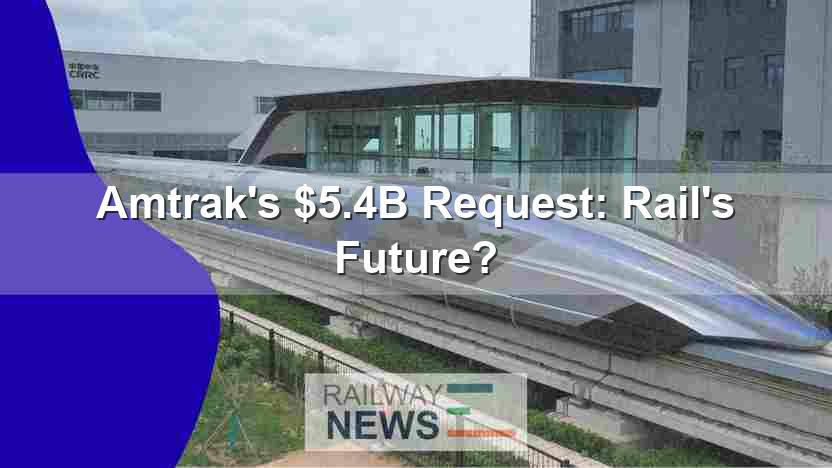
The financial health and future expansion of Amtrak (National Railroad Passenger Corporation), the United States’ national passenger rail system, are critically dependent on consistent and substantial federal funding. This article examines the recent $5.4 billion funding request submitted to the US Congress by Amtrak, delving into the justification for this substantial sum, the allocation of funds across various crucial projects, and the broader implications for the future of passenger rail in the United States. The request is not merely a reaction to the lingering financial impact of the COVID-19 pandemic, but also a strategic investment aimed at modernizing existing infrastructure, expanding service, and ultimately, bolstering the economic vitality of numerous communities across the nation. The subsequent analysis will explore the details of Amtrak’s funding request, highlighting the crucial role of passenger rail in the broader context of national transportation policy and economic development.
Amtrak’s Funding Request: A Breakdown
Amtrak’s $5.4 billion request for the fiscal year commencing October 1, 2021, is a multifaceted proposal designed to address both immediate needs and long-term strategic goals. A significant portion, approximately $3.88 billion, is earmarked for “base needs” – covering operational costs, maintenance of existing infrastructure, and mitigating the ongoing financial strain caused by the COVID-19 pandemic’s impact on ridership. This reflects the ongoing challenge of balancing the need for reliable passenger rail service with the financial realities of reduced revenue during a period of economic uncertainty. The remaining $1.55 billion is allocated to capital projects, underscoring Amtrak’s commitment to expanding and modernizing its network.
Northeast Corridor Improvements and Expansion
A substantial portion of the capital allocation is dedicated to the crucial Northeast Corridor (NEC) – the heavily trafficked rail line connecting Boston, New York City, and Washington, D.C. Amtrak has requested a staggering $31 billion over five years for NEC renovations and upgrades, with approximately $16 billion specifically targeting the ambitious “Gateway” project in the New York City area. This project aims to enhance capacity and alleviate congestion on this critical section of the NEC, significantly improving reliability and passenger experience. The expansion plans include the addition of 39 new corridor routes across 166 cities by 2035, aiming to serve 20 million more commuters annually.
The Economic Rationale Behind Amtrak Investment
Amtrak’s funding request isn’t just about improving rail infrastructure; it’s about strategically investing in economic growth and development. The corporation emphasizes the significant economic stimulus that will be generated through job creation in various sectors – from railroad and construction to supporting industries. The plan also highlights the reduction of highway congestion, thereby alleviating traffic issues and associated environmental consequences. By investing in high-speed rail, Amtrak indirectly promotes economic efficiency and reduces dependence on highway infrastructure, mitigating environmental burdens and fostering sustainable transportation systems.
Government Support and the Future of Amtrak
Amtrak’s financial needs are intertwined with broader national transportation policy. The Biden administration’s proposed $80 billion investment in high-speed rail projects aligns with Amtrak’s strategic goals and reflects a growing recognition of the importance of intercity passenger rail in the United States. The infusion of funds from the American Rescue Plan Act of 2021, exceeding $1.69 billion, is a crucial short-term measure to offset lost revenue and maintain operational stability. However, continued, consistent, and substantial federal funding is paramount not only for maintaining current service levels but also for realizing Amtrak’s ambitious expansion and modernization plans.
Conclusions
Amtrak’s $5.4 billion funding request is a critical investment in the future of passenger rail in the United States. The request is not simply a response to the financial challenges brought on by the COVID-19 pandemic, but rather a strategic plan for revitalizing existing infrastructure, expanding service to underserved areas, and fostering economic development. The allocation of funds, particularly the substantial investment in the Northeast Corridor and its expansion plans, showcases Amtrak’s commitment to providing efficient, reliable, and sustainable transportation solutions. The economic rationale for supporting Amtrak is compelling, with job creation, reduction in highway congestion, and environmental benefits all contributing to a broader national benefit. The alignment of Amtrak’s vision with the Biden administration’s support for high-speed rail projects and the funding provided through the American Rescue Plan Act provides a foundation for optimism. However, the success of Amtrak’s long-term vision hinges on the continued commitment from the US Congress to provide the necessary funding to realize these transformative plans. The future of efficient, sustainable, and economically beneficial intercity rail transportation in the United States rests, in large part, on the successful approval of this critical funding request and the consistent provision of adequate resources in subsequent years. Continued investment in Amtrak is not merely a financial decision; it’s an investment in the economic vitality, social infrastructure, and environmental future of the nation. Failure to adequately support Amtrak would significantly hinder the potential for growth and modernization of the nation’s passenger rail system, hindering economic development and ultimately impacting the quality of life for millions of Americans.

Railway infrastructure, rolling stock and transport technologies specialist focused on global rail industry developments, high-speed rail systems, signaling technologies and freight transportation. Covering railway investments, public transport modernization, rail operations and international mobility projects across Europe, Asia and North America.
RELATED POSTS

September 5, 2026 4:19 pm
CPK launched formal tender talks with four consortia to design...

September 5, 2026 7:14 pm
HS2 Ltd signed renegotiated civils contracts with EKFB and Align...

September 6, 2026 4:12 am
Alstom delivered the first of 100 new G Class trams...
September 6, 2026 8:17 am
DB InfraGO reopened the Nuremberg-Regensburg line in Bavaria on 31...
September 5, 2026 6:17 pm
Universal Signalling won a deal to install its U-Cross system...
September 6, 2026 12:20 pm
Indian Railways ordered a probe after a fire destroyed 2...