
Surat Metro: Funding, Tech, & Indian Rail Modernization
The Surat Metro Rail Project in Gujarat, India, showcases significant investment and modern infrastructure development through international partnerships securing substantial funding from KfW and AFD, while integrating sustainable practices like solar energy to enhance environmental impact.
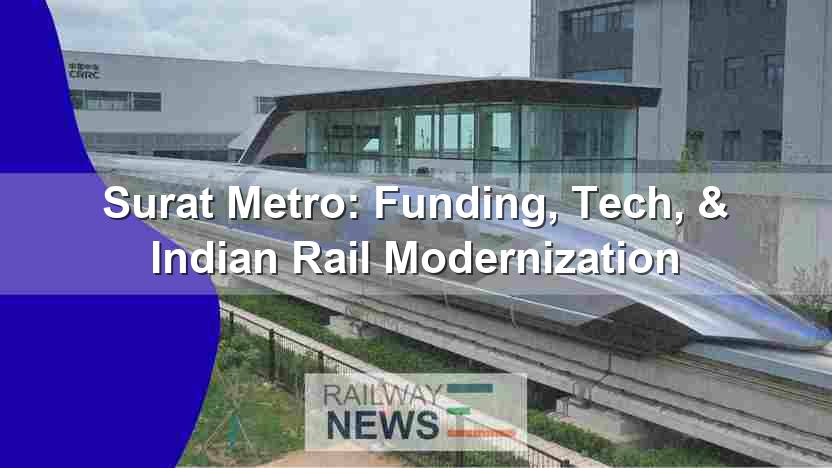
Financing and Development of the Surat Metro Rail Project: A Case Study in Indian Infrastructure Development
This article examines the Surat Metro Rail Project in Gujarat, India, focusing on its financing, technological aspects, and integration within the broader transportation network. The project, spanning 40.35 kilometers, represents a significant investment in improving urban mobility and showcases India’s commitment to modernizing its infrastructure. The project’s funding highlights international collaboration and the integration of sustainable practices. This analysis will explore the financial partnerships involved, the project’s technological advancements, its contribution to multimodal transport integration, and its impact on the surrounding community. Additionally, we will briefly contrast the Surat Metro with the ongoing modernization efforts across the Indian Railways network, highlighting the broader context of national infrastructure development.
Securing Funding for Urban Rail Development
The Surat Metro Rail Project, with a total estimated cost of $1.69 billion (€1.5 billion), has secured substantial funding from various sources. A significant portion, $498.02 million (€442.26 million), is provided by the Kreditanstalt für Wiederaufbau (KfW) – Germany’s development bank. This reflects a growing trend of international partnerships in funding large-scale infrastructure projects in developing nations. Further illustrating this collaboration, the Agence Française de Développement (AFD) – the French Development Agency – has also committed $281.52 million (€250 million) to the project. The Indian government’s contribution, combined with these substantial international loans, demonstrates the commitment to modernizing urban transportation infrastructure.
Technological Advancements and Sustainable Practices
Beyond financial aspects, the Surat Metro project incorporates modern technologies and environmentally conscious practices. The project aims to create an integrated multimodal transportation system, providing “first and last mile connectivity.” This implies seamless integration with other modes of transport like buses and feeder services to enhance accessibility and reduce reliance on private vehicles. Moreover, the planned harnessing of solar energy at both depots underlines a commitment to sustainability and reducing the project’s carbon footprint. This adoption of renewable energy sources positions the Surat Metro as a model for environmentally responsible urban rail development.
Multimodal Integration and Urban Planning
The Surat Metro’s focus on multimodal integration is crucial for its long-term success. A well-functioning integrated transport system requires not only efficient metro operations but also coordinated feeder services, dedicated bus routes, and convenient access points. The project’s commitment to first and last-mile connectivity directly addresses the challenge of seamlessly connecting the metro system with residential areas and other transport hubs. This holistic approach is vital for maximizing ridership and minimizing the impact on existing traffic patterns. Success here hinges on effective planning and collaboration between different transport authorities and operators.
Modernization of the Broader Indian Railways Network
While the Surat Metro represents a significant investment in urban rail, the Indian government is also undertaking a detailed modernization program for its vast national railway network. The Adarsh Station Scheme, aiming to upgrade nearly 1253 railway stations, showcases this commitment. Improvements include accessibility enhancements for the physically handicapped and senior citizens (e.g., ramps), platform surface upgrades, façade improvements, enhanced illumination, and improved cleaning facilities. This nationwide effort, alongside projects like the Bhairabi – Sairang railway line in Mizoram, highlights India’s broader strategy to improve its national and regional rail infrastructure.
Conclusion
The Surat Metro Rail Project exemplifies India’s ambitious infrastructure development plans, showcasing a significant investment in urban transportation and highlighting the importance of international collaboration in financing such projects. The project’s securing of substantial funding from both the KfW and the AFD underscores the global confidence in India’s infrastructure growth. Moreover, the integration of sustainable practices, including solar energy utilization, demonstrates a commitment to environmentally responsible development. The focus on multimodal integration and first/last-mile connectivity promises to improve the efficiency and accessibility of the entire transportation network in Surat. When considered alongside the broader modernization efforts within the Indian Railways, such as the Adarsh Station Scheme, the Surat Metro project reflects a detailed national strategy to enhance and modernize the country’s transportation infrastructure. The success of projects like the Surat Metro will not only significantly impact urban mobility in Surat but also serve as a model for future urban rail development throughout India and potentially beyond, demonstrating the potential for sustainable, efficient, and internationally collaborative infrastructure projects.

Railway infrastructure, rolling stock and transport technologies specialist focused on global rail industry developments, high-speed rail systems, signaling technologies and freight transportation. Covering railway investments, public transport modernization, rail operations and international mobility projects across Europe, Asia and North America.
RELATED POSTS

September 5, 2026 4:19 pm
CPK launched formal tender talks with four consortia to design...

September 6, 2026 4:12 am
Alstom delivered the first of 100 new G Class trams...

September 5, 2026 7:14 pm
HS2 Ltd signed renegotiated civils contracts with EKFB and Align...
September 5, 2026 6:17 pm
Universal Signalling won a deal to install its U-Cross system...
September 6, 2026 8:17 am
DB InfraGO reopened the Nuremberg-Regensburg line in Bavaria on 31...
September 6, 2026 12:20 pm
Indian Railways ordered a probe after a fire destroyed 2...