
TGV M: France’s High-Speed Rail Revolution
This article explores Alstom’s new TGV M high-speed train, a significant development that represents a substantial advancement in French railway technology, showcasing strategic shifts towards enhanced passenger capacity, flexible configuration, advanced digital integration, and improved operational efficiency. The project, involving collaborative efforts between Alstom and SNCF Voyageurs, highlights a commitment to technological innovation and sustainable rail transport, with the production process emphasizing expertise across various engineering disciplines.
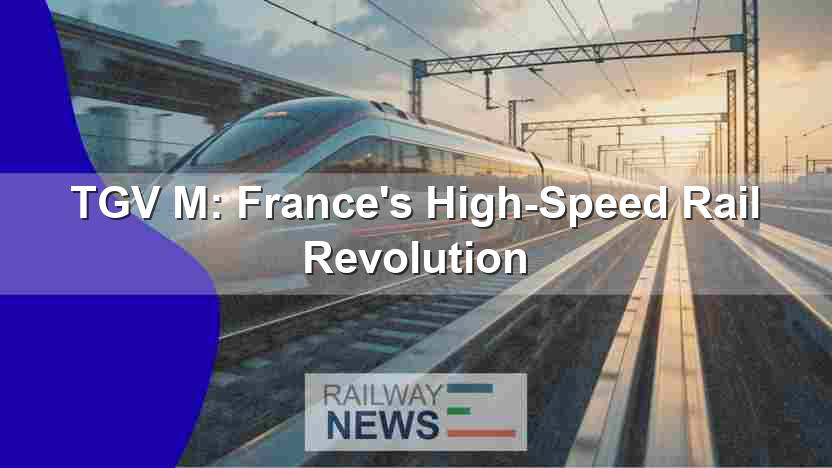
This article explores the significant development and deployment of Alstom’s new TGV M high-speed train, a project representing a substantial advancement in French railway technology and a major undertaking for the French rail industry. The introduction of this new rolling stock (RS) signifies more than just an upgrade; it embodies a strategic shift towards enhanced passenger capacity, flexible configuration, advanced digital integration, and improved operational efficiency. The project, a collaborative effort between Alstom and SNCF Voyageurs, showcases a commitment to technological innovation and sustainable rail transport. We will explore the production process, technological features, operational implications, and broader economic and societal impacts of the TGV M. The article will also briefly touch upon Alstom’s broader commitment to sustainable rail transport, exemplified by its recent hydrogen-fuelled train project in Germany.
The Birth of the TGV M: Production and Design
Alstom’s La Rochelle workshops are now the heart of TGV M production. The commencement of the production line marks a significant milestone, bringing to life a design process that involved ten of Alstom’s sixteen French locations. This distributed design effort reflects the complexity of integrating advanced technologies into a high-speed train, demanding expertise across various engineering disciplines. The order for 115 units – 100 for domestic and 15 for international services – underlines the significant scale of the project and its anticipated impact on the French national rail network (SNCF). This ambitious project is projected to create up to 4,000 jobs in the French rail industry, showcasing a positive economic ripple effect.
Technological Advancements and Passenger Experience
The TGV M boasts several key technological advancements. Its modular design allows for flexible configuration, adapting to varying passenger demand. The ability to quickly reconfigure the interior by adding or removing seats, bicycle racks, or luggage space represents a significant improvement in operational flexibility. This adaptability is crucial for optimizing capacity utilization across different routes and time periods. The increased seating capacity – up to 740 seats, a 20% increase over the current maximum of 634 – promises enhanced passenger comfort and reduced overcrowding. This increase in capacity is directly aimed at meeting the growing demand for high-speed rail travel in France.
Digital Integration and Network Compatibility
The TGV M is designed for seamless integration with modern digital systems. Alstom is undertaking a detailed project to ensure compatibility with existing infrastructure and digital solutions. This involves detailed network and station compatibility analysis to ensure smooth operation across the French national network. The train’s “hyper-connected” nature underscores a commitment to leveraging digital technologies to improve operational efficiency, enhance the passenger experience through information systems, and meet evolving customer expectations for digital services. This commitment to digital integration is a key element of Alstom’s strategy for modernizing France’s railway system.
Sustainability and Future Outlook
While the TGV M itself is an electric train, contributing to environmental sustainability through reduced carbon emissions, Alstom’s recent commissioning of hydrogen-fuelled trains in Germany highlights a broader commitment to sustainable rail solutions. This showcases a forward-thinking approach to exploring and implementing various sustainable technologies in the rail sector. The TGV M project, while focusing on immediate improvements to the French high-speed rail network, also indirectly supports broader environmental goals by offering a more efficient and environmentally friendly mode of transportation compared to other forms of travel.
Conclusion
The Alstom TGV M project represents a substantial investment in the future of French high-speed rail. The production of 115 new trains, the creation of thousands of jobs, and the deployment of innovative technologies demonstrate a commitment to both technological advancement and economic growth. The modular design, enhanced passenger capacity, and sophisticated digital integration showcase Alstom’s forward-thinking approach to railway engineering. The emphasis on adapting to market requirements and ensuring compatibility with the existing infrastructure highlights the meticulous planning involved in such a large-scale project. The project’s success will not only improve the efficiency and passenger experience of France’s high-speed rail network but also establish a benchmark for future high-speed train developments globally. The integration of digital systems further positions France at the forefront of technologically advanced rail transportation, demonstrating a commitment to innovation and sustainable infrastructure development. Finally, the broader context of Alstom’s exploration of hydrogen-fuelled trains suggests a longer-term commitment to environmentally responsible rail solutions.

Railway infrastructure, rolling stock and transport technologies specialist focused on global rail industry developments, high-speed rail systems, signaling technologies and freight transportation. Covering railway investments, public transport modernization, rail operations and international mobility projects across Europe, Asia and North America.
RELATED POSTS

September 5, 2026 4:19 pm
CPK launched formal tender talks with four consortia to design...

September 5, 2026 7:14 pm
HS2 Ltd signed renegotiated civils contracts with EKFB and Align...

September 6, 2026 4:12 am
Alstom delivered the first of 100 new G Class trams...
September 6, 2026 8:17 am
DB InfraGO reopened the Nuremberg-Regensburg line in Bavaria on 31...
September 5, 2026 6:17 pm
Universal Signalling won a deal to install its U-Cross system...
September 6, 2026 12:20 pm
Indian Railways ordered a probe after a fire destroyed 2...