
Train Braking Distance: How Long Does a Train Take to Stop?
Train braking distance explained: why trains need up to 3 km to stop, braking distances at different speeds, types of train brakes, and how signalling spacing is determined by stopping distance.
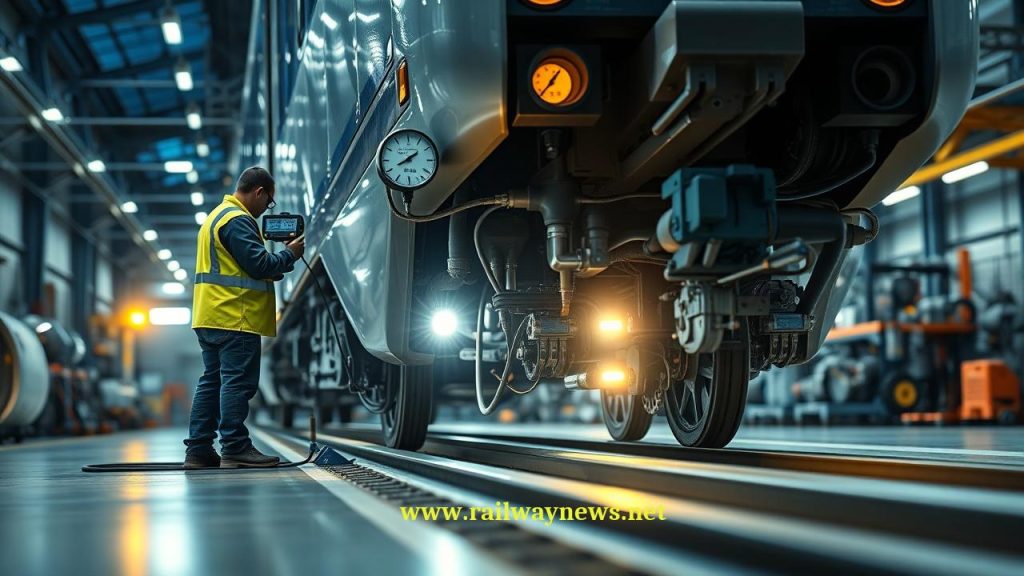
Quick Answer — Train Braking Distance
A passenger train travelling at 100 km/h typically needs 700–1,500 metres to stop — roughly 20 to 30 times longer than a car at the same speed. At 300 km/h, a high-speed train requires approximately 3,000–5,000 metres. The vast difference compared to road vehicles comes down to three fundamental factors: trains have enormously greater mass, steel wheels on steel rails generate far less friction than rubber tyres on asphalt, and braking too hard causes wheels to slide — making things worse, not better. Braking distance is not just a safety consideration — it is the primary factor that determines how far apart railway signals must be spaced and, ultimately, how many trains can run on a line per hour.
Why Do Trains Take So Long to Stop? The Physics
The answer lies in two fundamental physical properties: kinetic energy and friction.
A moving object’s kinetic energy is KE = ½mv². Because speed is squared, doubling a train’s speed does not double its braking distance — it quadruples it. A train doing 200 km/h has four times the kinetic energy of the same train at 100 km/h and needs roughly four times the distance to dissipate that energy through braking.
The second factor is friction. Rubber tyres on dry asphalt generate a friction coefficient (μ) of approximately 0.7–0.8. Steel wheels on steel rails generate only 0.1–0.3 — less than a quarter as much. This low friction is actually beneficial for energy efficiency (less rolling resistance means longer range per unit of energy) but it significantly limits how hard a train can brake before the wheels start sliding.
When a wheel slides rather than rolls — just as a car wheel does when ABS is absent — the effective braking force actually decreases rather than increases. A sliding steel wheel on a steel rail has a friction coefficient as low as 0.05. This means locking the brakes too hard is counterproductive. It is also damaging: a sliding wheel develops a flat spot very quickly, creating a pounding effect every revolution that damages both the wheel and the rail.
Train Braking Distance at Different Speeds
The table below shows indicative emergency braking distances for different train types under dry rail, level track conditions. Real-world distances vary with train mass, brake type, track gradient, and rail surface conditions.
| Train Type | Speed | Emergency Stop | Service Stop | Equivalent to |
|---|---|---|---|---|
| Car (reference) | 100 km/h | ~40 m | ~55 m | Half a football pitch |
| Metro / suburban train | 80 km/h | ~400–600 m | ~250–350 m | 4–6 football pitches |
| Regional / intercity passenger | 160 km/h | ~1,200–1,800 m | ~800–1,100 m | 12–18 football pitches |
| High speed rail (TGV / ICE) | 300 km/h | ~3,200–4,500 m | ~2,000–2,800 m | 32–45 football pitches |
| Shinkansen N700S | 285 km/h | ~3,800 m | ~2,400 m | 38 football pitches |
| Heavy freight train (loaded) | 100 km/h | ~1,500–2,500 m | ~1,000–1,800 m | 15–25 football pitches |
| Very long freight train (2 km+) | 80 km/h | ~2,000–4,000 m | ~1,500–3,000 m | Length of train itself or more |
⚠ Note: Values are indicative only. Actual braking distances depend on train mass, brake equipment, track gradient, rail conditions and driver/ATC response time. Always refer to official infrastructure and rolling stock documentation for specific operational values.
Train vs Car: The Braking Distance Comparison
The contrast between train and car braking performance is stark — and frequently misunderstood by the general public, particularly after level crossing and trespass accidents.
| Factor | Car | Passenger Train | Why the Difference? |
|---|---|---|---|
| Tyre / wheel friction | μ 0.7–0.8 (rubber on asphalt) | μ 0.1–0.3 (steel on steel) | Steel-on-steel has ~4–8x less grip |
| Vehicle mass | 1.5–2.5 tonnes | 400–800 tonnes (passenger) Up to 20,000 t (freight) | 200–10,000x heavier = far more kinetic energy |
| Max deceleration | ~8–10 m/s² (with ABS) | ~0.8–1.3 m/s² (emergency) | Low friction limits maximum deceleration force |
| Braking at 100 km/h | ~40–50 m | 700–1,500 m | Train needs 15–35x more distance |
| Steering to avoid obstacle | Yes — can swerve | No — constrained to track | Train cannot steer — braking is its only option |
This comparison explains why level crossing safety campaigns emphasise that train drivers cannot stop in time even when they see an obstacle — and why clear sight lines and adequate warning times at level crossings are so critical.
Types of Train Brakes and How They Work
Modern trains use multiple braking systems simultaneously, each suited to different speed ranges and conditions:
1. Air (Pneumatic) Brakes — The Foundation
Almost every railway vehicle in the world uses an air brake system as its primary means of stopping. Compressed air is used to apply brake pads or shoes against the wheel tread or against brake discs mounted on the axle. The air brake is fail-safe: it is applied when air pressure is released, not when it is applied — meaning a hose rupture or failure automatically triggers braking rather than a runaway condition. The Westinghouse automatic air brake, patented in 1869, established this fail-safe principle and remains the basis of virtually all freight and many passenger brake systems worldwide.
2. Regenerative Electric Braking — Energy Recovery
On electric trains, regenerative braking uses the traction motors as generators when decelerating. The kinetic energy of the train is converted into electrical energy, which is fed back into the overhead line (or a wayside energy storage system) where it can be used by other trains accelerating nearby. Regenerative braking is smooth and quiet, and on metro systems with frequent stops, can recover 15–30% of total traction energy. It is the primary service brake on most modern electric multiple units and high-speed trains.
3. Rheostatic (Dynamic) Braking
Rheostatic braking also uses traction motors as generators but dissipates the energy as heat through large resistors rather than returning it to the network. It is used where regenerative braking is not possible — for example, on non-electrified lines, or when no other train is available to absorb the returned energy. Rheostatic braking is effective from high speed down to about 10–15 km/h, below which air brakes take over.
4. Eddy Current Brakes — Non-Contact High-Speed Braking
Eddy current brakes generate braking force by inducing electrical currents in the rail through powerful electromagnets mounted beneath the train. There is no mechanical contact — the braking force is magnetic. Eddy current brakes are highly effective at high speeds (where conventional friction brakes generate excessive heat) but their effectiveness diminishes at lower speeds. They are used on high-speed trains including the French TGV, German ICE, and Spanish AVE as a supplementary high-speed retardation system.
5. Magnetic Track Brakes — Emergency Low-Speed Stopping
Magnetic track brakes drop a powerful electromagnet directly onto the rail surface, generating very high friction forces through direct contact. They are exceptionally effective at low and medium speeds and are standard on trams and many metro vehicles. On high-speed trains, magnetic track brakes are used as emergency-only devices — they cannot be deployed at high speed without risk of damage. The TGV and Shinkansen use magnetic track brakes as a last-resort emergency system for very low-speed stopping.
6. Wheel Slide Protection (WSP) — The Railway ABS
Wheel Slide Protection (WSP) is the railway equivalent of a car’s ABS (Anti-lock Braking System). It monitors the rotational speed of each axle and detects when a wheel is about to slide (wheel deceleration faster than track-speed deceleration). When sliding is detected, WSP momentarily reduces brake pressure on that axle, allowing the wheel to spin up again and restore adhesion before reapplying the brakes. Without WSP, emergency braking in low-adhesion conditions (wet rail, leaves, ice) would cause flat spots and extended stopping distances. With WSP, the train automatically optimises brake application for the available adhesion.
What Factors Affect Braking Distance?
| Factor | Effect on Braking Distance |
|---|---|
| Speed | Exponential — doubling speed approximately quadruples braking distance. The most dominant single factor. |
| Train mass / loading | Heavier trains carry more kinetic energy. A fully loaded freight train has considerably longer braking distance than the same train empty. Passenger trains are less affected as passenger mass is small relative to vehicle mass. |
| Rail conditions | Wet rail: friction μ drops from ~0.25 to ~0.15 — braking distance increases ~40–70%. Leaf contamination: can reduce μ to ~0.05 — braking distance can triple. Ice: similar to leaves. Rail sanders and hydroblasting equipment address this. |
| Track gradient | Downhill gradient adds a gravity component that increases braking distance — a 1% downgrade adds roughly 10% to braking distance. Uphill gradient reduces braking distance. Gradients are critical in route signalling calculations. |
| Brake percentage | A measure of braked weight relative to total train weight. Higher brake percentage = shorter stopping distance. International freight cars must meet minimum brake percentage standards for different line speeds. |
| Response / reaction time | Time from decision to full brake application. For manual braking: ~2–4 seconds (driver reaction + brake build-up). For ATC emergency braking: ~0.5–1.5 seconds. At 300 km/h, 3 seconds of reaction time = 250 m of additional travel before brakes are fully applied. |
Braking Distance and Railway Signalling
Braking distance is the fundamental constraint that determines signal spacing on a railway line — and therefore how many trains can run per hour.
In a fixed block signalling system, each signal is placed at least one full braking distance behind the next signal. A driver seeing a red signal must be able to stop before reaching it. On a 160 km/h line with a 1,200 m braking distance, signals cannot be spaced closer than ~1,200 m — limiting the line to one train every ~27 seconds in theory, and considerably less in practice due to safety margins and operational factors.
This relationship between braking distance and capacity is precisely why ETCS Level 3 moving block is so significant for capacity. Instead of fixed signal blocks, the train receives a dynamic movement authority that ends at the rear of the preceding train. The safety margin — essentially a rolling braking distance bubble around each train — moves with the trains, allowing them to run much closer together on busy corridors. Moving block can increase line capacity by 30–40% on heavily trafficked urban metro lines.
On high-speed lines, the braking distance issue becomes even more significant: at 300 km/h with a ~4,000 m emergency braking distance, the minimum signal spacing is enormous — which is one reason why ETCS Level 2 with its continuous movement authority transmission is mandatory on all new European HSR lines.
The Leaf Fall Problem: When Rails Become Like Ice
One of the most challenging and counterintuitive braking hazards in railway operations is leaf contamination. In autumn, fallen leaves on the track are compressed by passing trains into a thin, highly slippery film on the rail head — often described as the railway equivalent of black ice. The compressed leaf layer can reduce the adhesion coefficient from ~0.25 to as low as 0.05 — a 80% reduction — dramatically extending braking distances and triggering wheel slide on deceleration and wheel spin on acceleration.
Railway operators manage this through:
- Rail sanders: trains deposit sand ahead of the driving wheels to temporarily improve adhesion. Sanding is automatically triggered by WSP under low-adhesion conditions.
- Railhead treatment trains: water-jetting (hydroblasting) trains that remove the leaf film overnight using high-pressure water. These can clear hundreds of kilometres of route per night.
- Seasonal timetable adjustments: some operators run trains earlier into stations or extend dwell times during the leaf fall season to allow for longer braking distances.
- Reduced speed limits: temporary speed restrictions on sections known to be affected by leaf fall.
Frequently Asked Questions (FAQ)

Railway infrastructure, rolling stock and transport technologies specialist focused on global rail industry developments, high-speed rail systems, signaling technologies and freight transportation. Covering railway investments, public transport modernization, rail operations and international mobility projects across Europe, Asia and North America.
RELATED POSTS
August 4, 2026 1:11 pm
Hitachi Rail Canada secured a $407.7M contract to install CBTC...
August 1, 2026 7:56 am
BMZ delivered two new TEM18DM diesel shunting locos to RZD...
August 1, 2026 7:14 pm
€205 billion funding shortfall threatens the TEN-T rail network's completion...

August 4, 2026 11:12 am
MBTA confirmed a $150.8 million overhaul of the 85-year-old Green...
August 1, 2026 7:11 pm
An Ipsos survey across 29 countries found that 33% of...
August 1, 2026 8:06 pm
European Commission approved a regulation on 9 July 2026 requiring...