
Rolling Highway (RoLa): Trucks on Trains
Rolling Highway occupies an awkward position in the European freight landscape.
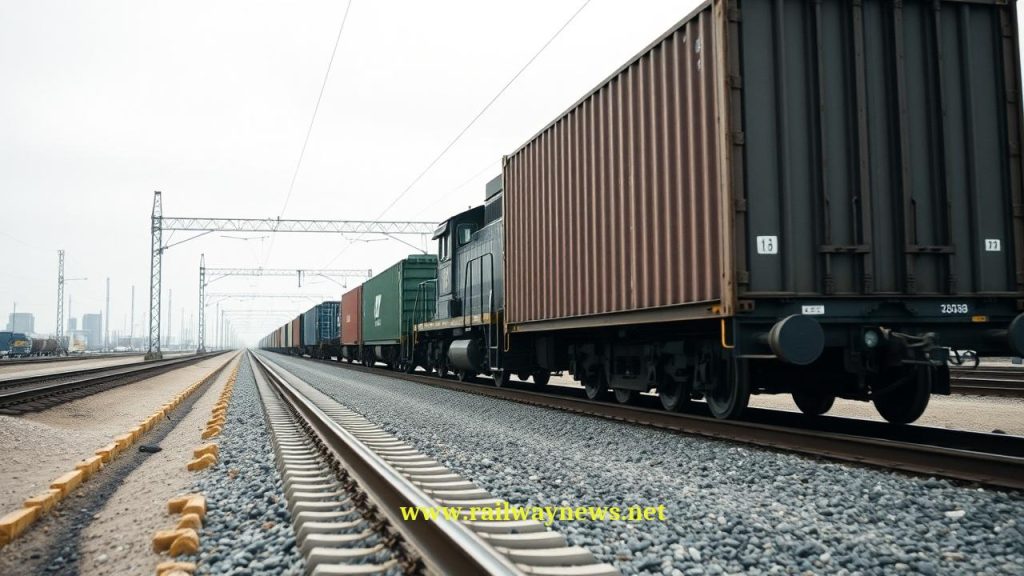
⚡ In Brief
- Rolling Highway (RoLa — from German Rollende Landstraße) is a combined transport system where complete trucks drive onto specialised low-floor railway wagons and travel by rail through mountain corridors or across geographical barriers.
- Truck drivers travel in a separate accompanying passenger coach while their vehicles ride the train — time spent on board counts toward mandatory EU driver rest periods.
- The Alpine RoLa network — operated principally through the Brenner, Lötschberg, and Simplon corridors — carried approximately 200,000 truck crossings per year at its peak, removing equivalent lorry traffic from Alpine roads.
- RoLa requires a very low wagon floor height (typically 250–270 mm above rail) and large loading gauge clearance, making it dependent on specific infrastructure that is not universally available.
- The opening of the Gotthard and Brenner base tunnels has changed RoLa economics significantly — longer, flatter tunnels favour conventional intermodal transport over accompanied transport.
Every weekday, thousands of heavy trucks queue at the approaches to Alpine passes. The St Gotthard, the Brenner, the Simplon — these mountain crossings are among the most congested freight corridors in Europe, carrying goods between northern and southern Europe on roads that were never designed for the volumes they now handle. The communities along these passes have campaigned for decades to reduce truck traffic. The Alpine Convention — a multilateral treaty — commits signatory states to shifting freight from road to rail across the Alps.
Rolling Highway is one of the tools that attempts to bridge the gap between where trucks want to go and where politicians want them not to drive. It is a pragmatic compromise: if you cannot stop trucks from crossing the Alps, at least put them on a train for the hardest part of the journey.
What Is Rolling Highway (RoLa)?
Rolling Highway — known in German as Rollende Landstraße (RoLa) and in French as autoroute ferroviaire — is an accompanied intermodal transport service in which complete road vehicles, typically articulated lorries (tractor units with semi-trailers), drive under their own power onto purpose-built low-floor railway wagons at a terminal. The train then transports the trucks through a tunnel or over a mountain pass to a destination terminal, where the trucks drive off and continue their journey by road.
The key distinction from conventional intermodal transport is accompanied operation: the truck driver travels with the vehicle, in a separate passenger coach attached to the train. The cargo is not transferred from the truck — the entire vehicle travels intact. This eliminates the need for cargo rehandling at terminals and makes RoLa accessible to any lorry, not just those carrying standardised containers or swap bodies.
How a RoLa Journey Works
Step 1 — Arrival at the loading terminal: The truck driver arrives at the RoLa terminal (e.g., Brenner or Wörgl in Austria, Novara in Italy) and books a slot on the next available train. The terminal has a drive-through ramp at rail level.
Step 2 — Loading: The driver steers the truck onto the low-floor wagons. The wagons are connected in a continuous flat deck — the truck drives forward along the train until reaching its allocated position. The process takes 5–10 minutes per truck. A full RoLa train typically carries 20–24 trucks in a formation of 30–35 wagons.
Step 3 — Journey: The driver walks to the accompanying passenger coach, which provides seating, toilets, and basic catering. EU regulations recognise time spent in the accompanying coach as qualifying rest time, provided the coach meets minimum comfort standards. The train travels through the corridor at speeds of 80–120 km/h.
Step 4 — Unloading: At the destination terminal, the driver returns to the truck, drives off the wagons, and continues the road journey. Total terminal dwell time at each end is typically 30–45 minutes.
RoLa vs Conventional Intermodal: Key Differences
| Parameter | RoLa (Accompanied) | Conventional Intermodal (Unaccompanied) |
|---|---|---|
| What travels by rail | Complete truck (tractor + trailer) + driver | Container, swap body, or semi-trailer only |
| Cargo handling | None — no transfer required | Crane or reach stacker at each terminal |
| Vehicle compatibility | Any road vehicle (including non-standard trailers) | ISO containers, swap bodies, or pocket-wagon compatible trailers only |
| Terminal infrastructure | Drive-on/drive-off ramp; minimal crane equipment | Gantry cranes, reach stackers, large yard |
| Driver rest compliance | Travel time counts as rest (EU Regulation 561/2006) | Driver must arrange separate rest at origin/destination |
| Cost per truck | Higher (full truck weight, low efficiency) | Lower (cargo only, higher density per train) |
| Loading gauge requirement | Very high (full truck height + wagon) | Standard or enhanced (P/C profiles) |
The Low-Floor Wagon: Engineering for RoLa
The defining technical challenge of RoLa is the wagon floor height. A standard articulated lorry stands approximately 4.0 metres tall. For the truck to fit within the railway structure gauge while sitting on a wagon, the wagon floor must be as low as possible above the rail head — typically 250–270 mm, compared to 1,200–1,300 mm for a standard flat wagon.
Achieving this requires special bogie designs where the wheels are recessed into pockets in the wagon frame rather than sitting beneath a flat floor. The wheels are smaller in diameter than standard freight wagon wheels (typically 360–400 mm versus 920 mm standard), and the entire wagon is designed around the constraint of minimising floor height while maintaining structural strength under the 40+ tonne truck load.
The resulting wagons — sometimes called “pocket wagons” for RoLa specifically, though the term is also used for semi-trailer intermodal wagons — are complex and expensive to manufacture and maintain. Their small wheels wear more rapidly than standard freight wagon wheels and require more frequent replacement.
Major RoLa Corridors in Europe
| Corridor | Route | Operator | Status (2026) | Annual Volume (peak) |
|---|---|---|---|---|
| Brenner | Wörgl (AT) – Brenner – Trento/Verona (IT) | RoLa Brenner / ÖBB Rail Cargo | Active — multiple daily departures | ~100,000 trucks/year |
| Lötschberg / Simplon | Kandersteg (CH) – Goppenstein / Iselle (IT) | BLS Cargo | Active — scheduled service | ~30,000 trucks/year |
| Fréjus / Mont Cenis | Aiton (FR) – Orbassano (IT) | Viia Fréjus (SNCF/RFI JV) | Active — growing | ~25,000 trucks/year |
| Pyrenees | Hendaye (FR) – Irun (ES) / Le Boulou (FR) – Portbou (ES) | Viia Eusko / SNCF | Partial — gauge change complicates | ~15,000 trucks/year |
| Channel Tunnel | Folkestone (UK) – Calais (FR) | Eurotunnel (Getlink) | Active — Le Shuttle Freight | ~1.5 million trucks/year |
The Channel Tunnel: The World’s Largest RoLa Operation
The Channel Tunnel’s Le Shuttle Freight service is technically the world’s largest rolling highway operation, though it is rarely described in those terms. Trucks drive onto dedicated shuttle trains at Folkestone, travel through the 50 km tunnel at up to 140 km/h, and emerge at Coquelles near Calais — a crossing that takes approximately 35 minutes from platform to platform. The service operates 24 hours a day, 365 days a year, with departures every 45–90 minutes during peak periods.
Unlike Alpine RoLa services, Le Shuttle Freight does not provide an accompanying passenger coach — drivers wait in a lounge area in the shuttle train’s amenity vehicle rather than travelling in comfort-standard seating. The crossing time is short enough that extended driver amenity provision is not operationally necessary.
RoLa Economics: Why It Needs Subsidy
RoLa is structurally more expensive per tonne-kilometre than conventional intermodal transport. The reasons are intrinsic to its concept:
- Dead weight: The tractor unit — which can weigh 8–10 tonnes — travels by rail without contributing any cargo capacity. In conventional intermodal transport, only the cargo-bearing unit travels by rail.
- Low wagon utilisation: A 20-truck RoLa train carries approximately the same payload as a 40-container intermodal train of similar length, but requires more complex and expensive wagons.
- Passenger coach cost: The accompanying coach adds capital cost, maintenance cost, and reduces the freight-carrying length of the train.
- Terminal throughput: Drive-on/drive-off loading is slower than crane loading — a full RoLa train takes 45–60 minutes to load, versus 20–30 minutes for an equivalent intermodal train.
As a result, most European RoLa services receive public subsidy — either from national governments (Austria, Switzerland) or from EU funds — justified on environmental and road congestion grounds. Switzerland’s LSVA (heavy vehicle charge) system, which levies distance-based charges on trucks using Swiss roads, effectively cross-subsidises RoLa by making road transit more expensive and rail transit relatively more attractive.
The Gotthard Effect: What New Tunnels Mean for RoLa
The opening of the Gotthard Base Tunnel in 2016 and the Ceneri Base Tunnel in 2020 created a flat, high-capacity rail route through the Swiss Alps that has fundamentally changed the competitive dynamics of Alpine freight transport. These tunnels were designed for conventional intermodal freight — 4-metre corridor height allowing high-cube containers and unaccompanied semi-trailers on pocket wagons — at speeds of 100 km/h.
The result is that the Gotthard axis now offers highly competitive unaccompanied intermodal services that are cheaper per truck than RoLa and require no driver to accompany the vehicle. The shift in traffic from RoLa to conventional intermodal on the Gotthard corridor has been significant, and some industry observers have questioned whether RoLa remains viable on corridors where good conventional intermodal alternatives exist.
The Brenner Base Tunnel, when complete (expected in the early 2030s), will create a similar dynamic on the Brenner corridor — currently the most important RoLa route in Europe.
Editor’s Analysis
Rolling Highway occupies an awkward position in the European freight landscape. It was conceived as a transition technology — a way to shift trucks to rail in the short term while better infrastructure was built — but “short term” has stretched into decades, and the infrastructure is now arriving. The Gotthard Base Tunnel demonstrated that when you give intermodal freight a genuinely competitive rail route, it uses it: traffic on the Gotthard corridor shifted from RoLa to conventional intermodal faster than many predicted. The Brenner Base Tunnel will almost certainly repeat this dynamic, eroding the Brenner RoLa service’s volumes from the early 2030s onwards. What remains for RoLa is the traffic that genuinely cannot use conventional intermodal — non-standard trailers, temperature-controlled loads in refrigerated vehicles where the refrigeration unit needs to run, vehicles with dangerous goods that cannot be unaccompanied. These niches are real but not large enough to sustain the current network without subsidy. The honest assessment is that RoLa is a transitional technology whose transition is finally completing, and that the future of Alpine freight lies in conventional intermodal on the new base tunnels rather than in accompanied transport on the mountain lines. — Railway News Editorial
Frequently Asked Questions
- Q: What does RoLa stand for?
- RoLa is an abbreviation of the German term Rollende Landstraße, which translates literally as “rolling highway” or “rolling motorway.” The term reflects the concept of a motorway’s function — moving trucks from A to B — delivered on railway infrastructure. The French equivalent term, autoroute ferroviaire (railway motorway), conveys the same concept. In English, the service is usually described as “rolling road” or “rolling highway,” though “RoLa” is widely understood in European logistics.
- Q: Can any truck use a RoLa service?
- In principle, yes — the key advantage of RoLa over conventional intermodal is that it accepts any road vehicle that fits within the loading gauge, not just those carrying standardised containers or compatible trailers. This includes refrigerated vehicles, tankers, low-loaders, car transporters, and other specialised vehicles that cannot be handled by intermodal terminal cranes. In practice, there are height and width limits set by the structure gauge of the route, and very heavy or oversized vehicles may need special clearance. Standard European articulated lorries (13.6 m trailer, up to 4.0 m height) are accommodated on all major RoLa routes.
- Q: Does time spent on a RoLa train count as driver rest?
- Yes, under EU Regulation 561/2006, a driver travelling in an accompanying coach on a ferry or train service may count the journey time as a regular rest period, provided the rest is not interrupted and the driver has access to a sleeping berth or reclining seat. Most RoLa coaches on longer Alpine services (1.5–3 hours) qualify for this provision, though shorter crossings may not meet the minimum rest period threshold. This is a significant commercial advantage for operators: drivers can complete a legal rest period during the rail crossing, extending their available driving hours on arrival.
- Q: How does Rolling Highway compare to the Channel Tunnel truck service?
- The Channel Tunnel’s Le Shuttle Freight is the world’s highest-volume truck-on-train service, carrying approximately 1.5 million trucks per year — far more than all Alpine RoLa services combined. However, it differs from Alpine RoLa in several respects: the crossing is very short (35 minutes versus 1–3 hours for Alpine services), there is no full accompanying passenger coach, and the service is commercially operated without public subsidy. The Channel Tunnel’s commercial viability reflects the unique geography of the route — there is no alternative rail crossing — whereas Alpine RoLa competes with road routes and, increasingly, with conventional intermodal services through the new base tunnels.
- Q: Will RoLa services survive the opening of the Brenner Base Tunnel?
- This is genuinely uncertain. The Brenner Base Tunnel (expected to open in the early 2030s) will provide a flat, high-capacity corridor through the Alps on the Brenner axis — the same corridor served by the main Brenner RoLa route. Experience from the Gotthard Base Tunnel suggests that conventional intermodal will capture a significant share of traffic currently using RoLa, as it offers lower cost per truck for standardised cargo. RoLa is likely to retain a niche for non-standard vehicles and loads that cannot use conventional intermodal, but volumes will probably fall significantly. Austrian and Italian policy decisions on subsidy levels will be a key factor in whether a reduced-scale RoLa service continues to operate on the Brenner corridor post-BBT.

Railway infrastructure, rolling stock and transport technologies specialist focused on global rail industry developments, high-speed rail systems, signaling technologies and freight transportation. Covering railway investments, public transport modernization, rail operations and international mobility projects across Europe, Asia and North America.
RELATED POSTS

September 6, 2026 5:19 am
Hitachi delivered Taiwan's first N700ST high-speed train from Japan in...

September 5, 2026 4:19 pm
CPK launched formal tender talks with four consortia to design...

September 5, 2026 7:14 pm
HS2 Ltd signed renegotiated civils contracts with EKFB and Align...

September 6, 2026 4:12 am
Alstom delivered the first of 100 new G Class trams...

September 6, 2026 1:17 am
Hitachi Toshiba Supreme Consortium confirmed the first of 12 N700ST...

September 6, 2026 6:17 am
Hungary ordered a national ban on most freight trains from...