
What Are Railway Signal Colours? Aspects Explained (2026)
Railway signal colours & aspects: meaning of red, yellow, green, flashing aspects. 3‑aspect vs 4‑aspect table, braking distances, and a complete SPAD prevention checklist.
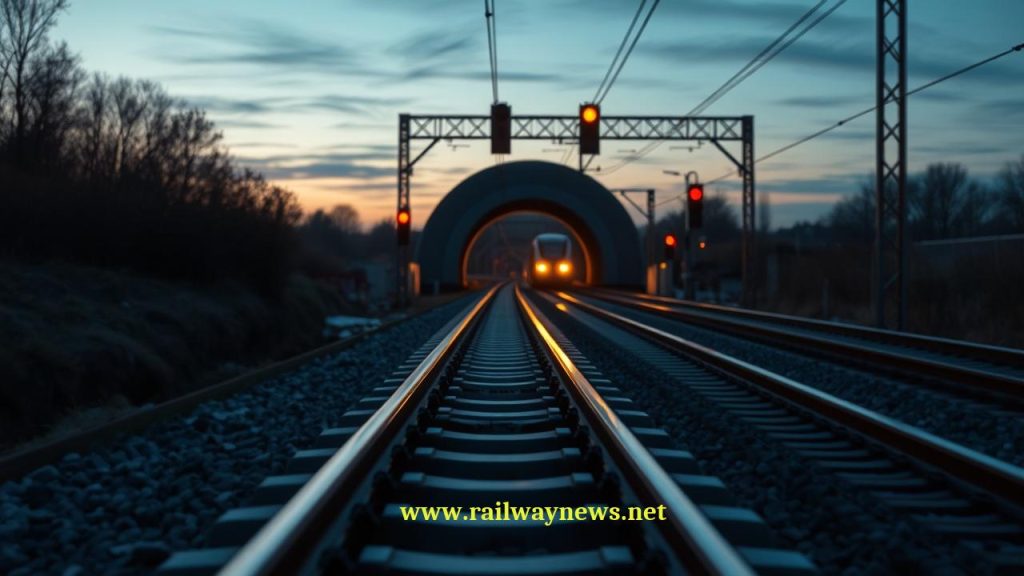
🚆 QUICK ANSWER — RAILWAY SIGNAL COLOURS
What do railway signal colours mean? Railway signals use coloured lights (or semaphore arms) to control train movements. Red means STOP (absolute stop and stay). Yellow (or amber) warns the driver to prepare to stop at the next signal — it indicates that the next signal is at red. Double yellow (preliminary caution) advises that the next signal is yellow, used in four-aspect systems. Green means clear (proceed at line speed). Flashing aspects add supplementary instructions (e.g., flashing yellow for diverging routes). Standardisation follows national rules: UK uses 4-aspect (red, double yellow, yellow, green); Germany (H/V system) uses combined aspects; North America uses speed signalling with colour-light combinations. These aspects directly dictate braking distances (typically 1800 m for yellow at 160 km/h). Understanding aspects prevents SPADs and improves traffic fluidity.
1. What Are Railway Signal Colours & Aspects? Definition and Purpose
Railway signal colours and aspects form the visual language that conveys movement authorities from the signaller to the train driver. An “aspect” is the entire displayed indication — a combination of colour, number of lights, and sometimes flashing state. Traditional semaphore signals used arm positions (horizontal for stop, inclined for clear), but colour-light signals, introduced from the 1920s, offer higher reliability and better night visibility. Modern high-density lines use multi-aspect colour-light signalling (three‑aspect or four‑aspect) to maximise line capacity while maintaining safe braking distances. The fundamental principle is “fail-safe”: any malfunction forces the most restrictive aspect (red). IEC 61225 and CENELEC EN 50128 guide the safety requirements for signalling systems.
The meaning of each aspect is legally defined by each country’s rulebook (e.g., UK Rule Book Module S5, NORAC in North America). However, the red-yellow-green sequence is nearly universal. The driver must interpret the aspect relative to the line speed, gradient, and train braking capability. A yellow aspect typically requires braking to ensure the train can stop before the next red signal. In cab signalling systems (ETCS, CBTC), aspects are shown in‑cab, but lineside colour lights remain as backup.
2. Signal Colours and Basic Meanings (Absolute vs. Permissive)
Every colour-light signal can display three primary colours, but aspects vary by configuration. Below is a comparison of three-aspect and four-aspect systems, which dominate main line railways in Europe and Asia.
| Aspect type | Colours / indications | Braking distance coverage | Typical max line speed |
|---|---|---|---|
| 3-aspect | Red – Yellow – Green | One warning step (yellow → red) | ≤ 120 km/h (older lines) |
| 4-aspect | Red – (Double Yellow) – Yellow – Green | Two-step warning (double yellow → yellow → red) | 160–200 km/h (high-speed lines) |
| Speed signalling (NORAC) | Colour + position + number plates | Variable (approach medium, limited) | Up to 125 mph (200 km/h) |
Absolute signals (e.g., home signals, starting signals) — a red aspect means the train must stop and cannot pass without authority. Permissive signals (distant or automatic) — a red aspect indicates stop but may be passed at very low speed under specific rules (e.g., shunt ahead).
3. Aspect Sequences and Their Meaning in Operation (How They Work)
Drivers interpret aspects in relation to the signal spacing and sighting distance. On a high-speed line with 4‑aspect signalling, signal spacing is typically 1000 m to 1500 m. A green aspect indicates at least two clear blocks ahead. Yellow means the next signal is red, so the driver must commence braking to stop at that next signal. Double yellow tells the driver that the following signal is yellow, prompting initial speed reduction. Flashing aspects — e.g., flashing yellow (sometimes called “preliminary caution” or “diverging route”) — warn that the train will take a diverging junction with reduced permissible speed. The table below provides standard numerical data.
| Aspect | Meaning (UK/Europe) | Required action | Typical braking distance (160 km/h) |
|---|---|---|---|
| Red | Stop – absolute block occupied | Bring train to a halt before the signal | Full service brake (approx 800–1200 m) |
| Yellow (single) | Caution – next signal red | Brake to stop at next signal | Full braking initiated (1800 m sighting) |
| Double yellow | Preliminary caution | Reduce speed, expect yellow next | Speed reduction to 100 km/h approx. |
| Green | Clear – two or more blocks free | Proceed at line speed (max permissible) | No braking required |
| Flashing yellow | Diverging route ahead (junction) | Reduce to turnout speed (e.g., 65 km/h) | Depends on turnout radius |
4. Types of Railway Signals (By Technology and Placement)
Signals are classified not only by colour aspects but also by physical implementation and function. Main aspects are displayed by semaphores (historic but still in use on heritage lines), colour-light signals (LED or halogen), and position-light ground signals for shunting. Below is a classification table.
| Signal type | Technology | Aspects / indication range | Typical use |
|---|---|---|---|
| Colour-light (LED) | High-brightness LEDs, energy efficient | Red, yellow, double yellow, green, flashing | Main line, high-speed, metro |
| Semaphore (upper quadrant) | Mechanical arm with coloured spectacle | Horizontal = stop, 45° = caution, vertical = clear | Heritage / secondary lines |
| Position-light (shunt) | Two or three white lights in diagonal | Lunar white lights – shunt ahead authorised | Yard areas, sidings |
| Distant signal (fixed) | Often colour-light or semaphore | Yellow or green only (cannot display red) | Prior warning of home signal |
5. Real-World Applications: Signal Systems Across Different Countries
Different railways adapted colour aspects to local operational needs. Great Britain uses 4-aspect colour-light signals on the West Coast Main Line (WCML) and East Coast Main Line (ECML) for 200 km/h operation. Germany uses Ks (Kompatible Signalisierung) signals that combine colour aspects with a text indicator. France uses BAL (Block Automatique Lumineux) with three or four aspects. The table highlights real-world network deployments.
| Country / region | Signal system name | Aspect sequence | Max line speed (example) |
|---|---|---|---|
| United Kingdom | 4-aspect colour light / TASS | Red – Double yellow – Yellow – Green | 200 km/h (ECML) |
| Germany | Ks signalling (H/V replaced) | Green/Yellow/Red + Speed codes | 250 km/h (high-speed lines) |
| USA (Northeast Corridor) | NORAC speed signalling | Red, Yellow, Green, plus lunar & flashing aspects | 240 km/h (Acela) |
| Japan (Shinkansen) | ATC combined with lineside signals | Cab signalling primary, lineside green/yellow/red | 320 km/h |
6. Benefits, Challenges, and the Role of Colour Aspects in SPAD Prevention
Standardised colour aspects dramatically improve safety: a driver seeing a yellow aspect knows exactly which action to take. However, human factors still cause SPADs (Signals Passed at Danger). Research shows that distraction, misreading of flashing aspects, and adverse weather (sun glare, fog) can lead to aspect misinterpretation. To mitigate, modern railways add AWS (Automatic Warning System) and TPWS (Train Protection & Warning System) that trigger audible warnings when a train approaches a red or yellow signal. Moreover, colour‑blind drivers must pass lantern tests; signal design ensures red is always bottom or left-most (positional redundancy). LED signals with high contrast and background baffles reduce sun phantom effects.
Benefits include increased line capacity (4-aspect reduces headway to 2.5 minutes) and reduced energy consumption (drivers coast rather than brake harshly). Challenges include retrofitting older semaphore lines with colour-light systems (costly), and ensuring consistent aspect sighting across curves. Railway organisations provide periodic “aspect awareness” training every two years.
7. Future of Railway Signalling: ETCS and the Decline of Lineside Colour Aspects
The European Train Control System (ETCS) Level 2 and 3 will gradually replace traditional colour-light signals on high‑speed corridors. In ETCS Level 2, movement authorities are displayed inside the cab (Driver Machine Interface DMI) using abstract symbols representing target speeds. Nevertheless, many mixed-traffic lines will retain colour-light signals as fallback. The transition introduces “signal by ETCS” where lineside signals may be removed entirely, but colour aspects survive on lower categories. The UK’s Digital Railway programme and Germany’s Digitale Schiene Deutschland plan to decommission thousands of lineside signals by 2035.
Regardless of digitalisation, the underlying logic (red = stop, yellow = caution, green = clear) remains embedded in signalling principles. For the next decade, lineside colour signals will continue to be crucial for drivers, especially on non-ETCS lines. Maintainers must follow EN 50126 (RAMS) for signal reliability, ensuring mean time between dangerous failures exceeds 10⁶ hours.
8. Frequently Asked Questions (FAQs) about Railway Signal Colours & Aspects
| 📖 RELATED READING – RAILWAY SIGNALLING WIKI | ||
|---|---|---|
🚦 | What is UIC? The International Union of Railways — Standards, Leaflets & Role Explained UIC’s, UIC’s leaflets and anymore. | Read → |
🚄 | What is ETCS? European Train Control System Cab signalling, ERTMS levels, and transition from lineside colour aspects. | Read → |
© railwaynews.net — railway signal colours & aspects: definitive reference. Compliant with UK/European signalling principles. Updated 2026.

Railway infrastructure, rolling stock and transport technologies specialist focused on global rail industry developments, high-speed rail systems, signaling technologies and freight transportation. Covering railway investments, public transport modernization, rail operations and international mobility projects across Europe, Asia and North America.
RELATED POSTS
August 4, 2026 1:11 pm
Hitachi Rail Canada secured a $407.7M contract to install CBTC...
August 1, 2026 7:56 am
BMZ delivered two new TEM18DM diesel shunting locos to RZD...
August 1, 2026 7:14 pm
€205 billion funding shortfall threatens the TEN-T rail network's completion...
August 4, 2026 11:12 am
MBTA confirmed a $150.8 million overhaul of the 85-year-old Green...
August 1, 2026 7:11 pm
An Ipsos survey across 29 countries found that 33% of...
August 1, 2026 8:06 pm
European Commission approved a regulation on 9 July 2026 requiring...